
Cook County Divorce Records
Cook County divorce records are filed with the Clerk of the Circuit Court and cover every dissolution of marriage case heard in the county's court system. Whether you need to search an existing case, get a certified copy of a decree, or verify a past proceeding, this guide walks through the main ways to access Cook County divorce records and what to expect at each step.
County at a Glance
Cook County Circuit Court Clerk
The Clerk of the Circuit Court of Cook County is the official custodian of all divorce records filed in the county. The main office is downtown at the Richard J. Daley Center, which handles the bulk of Domestic Relations Division cases. Cook County is the largest county in Illinois, with around 5.3 million residents, so the volume of court records here is substantial.
| Clerk | Mariyana T. Spyropoulos |
|---|---|
| Address | 50 W. Washington, Suite 1001, Chicago, IL 60602-1305 |
| Phone | (312) 603-5030 |
| Fax | (312) 603-4557 |
| Website | cookcountyclerkofcourt.org |
| Division | Domestic Relations Division |
Cook County operates multiple courthouse locations. The Richard J. Daley Center in Chicago serves as the main filing hub. Divorce cases may also be heard at the Bridgeview Courthouse, the Markham Courthouse, the Maywood Courthouse, the Rolling Meadows Courthouse, or the Skokie Courthouse, depending on where the petitioner lives. If you are not sure which location holds your case records, the Clerk's office can direct you.
The Clerk's website provides an online case search tool. You can look up a case using a party name or, if you already have it, the case number. Online results show basic case status and filing history. Certified copies of orders and decrees must be requested through the Clerk's office, either in person or by mail.
The Cook County Circuit Court Clerk's website gives an overview of the online case search and in-person records process.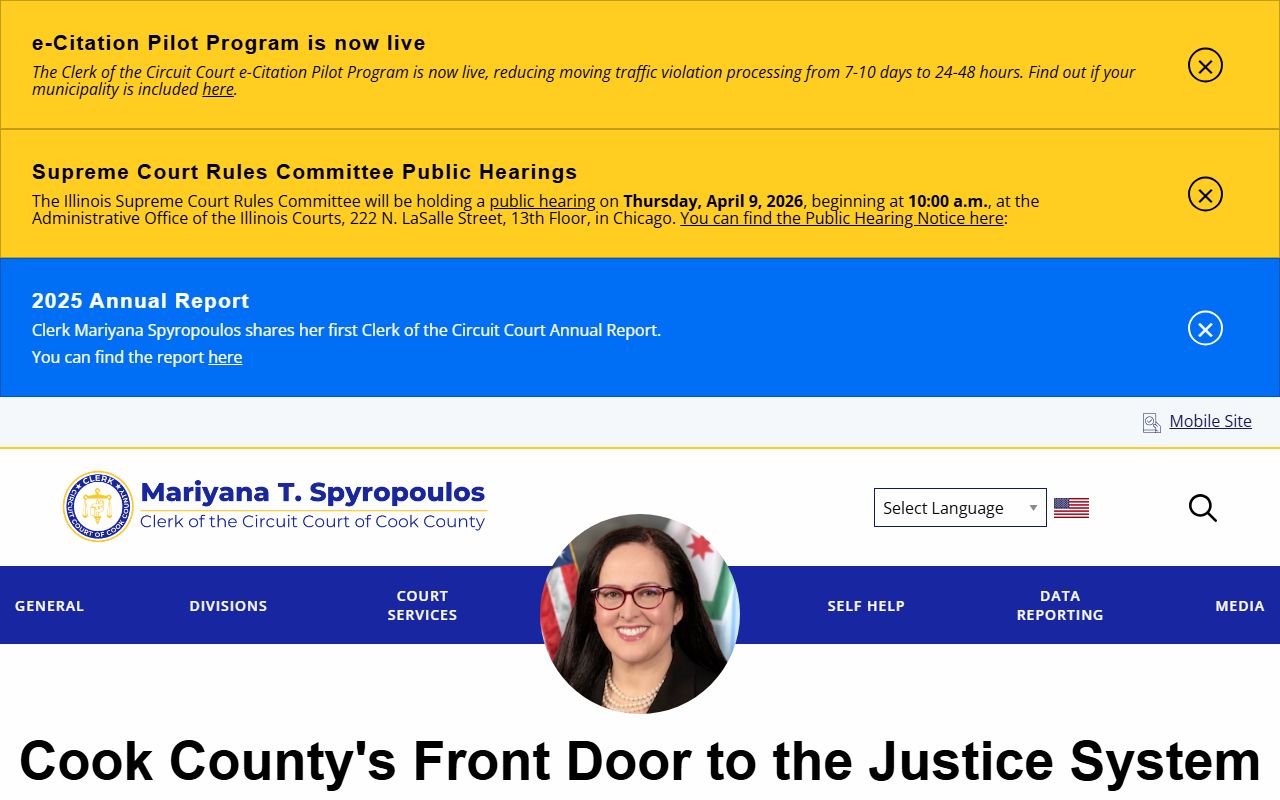 The site lists courthouse locations and contact details for each division, which helps when you are tracking down a case filed at a suburban branch.
How to Search and Request Records
There are three main ways to get Cook County divorce records: online case search, in-person request, and mail request. Each works for different needs.
Online case search is the fastest starting point. Go to the Cook County Clerk of the Circuit Court website and use the case search portal. You will need the full name of at least one party or the case number. The results show the case status, hearing dates, and a list of filings. This is useful for confirming a case exists or checking whether a final order was entered. The online system does not let you download full documents, so you will still need to contact the Clerk for copies.
In-person requests work well when you need certified copies or have a complex situation. Bring valid photo ID. Staff at the Daley Center or any suburban courthouse can pull the physical case file if it has not been archived. Older files may have been sent to storage, which can add time. Fees apply for certified copies; check the Clerk's current fee schedule before you go.
Mail requests are an option if you cannot visit in person. Write to the Clerk's office at 50 W. Washington, Suite 1001, Chicago, IL 60602, and include the case number or the full names of both parties and the approximate year the case was filed. Include a check or money order for the copy fee and a self-addressed stamped envelope. Processing times vary.
Note: Cook County divorce records are generally public, but some personal details within the file may be sealed or redacted under court order.Illinois Dissolution of Marriage Law
Illinois uses a no-fault divorce system. The only legal ground for dissolution of marriage in Illinois is irreconcilable differences, as set out in 750 ILCS 5/401 of the Illinois Marriage and Dissolution of Marriage Act. Fault grounds were eliminated in 2016. The court presumes irreconcilable differences exist if the spouses have lived separately for at least six months before the judgment is entered.
One spouse must have been an Illinois resident for at least 90 days before filing, as required by 750 ILCS 5/413. In Cook County that residency requirement is straightforward to meet given the county's large population and constant in-migration. The case is filed in the circuit court of the county where at least one spouse lives.
A final divorce decree in Cook County will typically include the judgment for dissolution, property division terms, any spousal support order, and, if children are involved, a parenting plan. These documents are part of the public court record and can be obtained through the Clerk's office.
State Verification Through IDPH
The Illinois Department of Public Health maintains a statewide index of dissolution of marriage records going back to 1962. IDPH does not issue certified copies of divorce decrees. What they provide is a verification: a letter confirming that a dissolution record exists in their files for two named individuals.
Verifications cost $5 per search and cover records from 1962 to the present. You can request one by mail. Send your request to IDPH Division of Vital Records at 925 E. Ridgely Ave., Springfield, IL 62702, or call (217) 782-6553. Allow four to six weeks for mail processing. You will need to provide the full names of both parties and the approximate year of the divorce.
This state-level verification is useful when you need to confirm a dissolution happened but do not need the full court file. For actual decree copies, go to the Cook County Clerk's office directly.
The IDPH dissolution of marriage records page explains what verifications cover and how to submit a request by mail.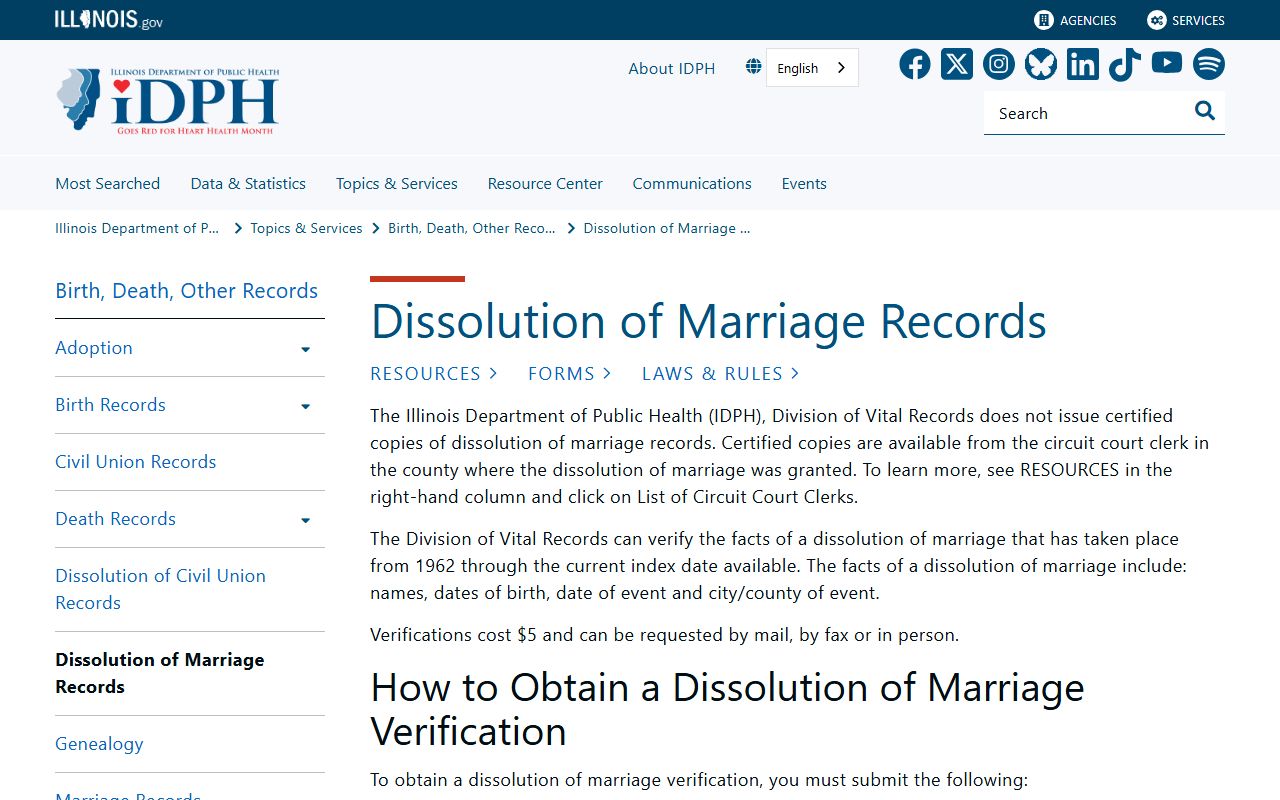 The page also clarifies that IDPH records are for verification only and that certified copies must come from the circuit court where the case was filed.
Note: IDPH verifications are not accepted as proof of divorce in all legal situations. Check with the agency requesting proof before ordering one.
The page also clarifies that IDPH records are for verification only and that certified copies must come from the circuit court where the case was filed.
Note: IDPH verifications are not accepted as proof of divorce in all legal situations. Check with the agency requesting proof before ordering one.
What Divorce Records Contain
A Cook County divorce file is a collection of documents built up over the life of the case. The core record is the judgment for dissolution of marriage, which is the final order signed by the judge. That document states the date the marriage ended and the basic terms of the dissolution.
Beyond the judgment, the file may include the original petition, the respondent's answer, financial disclosure statements, settlement agreements, and any temporary orders entered during the case. If children were involved, the file will contain the parenting plan or custody judgment. Pleadings related to property division, business valuation, or support calculations may also be in the file. The size of a divorce file varies a lot. A simple uncontested case might have just a few documents. A complex contested case can run to hundreds of pages.
Some items in a divorce file can be sealed. Financial records, minor children's information, and certain personal data may be restricted. If you request a copy and some pages come back redacted, that is why. You can ask the Clerk's staff which documents are available as public copies.
Legal Help in Cook County
Not everyone navigating a divorce needs an attorney, but many people do. Cook County has several legal aid organizations that serve low-income residents. The Illinois Courts website lists circuit clerk contacts statewide, which can help you find the right office if your situation crosses county lines.
For self-represented litigants, the Daley Center courthouse has a law library and self-help resources. Many forms used in Cook County dissolution cases are available through the Illinois Courts website. If you qualify for free legal assistance, organizations like the Legal Aid Society of Metropolitan Family Services and LAF (Legal Assistance Foundation) serve Cook County residents.
The Illinois Genealogical Society is another resource if you are researching historical divorce records for family history purposes. They can help locate older records that predate the 1962 IDPH index. The Illinois State Archives at (217) 782-4682 also holds some historical court records.
Cities in Cook County
Cook County contains more qualifying cities than any other county in Illinois. The following cities have dedicated records pages:
Nearby Counties
Divorce cases are filed in the county where a spouse lives. If you are not sure whether a case was filed in Cook County or a neighboring county, check these nearby county pages as well: