
Find Divorce Records in Evanston
Divorce records for Evanston are filed with the Cook County Circuit Court Clerk, Mariyana T. Spyropoulos, whose office maintains dissolution of marriage cases for all Cook County cities including Evanston. This page covers how to search, request, and use those records.
Evanston at a Glance
Which County Handles Evanston Divorce Records
Evanston lies entirely within Cook County. The city does not maintain its own divorce court or case files. Every dissolution of marriage filed by an Evanston resident goes through the Cook County Circuit Court. The Circuit Court Clerk for Cook County holds all those records.
The main clerk's office is at 50 W. Washington, Suite 1001, Chicago, IL 60602-1305. You can reach them by phone at 312/603-5030. Their website is at cookcountyclerkofcourt.org. Evanston is in the northern part of Cook County. The Skokie Courthouse at 5600 Old Orchard Road, Skokie, IL 60077 handles some northern Cook County domestic relations cases. If you aren't sure which courthouse holds a specific case, call the main clerk number first.
The online case search tool at cookcountyclerkofcourt.org/online-case-information is available at no charge. You can search by party name or case number. It shows docket entries and basic case information. To get copies of the actual documents, you need to make a copy request directly with the clerk's office.
Note: The Skokie Courthouse at 5600 Old Orchard Road serves the northern suburbs of Cook County and is often more convenient than the downtown Chicago location for Evanston residents.
How to Access Evanston Divorce Records
Cook County gives you several options to get divorce records. The online case search is the fastest starting point. Use it to confirm a case exists, find the case number, and check the docket. It costs nothing. You can access it any time from home or a library.
In-person requests are the most direct way to get document copies. Go to the clerk's office at the Daley Center, 50 W. Washington, Chicago, or to the Skokie Courthouse at 5600 Old Orchard Road. Bring a valid photo ID. Know the case number if you have it, or the full names of both parties and the approximate year. Staff can search by name. Copy fees apply per page, and certified copies cost more than plain copies. Ask about current rates when you call or before you visit.
Mail requests work too. Write to the clerk at 50 W. Washington, Suite 1001, Chicago, IL 60602. Include both party names, the divorce year, and payment for copy fees. Add a self-addressed stamped envelope. Mail processing can take several weeks. If you need the records quickly, an in-person visit is faster.
Phone inquiries to 312/603-5030 can help you confirm whether a record exists, get the case number, and find out what documents are available before you make a formal request. The staff can also tell you which courthouse holds the physical file.
What Evanston Divorce Files Contain
A Cook County divorce file is a complete record of everything filed during the case. It starts with the Petition for Dissolution of Marriage, which the filing spouse submits to open the case. The other spouse then files a response. Both parties must submit financial disclosures that cover income, bank accounts, property, and debts. These disclosures are part of the file.
If children were involved, the file includes a parenting plan or allocation judgment. That document covers parenting time schedules, decision-making authority, and child support. Any modifications filed after the original judgment are added to the same case file. If the parents had a contested custody dispute, the file may include guardian ad litem reports, evaluations, and related orders.
Property settlement agreements detail how the couple divided their assets and debts. These can include real estate transfer documents, retirement account division orders, and vehicle titles. The final document in the file is the Judgment for Dissolution of Marriage. This is the official court order ending the marriage. It is the document most often needed for legal or financial purposes after a divorce.
The Illinois Marriage and Dissolution of Marriage Act (750 ILCS 5) governs what the court must address in every Illinois divorce case.
The Illinois statutes page for 750 ILCS 5 shows the full text of the Marriage and Dissolution of Marriage Act that governs all Illinois divorce cases, including those filed for Evanston residents.
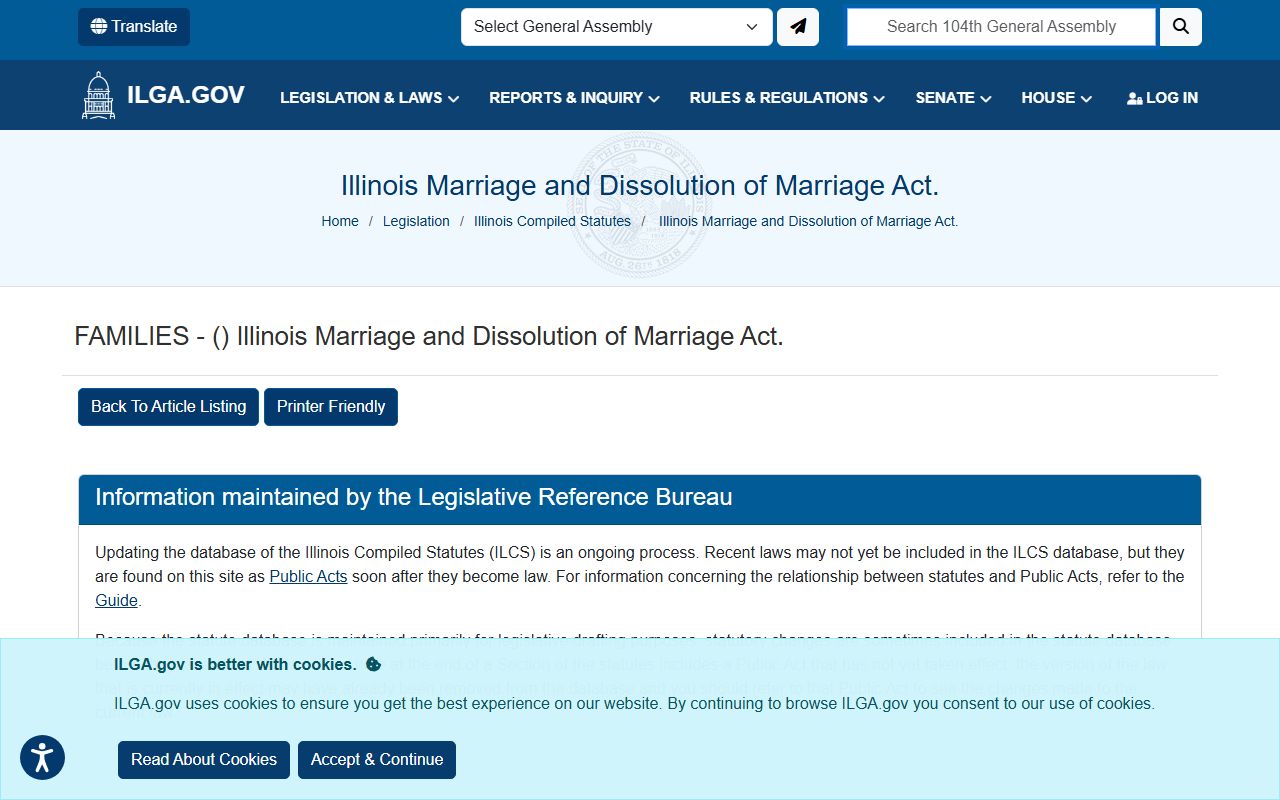
The statute applies statewide; Cook County courts follow these rules for every Evanston dissolution case.
IDPH Statewide Divorce Verification
The Illinois Department of Public Health maintains a statewide index of divorce records from 1962 forward. This is an option if you need to confirm that a divorce happened but don't need the full court file. The IDPH can verify a record and issue a certificate. It cannot provide the actual petition, decree, or other case documents.
The fee is $5 per search. Send requests by mail to the Illinois Department of Public Health, Division of Vital Records, 925 E. Ridgely Ave., Springfield, IL 62702. Call (217) 782-6553 with questions. Mail processing takes roughly four to six weeks. You must include a copy of a valid government-issued photo ID. Accepted ID types are listed at dph.illinois.gov.
Full details on the IDPH process are at dph.illinois.gov/topics-services/birth-death-other-records/dissolution-marriage-records.html. If the divorce happened before 1962, skip the IDPH and go straight to the Cook County Circuit Court Clerk.
Illinois Divorce Law
Two statutes are central to Illinois divorce law. The Illinois Marriage and Dissolution of Marriage Act (750 ILCS 5) is the main divorce law. It covers filing requirements, grounds for dissolution, property division, spousal support, and decisions about children. Every Cook County divorce, including those for Evanston residents, follows this statute.
The Vital Records Act (410 ILCS 535) governs how vital records are kept and released. This includes divorce decrees. The act sets rules about access, who can request records, and what agencies must do to provide them.
Illinois requires no-fault divorce. The only recognized ground is irreconcilable differences. If both spouses agree the marriage is over and have lived apart for six months, the court accepts that as sufficient proof. Cases involving children, property, or support disputes often take longer, even when both parties agree on the basics. Evanston residents file in Cook County Circuit Court under these same rules.
Historical Records for Evanston Divorces
Older Evanston divorce records are held by the Cook County Circuit Court Clerk. Cases from before the electronic systems were set up may not be searchable online. For older files, call the clerk's office and ask about microfilm or archive storage. Some older records have been digitized but not all.
The Illinois State Archives at illinois.gov/ihpa/Archives holds historical state records and can direct you to older county-level court records. The Illinois Genealogical Society at ilgensoc.org offers research guides for finding divorce records from prior decades. These are worth checking for pre-1962 or early 20th century records.
Cook County historical court records from the late 1800s and early 1900s can sometimes be found through the Cook County Clerk of Court's archive division. Availability varies. Some records survived in good condition; others did not. If you hit a dead end, try the Newberry Library in Chicago, which holds substantial historical records for the greater Cook County area.
Nearby Illinois Cities
Other Illinois cities that rely on county courts for divorce records include: