
Search Des Plaines Divorce Records
Divorce records for Des Plaines are maintained by the Cook County Circuit Court Clerk, Mariyana T. Spyropoulos, whose office processes all dissolution of marriage filings from northwest Cook County, including Des Plaines and the communities served by the Rolling Meadows Courthouse.
Des Plaines at a Glance
Which County Handles Des Plaines Divorce Records
Des Plaines sits entirely within Cook County. The city does not have its own court for divorce. All dissolution of marriage cases filed by Des Plaines residents go through the Cook County Circuit Court. The Domestic Relations Division of that court handles every phase of a divorce case, from the initial filing to the final decree.
The central clerk's office is at 50 W. Washington, Suite 1001, Chicago, IL 60602-1305. Phone: 312/603-5030. For Des Plaines and other northwest Cook County communities, the Rolling Meadows Courthouse is the district courthouse that serves this area. It is located at 2121 Euclid Avenue, Rolling Meadows, IL. Some domestic relations cases from Des Plaines are handled there rather than at the downtown Daley Center.
If you are not sure which courthouse holds a particular case, use the online search tool or call the main clerk's number at 312/603-5030. The clerk can tell you which location has the file and whether you need to go there in person or can request copies by mail. Older files may be in storage, but the clerk can arrange retrieval.
The Illinois Courts circuit clerk directory lists Cook County as part of the First Judicial Circuit and identifies Mariyana T. Spyropoulos as the clerk for all Des Plaines divorce matters.
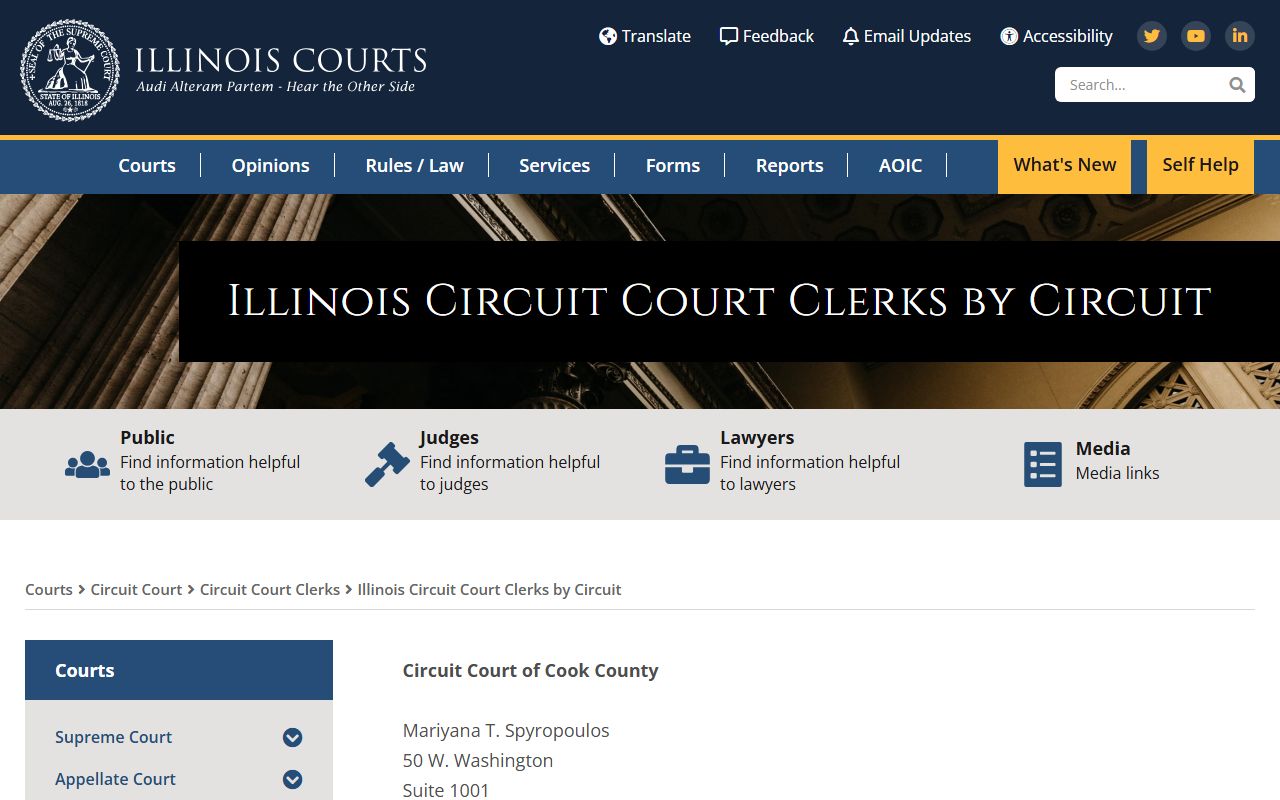
Des Plaines residents file for divorce through the Cook County Circuit Court, with the Rolling Meadows Courthouse serving as the local district facility for northwest Cook County.
How to Access Des Plaines Divorce Records
Cook County provides three main ways to get divorce records. Online is the easiest first step. Go to cookcountyclerkofcourt.org/online-case-information and search by party name or case number. The tool shows basic docket information at no cost. You can see if a case exists, when it was filed, and its current status.
For actual copies of case documents, you need to go in person or submit a mail request. In person, you can visit the Rolling Meadows Courthouse at 2121 Euclid Avenue or the Daley Center at 50 W. Washington, Chicago. Bring a photo ID. Knowing the case number speeds up the search, but staff can look up cases by name. There is a per-page fee for copies, and certified copies cost more. Call the clerk at 312/603-5030 to confirm current fees before going.
Mail requests go to the Cook County Circuit Court Clerk, 50 W. Washington, Suite 1001, Chicago, IL 60602. Include both parties' full names, the approximate year the divorce was filed, and a check or money order for the fees. Include a self-addressed stamped envelope. Mail orders typically take several weeks to process. Note: The online case search shows docket entries only. For the actual documents, such as the petition, judgment, or decree, you must request copies from the clerk.
What Des Plaines Divorce Files Contain
A Cook County divorce case file holds every document submitted during the case. It begins with the Petition for Dissolution of Marriage, which starts the process. The responding spouse then files an answer. As the case moves forward, the file grows to include financial disclosure statements from both parties, any motions filed, interim court orders, and the agreements the parties reach.
Cases involving children also include a parenting plan or allocation judgment. This document sets out custody, parenting time, and how major decisions about the children will be made. Child support calculations and any modifications made after the original judgment are part of the record too. If the couple had significant assets or debts, a marital settlement agreement spelling out the division of property appears in the file as well.
The last main document is the Judgment for Dissolution of Marriage. This is the decree that ends the marriage. It incorporates all agreed terms or the judge's rulings. This is the document most people need when they must prove the divorce occurred, such as when updating a name on a driver's license or closing a joint account.
The governing statute for all Illinois divorce cases is the Illinois Marriage and Dissolution of Marriage Act (750 ILCS 5).
IDPH Statewide Divorce Verification
The Illinois Department of Public Health maintains a statewide index of divorce records dating back to 1962. This is a useful option when you need to confirm a divorce happened but don't need the full case file. The IDPH can issue a certificate of dissolution. It does not provide the full court documents, such as the petition or property settlement.
The fee is $5 per search. Mail requests to the Illinois Department of Public Health, Division of Vital Records, 925 E. Ridgely Ave., Springfield, IL 62702. Call (217) 782-6553 for questions. Mail processing takes four to six weeks. You must include a copy of a valid government-issued photo ID. See the accepted ID list at dph.illinois.gov.
Full details about the IDPH dissolution records program are at dph.illinois.gov/topics-services/birth-death-other-records/dissolution-marriage-records.html. For divorces that occurred before 1962, you need to contact the Cook County Circuit Court Clerk directly.
Illinois Divorce Law Overview
Illinois is a no-fault divorce state. The only recognized ground for divorce is irreconcilable differences. Neither spouse needs to show that the other did something wrong. To file in Illinois, at least one spouse must have lived in the state for 90 days before the petition is filed. The court can then proceed with the case.
All divorce cases in Illinois are governed by 750 ILCS 5. That statute covers property division, spousal support (called maintenance in Illinois), child support, and parenting arrangements. The way divorce records are stored and made available to the public is governed in part by the Vital Records Act (410 ILCS 535), which applies to court-issued dissolution records.
Note: Illinois does not require a formal separation period before filing. If both spouses agree the marriage has broken down, the case can proceed without a waiting period tied to living apart.
Historical and Archived Records
Very old divorce records from Des Plaines and Cook County may be held at the Illinois State Archives rather than at the current circuit court. The State Archives is part of the Illinois Historic Preservation Agency. Their site is at illinois.gov/ihpa/Archives. If the Cook County clerk cannot locate a record you need, check with the State Archives next.
The Illinois Genealogical Society at ilgensoc.org also has research tools and indexes useful for tracking down older records. They can help when you know a divorce occurred but you don't know the exact year or county. For most Des Plaines residents, Cook County records will cover what you need, but the genealogical society is a good backup for gaps in older records.
The Illinois IDPH outlines its dissolution of marriage verification process at the IDPH vital records page.
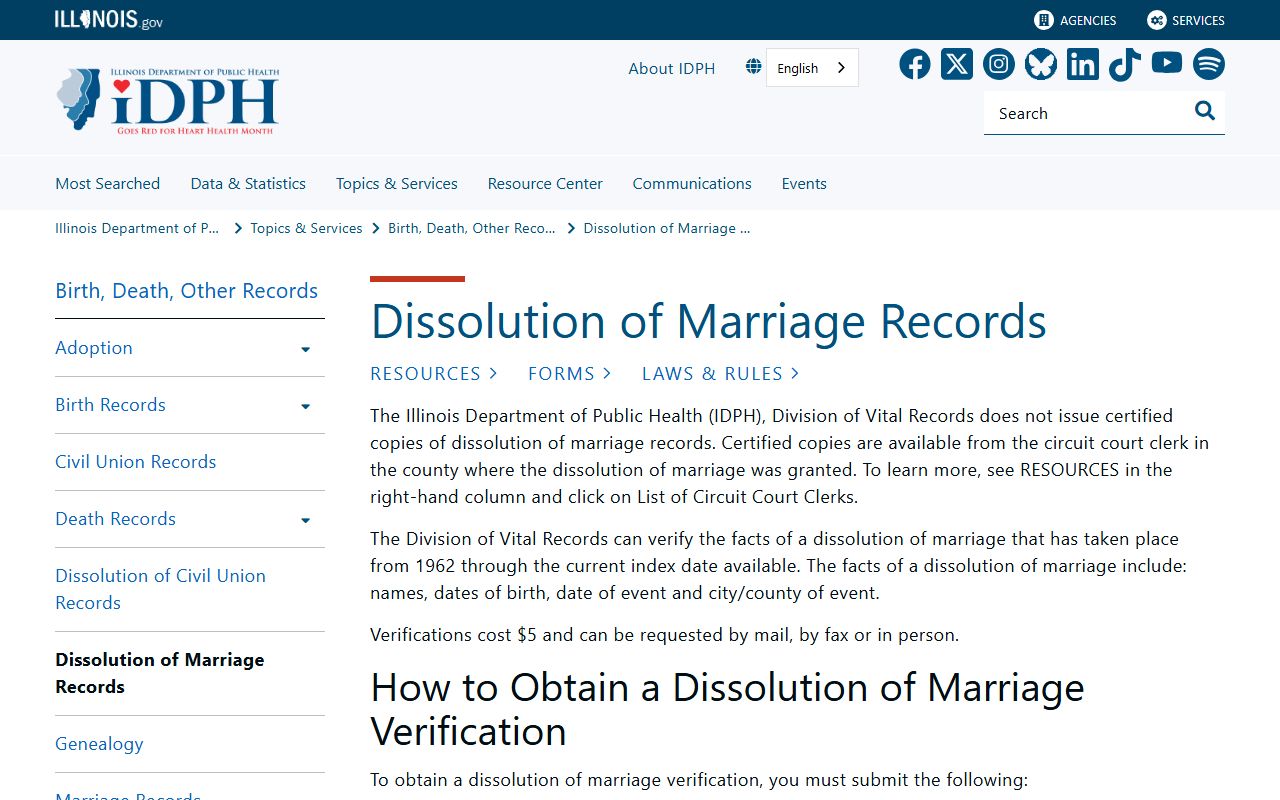
The IDPH index covers divorces from 1962 forward; earlier Des Plaines cases must be requested from the Cook County Circuit Court Clerk.
Nearby Illinois Cities
Other Illinois cities that rely on county courts for divorce records include: