
Will County Divorce Records Lookup
Will County divorce records are kept by the 12th Judicial Circuit Court Clerk in Joliet and cover every dissolution of marriage case filed in the county. If you need to find a case, get a copy of a divorce decree, or check whether a specific dissolution was recorded in Will County, this guide covers the process from start to finish.
County at a Glance
12th Judicial Circuit Court Clerk
Will County is the fourth largest county in Illinois by population. The 12th Judicial Circuit handles all family law cases in the county. The Family Law Division specifically manages dissolution of marriage proceedings. The Circuit Court Clerk's office in Joliet is the official keeper of those records once a case is closed.
| Clerk | Andrea Chasteen |
|---|---|
| Address | 100 West Jefferson Street, Joliet, IL 60432-4399 |
| Phone | (815) 727-8592 |
| Fax | (815) 740-8074 |
| Website | willcountyillinois.com/circuit-clerk |
| Division | Family Law Division |
The Clerk's office is located at 100 West Jefferson Street in Joliet. Online case search is available through the Clerk's website. You can use it to look up a case by party name or case number, check the case status, and see which documents have been filed. The online system shows case history but does not allow you to download full documents. For copies of actual court records, you will need to contact the Clerk's office directly.
The Illinois Courts clerk directory lists Will County's 12th Judicial Circuit and provides contact details alongside every other circuit in the state.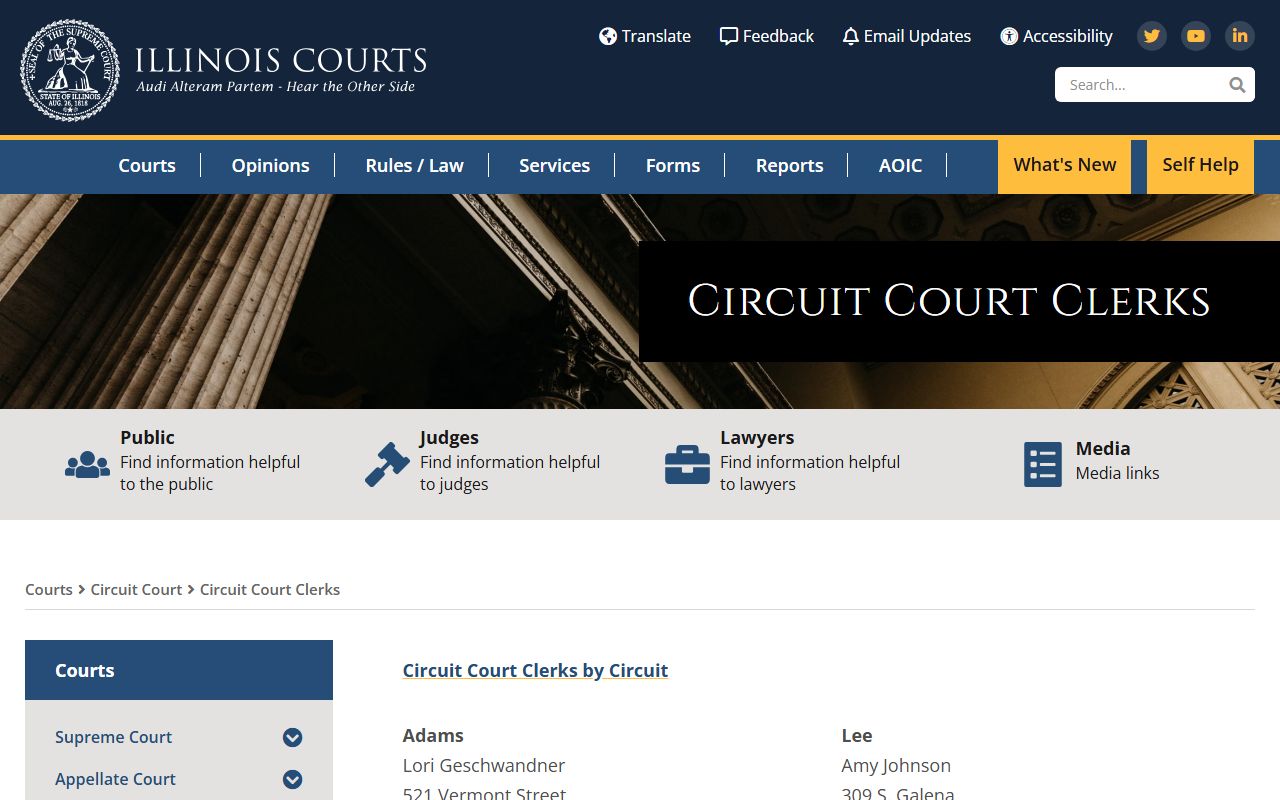 This directory is useful when a case might have been filed in a nearby circuit like Cook, DuPage, or Kendall County rather than Will.
Searching Will County Divorce Cases Online
Will County offers online case search through the Circuit Court Clerk's website at willcountyillinois.com/circuit-clerk. The search tool lets you look up cases by party name. Enter the last name and first name of either spouse and the system returns matching cases. From there you can review the case history, see which documents were filed, and confirm case status.
Online search results give you enough information to confirm whether a case exists and what the case number is. That case number is the most important thing to have before you request a copy of any document. With it, the Clerk's staff can pull your file much faster whether you visit in person or send a mail request.
Note: The online system reflects current records but may not include very old cases that have not been entered into the digital index. For cases filed before the county moved to electronic records, you may need to request a manual search by phone or in person.Getting Copies of Divorce Records
You can get copies of Will County divorce records in person, by mail, or in some cases by phone inquiry. Each method works for slightly different needs.
In-person visits to 100 West Jefferson Street in Joliet give you direct access to Clerk staff who can pull a file and process your copy request the same day in most cases. Bring a government-issued photo ID. The IDPH valid ID page lists what forms of identification are recognized across Illinois courts and agencies. Have the case number or both party names ready so staff can locate the file quickly. Fees for certified and plain copies are set by the court; confirm the current schedule before you go.
Mail requests should be sent to 100 West Jefferson Street, Joliet, IL 60432-4399. Include the names of both parties, the approximate year the divorce was finalized, and the case number if you have it. Attach a check or money order for the copy fee and a self-addressed stamped envelope. The Clerk will mail the copies back to you after processing. Turnaround times vary based on current demand.
Phone calls to (815) 727-8592 are useful for basic questions. Staff can often confirm whether a case is in the system, give you the case number, and tell you the current fee schedule. That information can make an in-person or mail request go more smoothly. If you need certified copies of specific court documents, though, a phone call alone will not be enough.
Illinois Dissolution of Marriage Law
Will County divorces are governed by Illinois law. The main statute is the Illinois Marriage and Dissolution of Marriage Act at 750 ILCS 5. Illinois uses a no-fault system. Under 750 ILCS 5/401, irreconcilable differences is the only ground for dissolution. Fault-based grounds do not exist in Illinois courts.
The residency rule at 750 ILCS 5/413 requires that one spouse live in Illinois for 90 days before filing. Will County residents who meet that threshold file in the 12th Judicial Circuit. Courts use a six-month living-apart presumption to establish irreconcilable differences, though parties can agree to waive it. Once the court enters the final judgment, the case record is transferred to the Clerk's office and becomes a permanent public record.
The Illinois Vital Records Act at 410 ILCS 535 requires that courts report dissolution judgments to IDPH. That is how the statewide divorce index gets built. The Act also sets access rules for vital records generally. Both statutes are worth knowing if you are trying to understand the full legal framework around Illinois divorce records.
IDPH State Verification Option
If you only need to confirm that a dissolution occurred in Illinois rather than get a certified copy of the decree, the Illinois Department of Public Health is a useful secondary source. IDPH maintains a statewide index of dissolution records dating back to 1962. They issue verification letters, not certified copies of court documents.
A verification costs $5 and is processed by mail. Send your request to IDPH Division of Vital Records, 925 E. Ridgely Ave., Springfield, IL 62702. You can also call (217) 782-6553 to ask questions before submitting. Include both parties' full names and the approximate year of the divorce. IDPH asks that you plan for four to six weeks for mail processing. If you need the actual decree or other court documents, contact the Will County Circuit Court Clerk directly since IDPH does not hold those records.
The IDPH dissolution of marriage page shows the verification process and explains the difference between a state verification and an official court copy.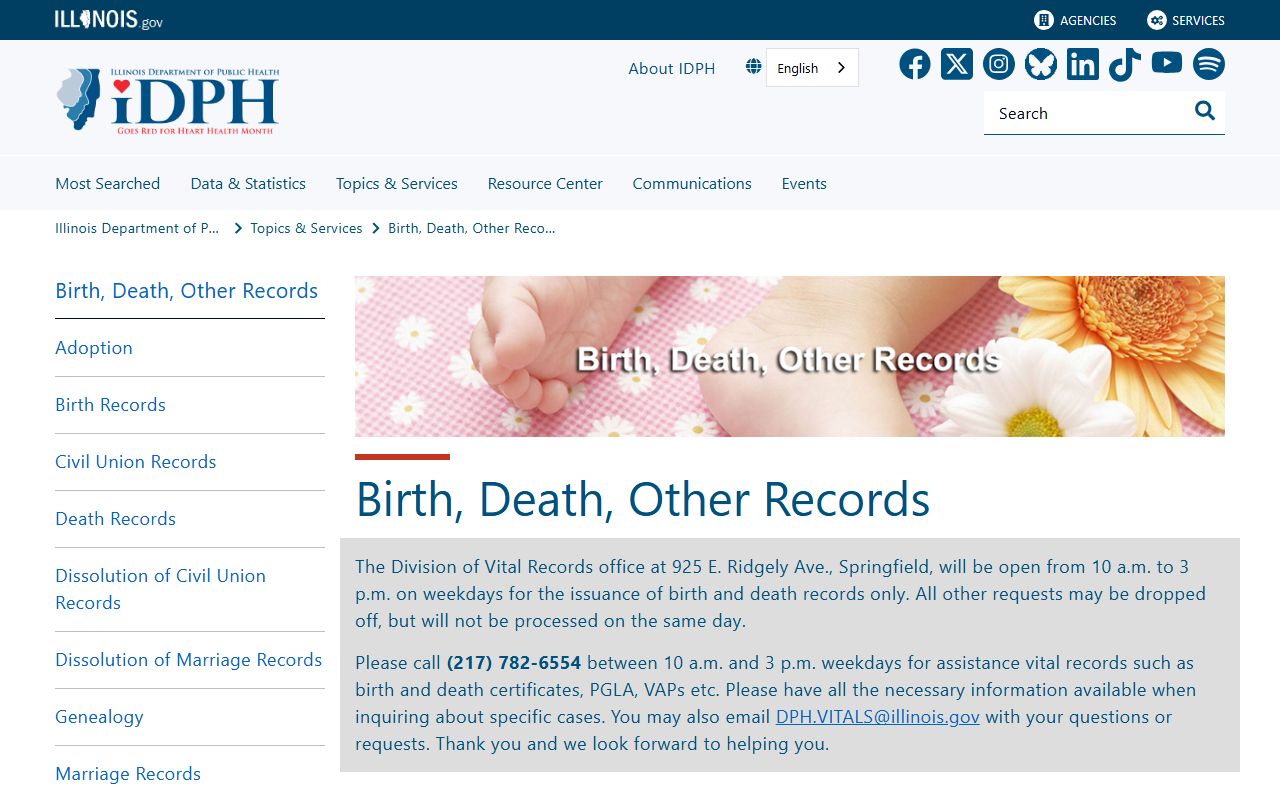 The page also notes the mailing address and turnaround times, which helps set expectations before you submit a request.
Note: IDPH verifications are not equivalent to certified copies in all legal or administrative contexts. Confirm with the institution requesting proof which type of document they will accept.
The page also notes the mailing address and turnaround times, which helps set expectations before you submit a request.
Note: IDPH verifications are not equivalent to certified copies in all legal or administrative contexts. Confirm with the institution requesting proof which type of document they will accept.
What Records Are in a Will County Divorce File
A Will County dissolution of marriage file holds all documents from the case. The final judgment for dissolution is the most commonly requested document. It states the date the marriage ended and summarizes the court's rulings on all contested or agreed issues.
The file also includes the petition, any response from the other spouse, financial affidavits, marital settlement agreements, and any interim orders entered while the case was open. Cases involving children will include an allocation of parental responsibilities judgment and a parenting plan. Contested property division may add additional documents like real estate deeds, retirement account orders, or business valuations to the file. Simple, agreed dissolutions tend to have shorter files.
Some parts of a divorce file may be sealed by court order. Sensitive financial documents, minor children's personal data, and certain health records can be restricted. If you receive a copy and some pages are missing or redacted, a sealing order likely covers that portion of the record. The Clerk's staff can tell you which sections are available to the public.
Genealogy and Historical Records
For older Will County dissolution records that predate the 1962 IDPH index, the Illinois State Archives at (217) 782-4682 can be a good place to start. The Archives holds historical court records from across the state and may have materials that are not available anywhere else for earlier periods.
The Illinois Genealogical Society is another useful resource for researchers tracing family history through court records. They have knowledge of historical Illinois indexes and can help you locate a dissolution record from decades past when digital tools fall short. Some older Will County records may also be available through the county's own historical resources.
Cities in Will County
Several cities in Will County meet the population threshold for a dedicated divorce records page. Dissolution of marriage cases for residents of these cities are handled through the 12th Judicial Circuit in Joliet:
Parts of Naperville, Orland Park, and Tinley Park also fall within Will County. If a resident of those cities filed in Will County, the 12th Judicial Circuit Clerk holds those records. Use the online case search to confirm the circuit before requesting copies.
Nearby Counties
Cases must be filed in the county where at least one spouse lives. If you are not certain whether a case was filed in Will County or a neighboring county, these pages may help: