
Search DuPage County Divorce Records
DuPage County divorce records are filed with the Circuit Court Clerk and maintained by the 18th Judicial Circuit, based in Wheaton. If you need to look up a dissolution of marriage case, request a certified copy of a divorce decree, or confirm that a case was filed in DuPage County, this page covers the process, the key offices involved, and the state-level resources that support your search.
County at a Glance
Circuit Court Clerk Office
DuPage County is the second largest county in Illinois by population. All dissolution of marriage cases in the county go through the 18th Judicial Circuit Court, and the Circuit Court Clerk maintains those records. The Clerk's office is the right starting point whether you need a copy of a judgment, a case history, or basic filing information.
| Clerk | Candice Adams |
|---|---|
| Mailing Address | P.O. Box 707, Wheaton, IL 60187-0707 |
| Phone | (630) 407-8700 |
| Fax | (630) 407-8575 |
| Website | dupageco.org/CircuitCourtClerk |
| Division | Family Division |
The Family Division of the DuPage County Circuit Court handles all dissolution of marriage proceedings. Cases are assigned to judges in that division, and all orders and judgments become part of the public record kept by the Clerk's office. If you know the case number, you can often get basic case status information by phone. For certified copies or document review, an in-person visit or written request is usually needed.
The Illinois Courts website provides a directory of circuit court clerks across the state, including DuPage County's 18th Judicial Circuit.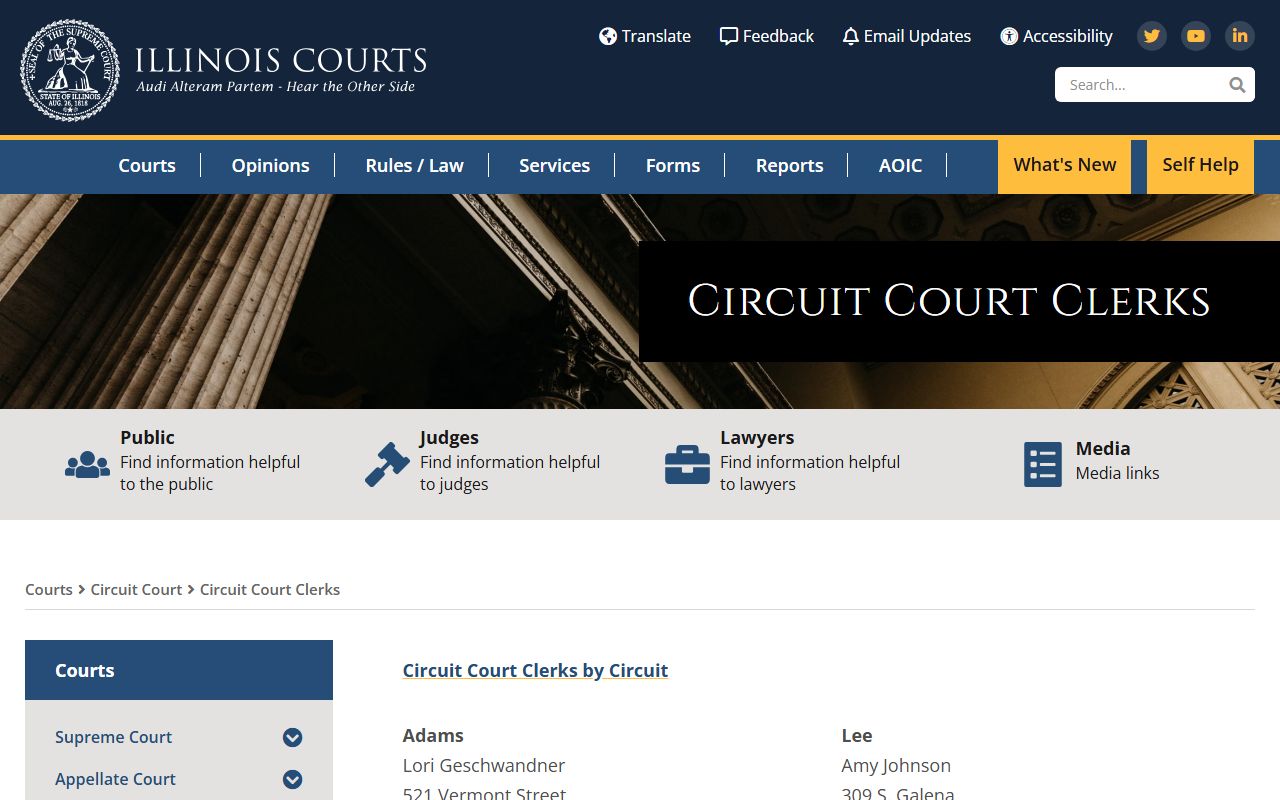 This directory is useful if a case may have been filed in a neighboring circuit and you need to track down the right clerk's office.
Accessing DuPage Divorce Records
You have a few ways to search and get copies of DuPage County divorce records. The method that works best depends on what you need and how quickly you need it.
In-person visits to the Clerk's office in Wheaton give you the most direct access. Staff can pull a case file, tell you which documents are available, and process copy requests on the spot in many cases. Bring a government-issued photo ID. The IDPH page on valid ID lists what forms of identification are accepted across Illinois courts and agencies. Fees for certified copies are set by the court; ask the Clerk's office for the current schedule before you go.
Mail requests work if you cannot make the trip to Wheaton. Write to the Clerk at P.O. Box 707, Wheaton, IL 60187-0707. Include the full names of both parties and the approximate year of the divorce. If you have the case number, include that too. Attach a check or money order for the copy fee and a self-addressed stamped envelope. The Clerk will mail copies back to you once the request is processed.
Phone calls to (630) 407-8700 can help you get basic case information or clarify the request process before you commit to a mail request or in-person visit. Staff can often confirm whether a case exists and give you the case number, which speeds up any subsequent request.
Note: If the divorce you are researching was filed many years ago, the file may be in storage. Ask the Clerk's office whether older records are available and whether there is a retrieval delay.Illinois Dissolution of Marriage Law
Illinois moved to a purely no-fault divorce system in 2016. The Illinois Marriage and Dissolution of Marriage Act governs all dissolutions in the state, including those filed in DuPage County. Under 750 ILCS 5/401, the only ground for divorce is irreconcilable differences. Fault grounds like adultery or cruelty no longer apply.
The residency rule under 750 ILCS 5/413 requires that at least one spouse live in Illinois for 90 days before the case can be filed. DuPage County residents who meet that requirement can file their petition in the 18th Judicial Circuit. The court presumes irreconcilable differences exist once spouses have lived separately for at least six months before the judgment is entered, though they can waive that waiting period by agreement.
The final divorce decree in DuPage County will address the dissolution itself and may also cover property division, allocation of parental responsibilities if minor children are involved, and any maintenance (spousal support) arrangement. All of these documents become part of the court record maintained by the Clerk's office and are accessible to the public unless sealed by the court.
What Divorce Records Include
A DuPage County dissolution of marriage file typically starts with the petition for dissolution and grows from there. The final document most people need is the judgment for dissolution of marriage, which is the order that legally ends the marriage. That document states the date the marriage ended and summarizes the court's rulings on all related issues.
The rest of the file can include financial affidavits, marital settlement agreements, parenting plans, orders about real estate or retirement accounts, and any orders entered during the case before the final judgment. Contested cases tend to have larger files with more motion practice and hearing records. Uncontested cases, where both parties agree on all terms, often have shorter, cleaner files.
Some portions of a divorce file may be restricted. Courts can seal financial records, information about minor children, or other sensitive material on request. If you get a copy that is partially redacted, that usually means a sealing order is in place for part of the file.
IDPH State Verification
If you just need to confirm that a dissolution of marriage occurred in Illinois, the state-level option is an IDPH verification. The Illinois Department of Public Health maintains a statewide divorce index covering records from 1962 to the present. They issue verification letters confirming a record exists, not actual court documents.
Verifications cost $5 per search. Send a mail request to IDPH Division of Vital Records, 925 E. Ridgely Ave., Springfield, IL 62702. You can also call (217) 782-6553 for questions. Include the full names of both parties, the state, and the approximate year. Plan for four to six weeks processing time by mail. If you need an actual copy of the divorce decree, you have to go to the DuPage County Clerk's office directly since IDPH does not hold court documents.
The IDPH vital records page for dissolution of marriage records describes the verification process and explains what information is needed to submit a request.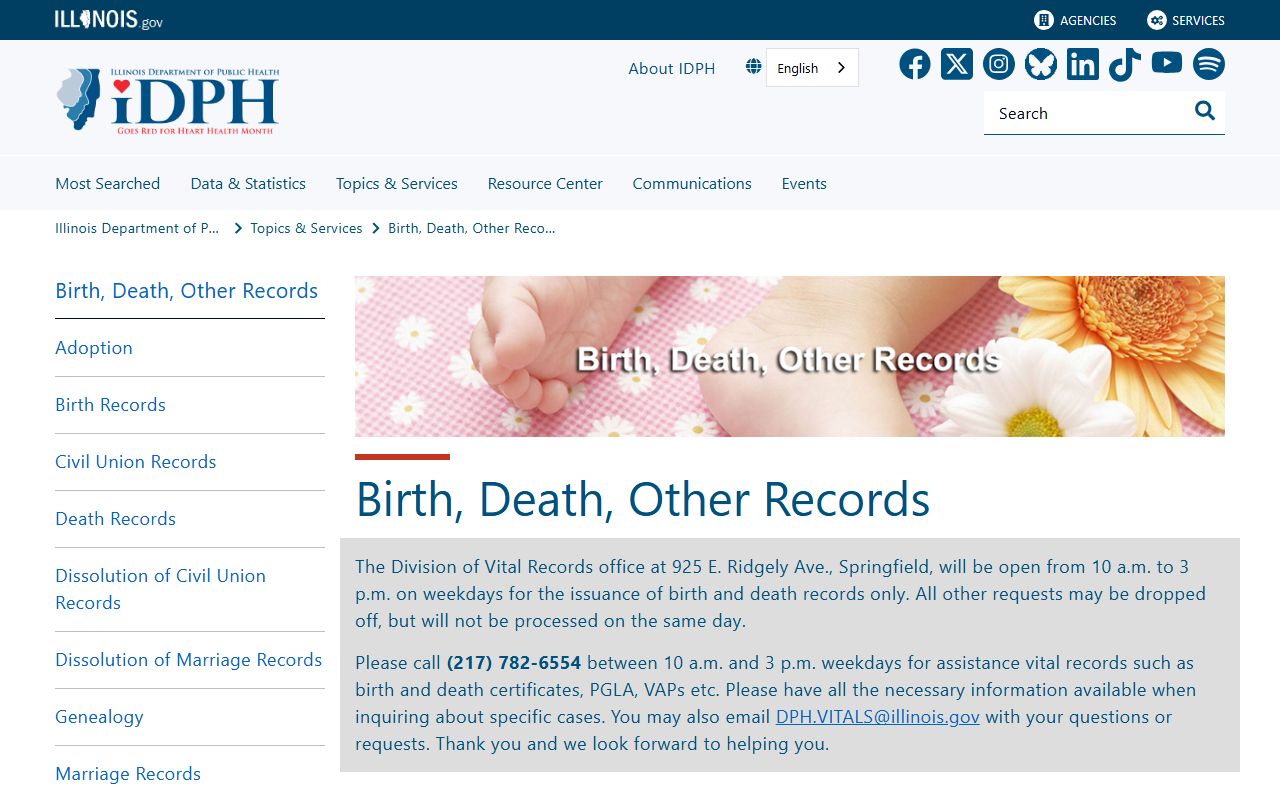 The page also notes that verifications are different from certified copies, which only the circuit court that handled the case can provide.
Legal and Genealogical Resources
DuPage County residents looking for legal help with a dissolution case have several options. The Illinois Courts website at illinoiscourts.gov lists clerk contacts and has self-help resources for people representing themselves. The DuPage County Bar Association maintains a referral service for residents who need attorney help.
For older or historical records, the Illinois State Archives at (217) 782-4682 can help locate records that predate the IDPH index. The Illinois Genealogical Society is also a good resource if you are tracing a family history and need to locate dissolution records from earlier decades. They have experience navigating older court indexes that are not fully digitized.
Cities in DuPage County
Several cities in DuPage County have their own divorce records pages. Dissolution cases for residents of these cities are filed through the 18th Judicial Circuit in Wheaton:
Other cities in DuPage County fall below the qualifying population threshold and do not have dedicated pages. If you are looking for records related to a smaller DuPage community, the 18th Judicial Circuit Clerk handles those cases as well.
Nearby Counties
Cases are filed in the county where at least one spouse lives. If there is any chance the divorce was filed in a neighboring county, check these pages: