
Tinley Park Divorce Records
Tinley Park divorce records are maintained by county circuit court clerks, not the city itself. Most of Tinley Park falls within Cook County, with a smaller portion in Will County, so the clerk you contact depends on where the case was filed.
Tinley Park at a Glance
Which County Handles Tinley Park Divorce Records
Tinley Park sits in two counties. The majority of the city is in Cook County. A smaller section on the southern and western edges falls within Will County. When someone files for divorce in Tinley Park, the case goes to the circuit court in whichever county that person lives in.
Cook County divorce cases are handled by the Cook County Circuit Court. The clerk is Mariyana T. Spyropoulos, located at 50 W. Washington, Suite 1001, Chicago, IL 60602. Phone is 312/603-5030. The website is cookcountyclerkofcourt.org.
Will County divorce cases go to the Will County Circuit Court. The clerk is Andrea Chasteen, at 100 West Jefferson Street, Joliet, IL 60432. Phone is 815/727-8592. If you are not sure which county your address falls in, check with both offices or use a county boundary map before you file.
Note: Filing in the wrong county can delay your case. Confirm your county of residence before you submit any paperwork.
How to Access Tinley Park Divorce Records
Cook County offers a few ways to look up divorce case records. The easiest starting point is the online case search at cookcountyclerkofcourt.org/online-case-information. You can search by name or case number. The results show basic case info, but full documents may require an in-person visit or a written request.
In person, Cook County cases for the west suburban area can be accessed at the Maywood Courthouse, located at 1500 Maybrook Drive in Maywood. That branch serves western Cook County, which includes most of Tinley Park. The main Daley Center in Chicago also holds records and public terminals for case lookup.
For Will County cases, you can visit the courthouse at 100 West Jefferson Street in Joliet. Mail requests are also accepted. Include a self-addressed stamped envelope and a check or money order for any copy fees. Call 815/727-8592 to confirm current fees and processing times before sending a request by mail.
You can also try Judici.com, a statewide case search tool used by many Illinois counties. McLean, Will, and other downstate courts participate, though Cook County does not use Judici. For Cook cases, the county's own portal is the better option.
The Cook County Circuit Clerk's online case search lets you look up divorce filings from home.
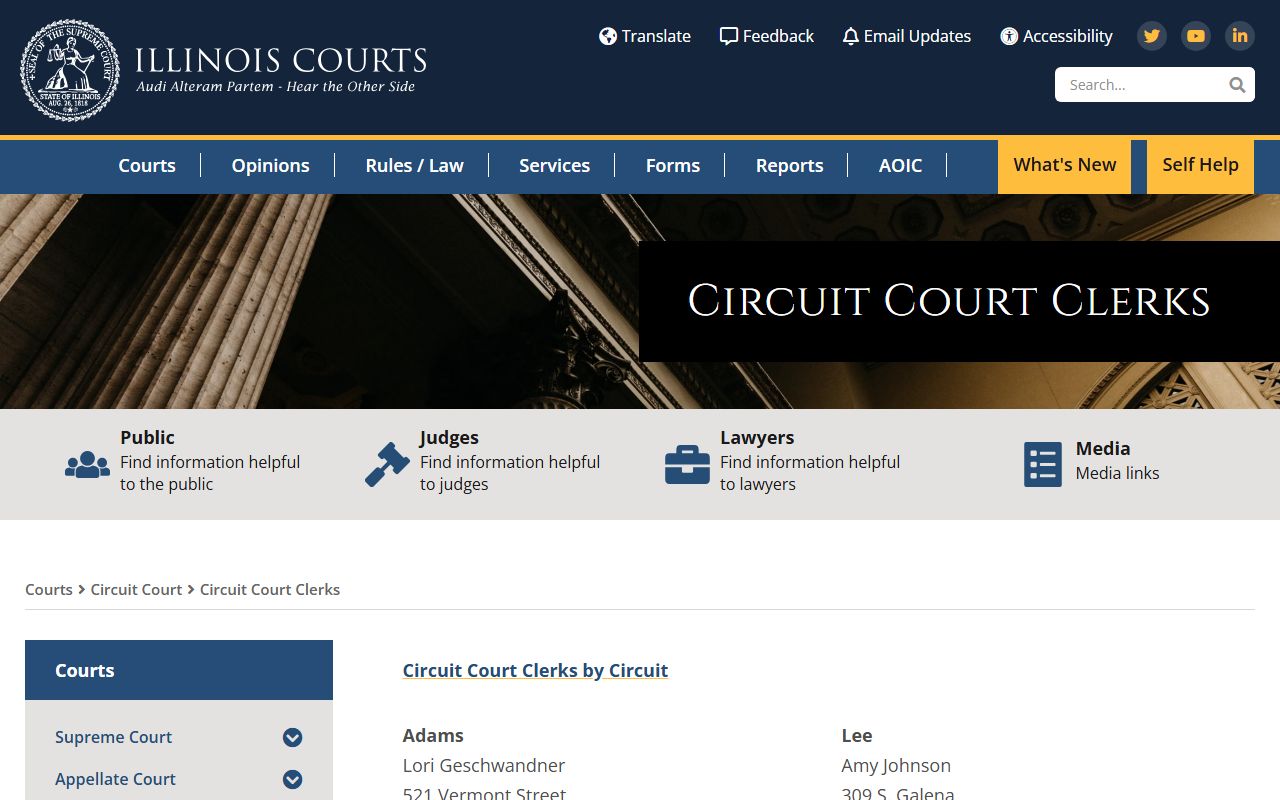
Search by name or case number to find basic filing details for Cook County divorce cases.
What Divorce Files Contain
Illinois divorce records are official court documents. They are part of the public record in most cases. A divorce file may contain the original petition for dissolution of marriage, proof of service, any temporary orders, financial disclosures, a parenting plan if children are involved, and the final judgment of dissolution.
Not every document in the file is open to the public. Exhibits with financial account details, sealed filings, and records involving minors may be restricted. The clerk's office can tell you what parts of a file are available for public inspection and what requires a court order to access.
Illinois divorce law is found in the Illinois Marriage and Dissolution of Marriage Act, 750 ILCS 5. That act covers all dissolution proceedings in the state, including those in Tinley Park.
Note: Financial affidavits filed in divorce cases are often protected. Do not assume every document in a case file is accessible without first checking with the clerk.
IDPH Statewide Divorce Verification
If you need a certified verification of a divorce rather than the full court file, the Illinois Department of Public Health can help. IDPH maintains a statewide index of divorces recorded in Illinois.
The fee is $5 per search. You can request a verification by mail or in person. The IDPH office is at 925 E. Ridgely Avenue, Springfield, IL 62702. The phone number is (217) 782-6553. Processing takes roughly 4 to 6 weeks by mail. In-person requests at the Springfield office may be faster.
To submit a request, you need a valid government-issued photo ID. IDPH has a list of accepted forms of ID at dph.illinois.gov/topics-services/birth-death-other-records/valid-government-issued-photo-id.html. Full details about the program are on the IDPH dissolution of marriage records page.
Keep in mind that IDPH only provides a verification letter. It does not give you a copy of the court judgment or the case file. For those documents, you need to go to the county circuit court where the divorce was filed.
The Illinois Department of Public Health offers statewide divorce verifications for $5.
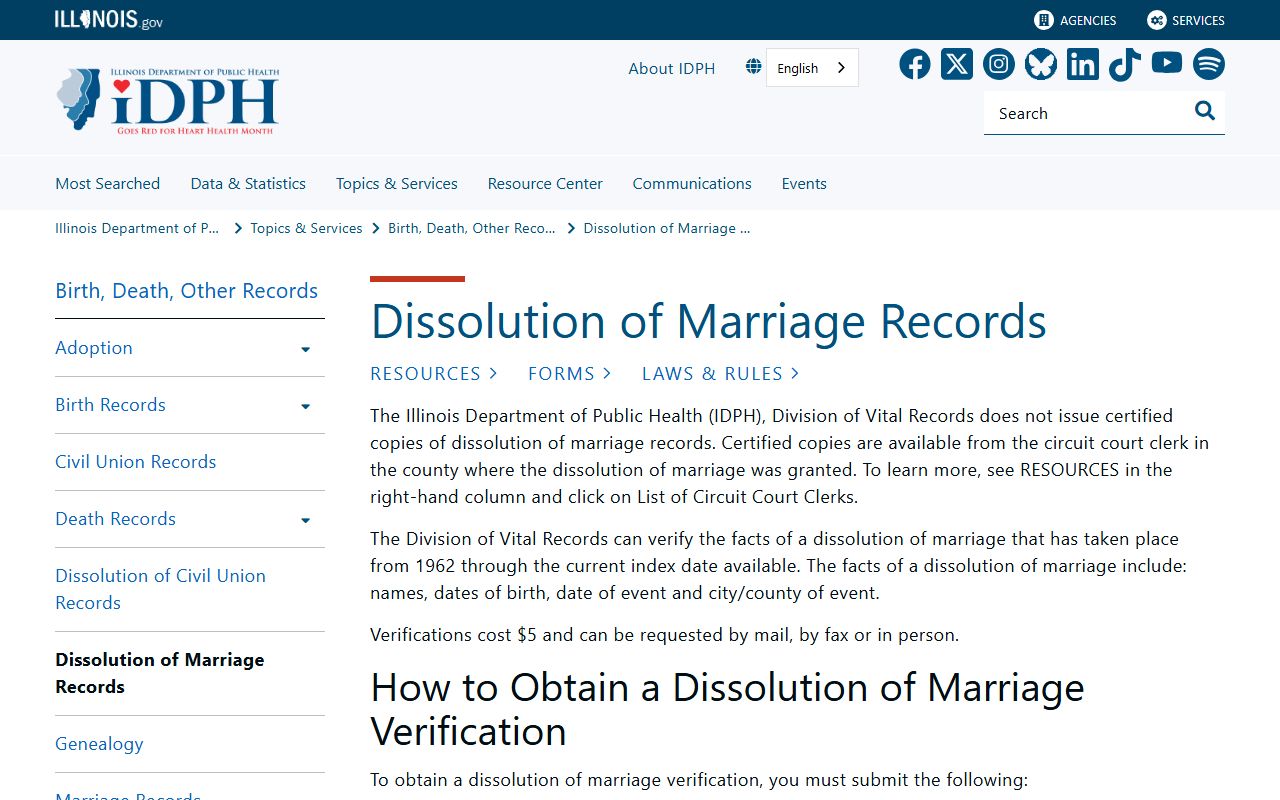
IDPH records go back to 1962 and cover divorces from all Illinois counties.
Illinois Divorce Law Overview
Illinois uses irreconcilable differences as the sole ground for divorce. You do not need to prove fault or wrongdoing. The law simply requires that the marriage has broken down with no reasonable chance of reconciliation.
There is a 90-day residency requirement. At least one spouse must have lived in Illinois for 90 days before filing. If you meet that requirement and live in Tinley Park, you can file in Cook County or Will County depending on your address.
Illinois divorce law is codified at 750 ILCS 5. The Vital Records Act, found at 410 ILCS 535, governs how divorce records are collected, stored, and accessed in Illinois.
Historical and Genealogy Records
Older divorce records are sometimes held in archives rather than active court files. For historical research, the Illinois State Archives holds older civil court records and may have divorce filings from past decades.
Genealogists can also check the Illinois State Genealogical Society for guidance on locating historical records. County historical societies and local library collections may also hold older index cards or docket books that are not digitized. Call the Cook County or Will County clerk directly to ask what years their records go back.
Nearby Illinois Cities
Other Illinois cities that rely on county courts for divorce records include: