
Find Divorce Records in Orland Park
Divorce records for Orland Park residents are filed primarily through the Cook County Circuit Court Clerk, Mariyana T. Spyropoulos, though a small portion of Orland Park falls within Will County, making the county of filing dependent on which county the petitioner lives in.
Orland Park at a Glance
Which County Handles Orland Park Divorce Records
Most of Orland Park falls within Cook County. However, the village also extends into a small portion of Will County along its southern and western edges. Which county handles a divorce depends on where the filing spouse lives. If you live in the Cook County portion of Orland Park, your case goes to the Cook County Circuit Court. If you live in the Will County portion, your case goes to the Will County Circuit Court.
For Cook County filers, the Circuit Court Clerk's main office is at 50 W. Washington, Suite 1001, Chicago, IL 60602-1305. Phone: 312/603-5030. The Bridgeview Courthouse at 10220 S. 76th Avenue in Bridgeview is the district courthouse that serves the southwest Cook County area, which includes most of Orland Park. Some Orland Park domestic relations cases are handled at Bridgeview rather than at the downtown Daley Center.
For Will County filers, the Circuit Court Clerk is Andrea Chasteen. Her office is at 100 West Jefferson St., Joliet, IL 60432. Phone: 815/727-8592. Will County's online case search is separate from Cook County's system. If you are not sure which county handled a case, check both systems or look at the filing address to determine the county.
The Illinois Courts circuit court clerk directory lists both Cook and Will County clerks, which is useful for Orland Park residents who need to confirm which court handled their case.
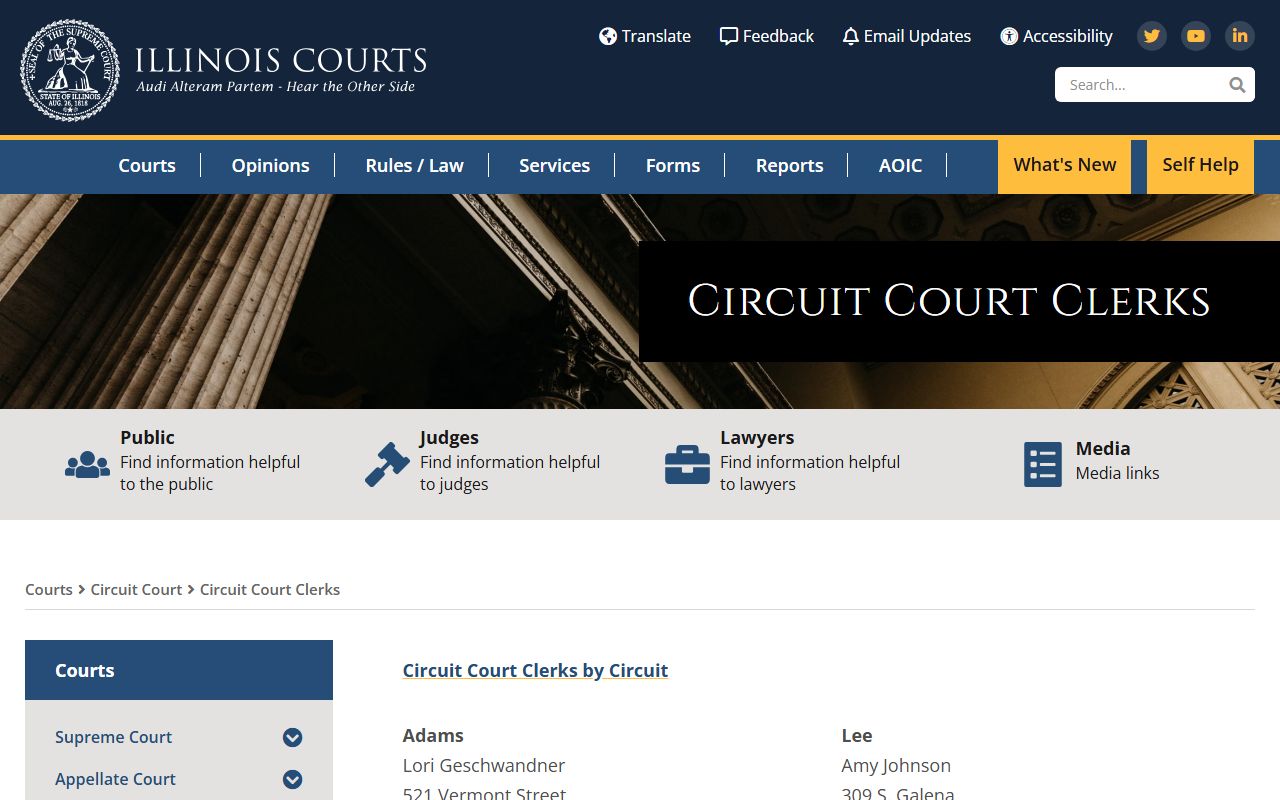
Orland Park's split between Cook and Will counties means you may need to search both county systems depending on which part of the village the petitioner lived in.
How to Access Orland Park Divorce Records
For Cook County divorce records, start with the online case search at cookcountyclerkofcourt.org/online-case-information. Search by party name or case number. The tool is free to use and shows basic case information, including the filing date and status. It does not provide full document text.
For copies of the actual case documents, go in person to the Bridgeview Courthouse at 10220 S. 76th Avenue or to the Daley Center at 50 W. Washington, Chicago. Bring a photo ID. If you don't have the case number, staff can search by name. Per-page fees apply to copies, and certified copies cost more than plain copies. Call 312/603-5030 to confirm current rates before going.
Mail requests for Cook County records go to the Cook County Circuit Court Clerk, 50 W. Washington, Suite 1001, Chicago, IL 60602. Include both parties' full names, the approximate year filed, and a check or money order for the fees. Add a self-addressed stamped envelope. For Will County records, contact the Will County Circuit Court Clerk at 100 West Jefferson St., Joliet, IL 60432, phone 815/727-8592.
Note: If you are not sure which county has the record, try Cook County first since most of Orland Park lies within its borders. If nothing turns up, check Will County next.
What Orland Park Divorce Files Contain
A Cook County or Will County divorce file holds all documents filed during the case. The file starts with the Petition for Dissolution of Marriage. The other spouse then files a response. As the case proceeds, financial disclosures, motions, court orders, and settlement agreements are added to the file.
If the couple had children, the file includes a parenting plan or allocation judgment that covers custody, parenting time, and decision-making authority. Child support worksheets and any later modifications to those amounts are also in the record. Marital settlement agreements, which describe how property and debts are divided between the spouses, are part of the file as well.
The final document in most files is the Judgment for Dissolution of Marriage, also called the divorce decree. This court order ends the marriage and sets out all the terms of the divorce, whether agreed by the parties or decided by the judge. Most people need this document when they must prove the divorce took place.
Illinois divorce law is set out in the Illinois Marriage and Dissolution of Marriage Act (750 ILCS 5). That statute covers the full range of divorce-related matters for both Cook and Will County cases.
IDPH Statewide Divorce Verification
The Illinois Department of Public Health keeps a statewide index of divorce records from 1962 forward. This is a useful option if you need to confirm a divorce happened but don't need the full court file. The IDPH can provide a certificate of dissolution. It does not supply the full case documents.
The search fee is $5. Mail requests to the Illinois Department of Public Health, Division of Vital Records, 925 E. Ridgely Ave., Springfield, IL 62702. Phone: (217) 782-6553. Mail processing takes four to six weeks. You must include a copy of a valid government-issued photo ID with your request. See accepted IDs at dph.illinois.gov.
The IDPH dissolution records page is at dph.illinois.gov/topics-services/birth-death-other-records/dissolution-marriage-records.html. For divorces before 1962, you must go directly to the county where the case was filed, either Cook or Will.
The Illinois IDPH valid ID requirements for record requests are listed at the IDPH photo ID page.
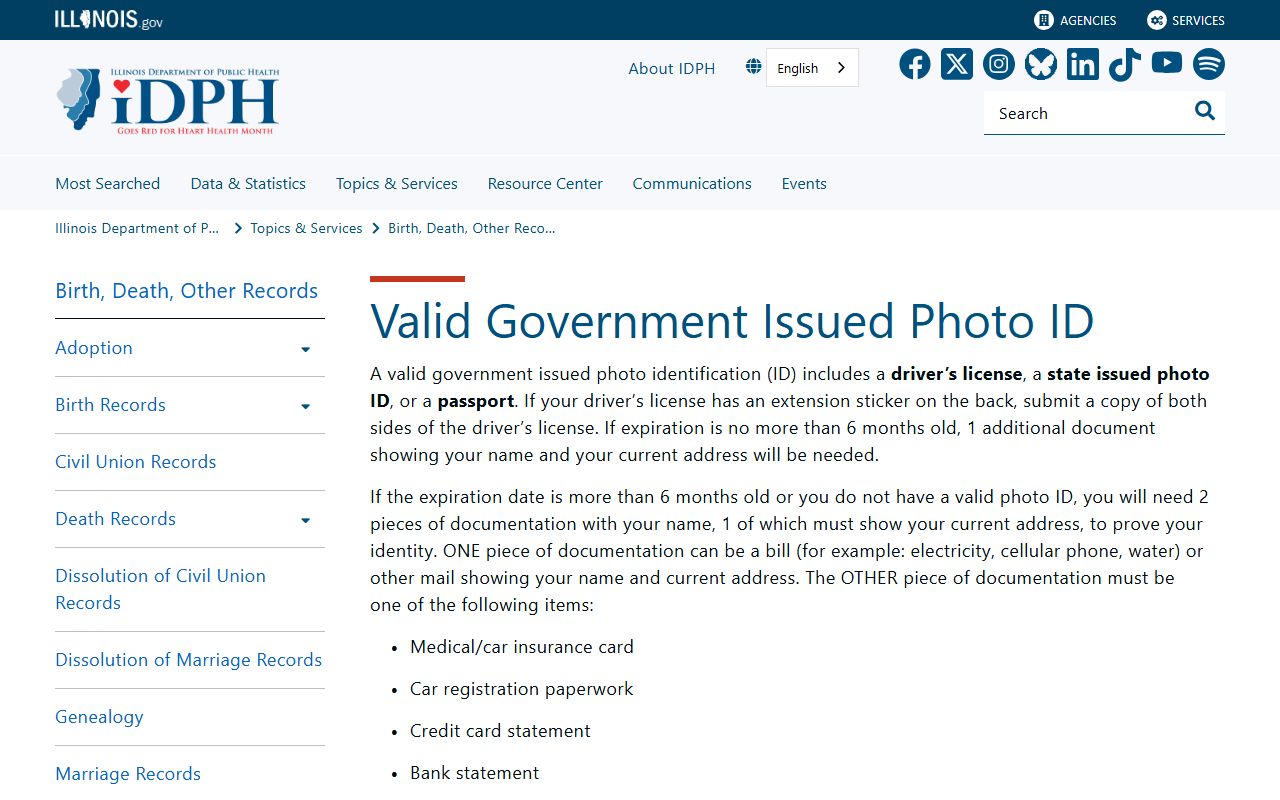
All IDPH divorce record requests must include a copy of an accepted government-issued photo ID; the IDPH page lists what counts as valid.
Illinois Divorce Law Overview
Illinois is a no-fault divorce state. The only ground is irreconcilable differences. No proof of fault is needed. At least one spouse must have lived in Illinois for 90 days before filing. The case is then filed in the county where that spouse lives.
All cases are governed by 750 ILCS 5, the Illinois Marriage and Dissolution of Marriage Act. That law covers property division, maintenance (alimony), child support, and parenting time. The Vital Records Act (410 ILCS 535) governs how divorce records are maintained and accessed by the public.
Note: Since Orland Park spans two counties, the county of filing is determined by where the petitioner lives, not by where the village government is located. Most residents fall in Cook County, so that is usually the right place to start.
Historical and Archived Records
Older divorce records from Cook County or Will County may be held at the Illinois State Archives. Their site is at illinois.gov/ihpa/Archives. If neither the Cook County clerk nor the Will County clerk has a record you need, the State Archives is the next step. This is most relevant for very old cases from the 19th or early 20th century.
The Illinois Genealogical Society at ilgensoc.org has research guides and indexes that can help trace older records across county lines. Their tools are useful when you know a divorce happened but aren't sure which county handled it. For Orland Park residents, the dual-county situation makes these genealogical resources more relevant than they would be for single-county cities.
Nearby Illinois Cities
Other Illinois cities that rely on county courts for divorce records include: