
Find Divorce Records in Lake County
Lake County divorce records are filed with the Circuit Court Clerk of the 19th Judicial Circuit and cover all dissolution of marriage cases heard in the county. This page explains how to search existing cases, request copies of court documents, and use state-level resources to verify or locate Lake County divorce records when you need them.
County at a Glance
What Divorce Records Contain
A Lake County divorce file is made up of every document filed in the case from start to finish. The document most people are after is the judgment for dissolution of marriage. That is the final court order that legally ends the marriage and addresses all related issues the court decided.
Beyond that final judgment, a typical dissolution file includes the original petition for dissolution, any response filed by the other spouse, financial disclosure forms, and any orders entered during the case while it was still pending. If children were involved, the file will also contain the allocation of parental responsibilities judgment and a parenting plan. In cases where property division was disputed, you may find appraisals, business valuations, or pension division orders in the record as well.
Uncontested cases are generally shorter. When both spouses agree on all terms before the court date, the file might have just the petition, a marital settlement agreement, and the judgment. Contested cases can be much larger. Either way, the Clerk's office holds the full record once the case is closed.
Courts can restrict access to parts of a file. Sensitive financial data, minor children's personal information, and certain medical records may be sealed. If you request a copy and some pages are withheld, ask the Clerk's staff which documents are available in the public portion of the file.
Lake County Circuit Court Clerk
Lake County is the third largest county in Illinois by population. The 19th Judicial Circuit Court handles all family law matters in the county, and the Circuit Court Clerk is responsible for maintaining those records. The Family Court Division specifically manages dissolution of marriage cases.
| Clerk | Erin Cartwright Weinstein |
|---|---|
| Address | 18 North County Street, Waukegan, IL 60085-4340 |
| Phone | (847) 377-3380 |
| Fax | (847) 360-6409 |
| Website | lakecountyil.gov/897/Circuit-Clerk |
| Division | Family Court Division |
The Clerk's office is located in Waukegan, which is the county seat. Records can be requested in person or by mail, according to the Lake County Clerk's office. If you are going in person, bringing a photo ID and a case number (if you have one) will speed things up considerably. The Clerk can also help you search by party name if you do not have a case number.
The Illinois Courts circuit clerks by district page shows the 19th Judicial Circuit along with all other circuits in the state.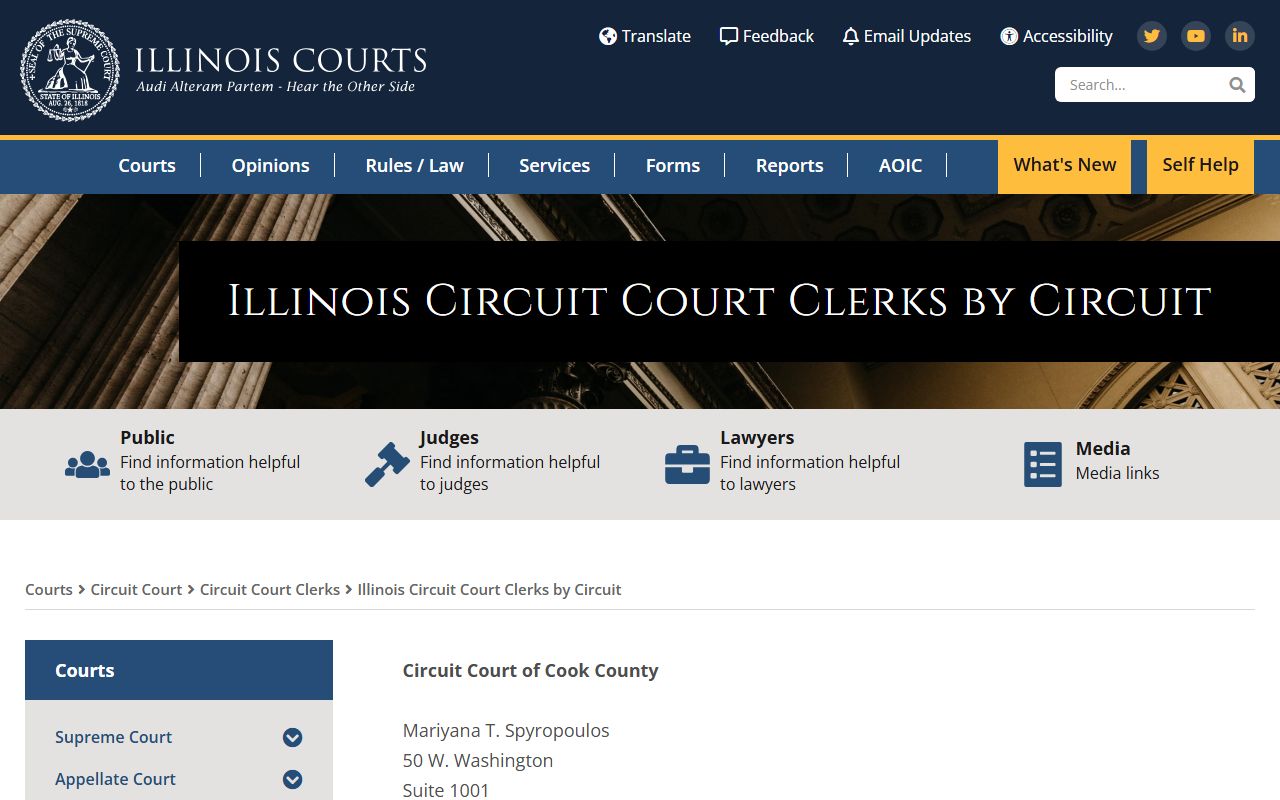 This page is useful when you need to contact clerks in neighboring circuits or want to confirm which circuit handles a particular county.
How to Request Lake County Divorce Records
The Lake County Circuit Court Clerk accepts record requests in person and by mail. Phone inquiries to (847) 377-3380 can help you confirm a case exists and find out the case number before you make a formal request.
For in-person requests, go to 18 North County Street in Waukegan. Bring valid photo ID. The IDPH valid ID page lists acceptable forms of government-issued identification recognized across Illinois agencies and courts. Tell the clerk what you need: a certified copy of the judgment, a list of filings in the case, or a specific document by name. Fees apply for certified copies and plain copies depending on the document type.
Mail requests should be sent to 18 North County Street, Waukegan, IL 60085-4340. Include the names of both parties, the approximate year of the divorce, and the case number if you have it. Attach payment for the applicable fee (check the Clerk's current schedule) and a self-addressed stamped envelope. Processing time for mail requests varies depending on current volume at the Clerk's office.
Note: Older case files may be archived off-site. If the divorce was filed more than 10 to 15 years ago, ask the Clerk whether a retrieval request is needed and how long that adds to processing time.Illinois Dissolution of Marriage Law
All divorces in Lake County follow the Illinois Marriage and Dissolution of Marriage Act, codified at 750 ILCS 5. Illinois is a no-fault state. Under 750 ILCS 5/401, the only ground for divorce is irreconcilable differences. Fault grounds were abolished in 2016. The court presumes irreconcilable differences exist when spouses have lived apart for at least six continuous months before the judgment is entered, though the parties can waive this by stipulation.
The residency requirement under 750 ILCS 5/413 says that one spouse must have lived in Illinois for 90 days before the petition can be filed. For Lake County residents, that means 90 days of Illinois residency. The case is then filed in the circuit court of the county where at least one spouse resides, which in this situation is the 19th Judicial Circuit in Waukegan.
The Illinois Vital Records Act at 410 ILCS 535 governs how the state collects and maintains dissolution of marriage records. Under that act, courts report dissolution judgments to IDPH, which is how the statewide index is built. The Act also sets rules about who can access vital records and in what form.
IDPH Verification for Lake County Divorces
The Illinois Department of Public Health runs a statewide index of dissolution of marriage records. It covers records from 1962 to the present across all Illinois counties, including Lake. IDPH does not issue certified copies of court documents. What you get from them is a verification letter confirming that a dissolution record exists for two named individuals.
The cost is $5 per search. Mail your request to IDPH Division of Vital Records, 925 E. Ridgely Ave., Springfield, IL 62702. Call (217) 782-6553 with questions. Allow four to six weeks for mail processing. Include the full names of both parties and the approximate year of the divorce. If you need an actual certified copy of the decree, contact the Lake County Circuit Court Clerk directly.
The IDPH dissolution of marriage page describes exactly what the verification covers and how to submit the request by mail.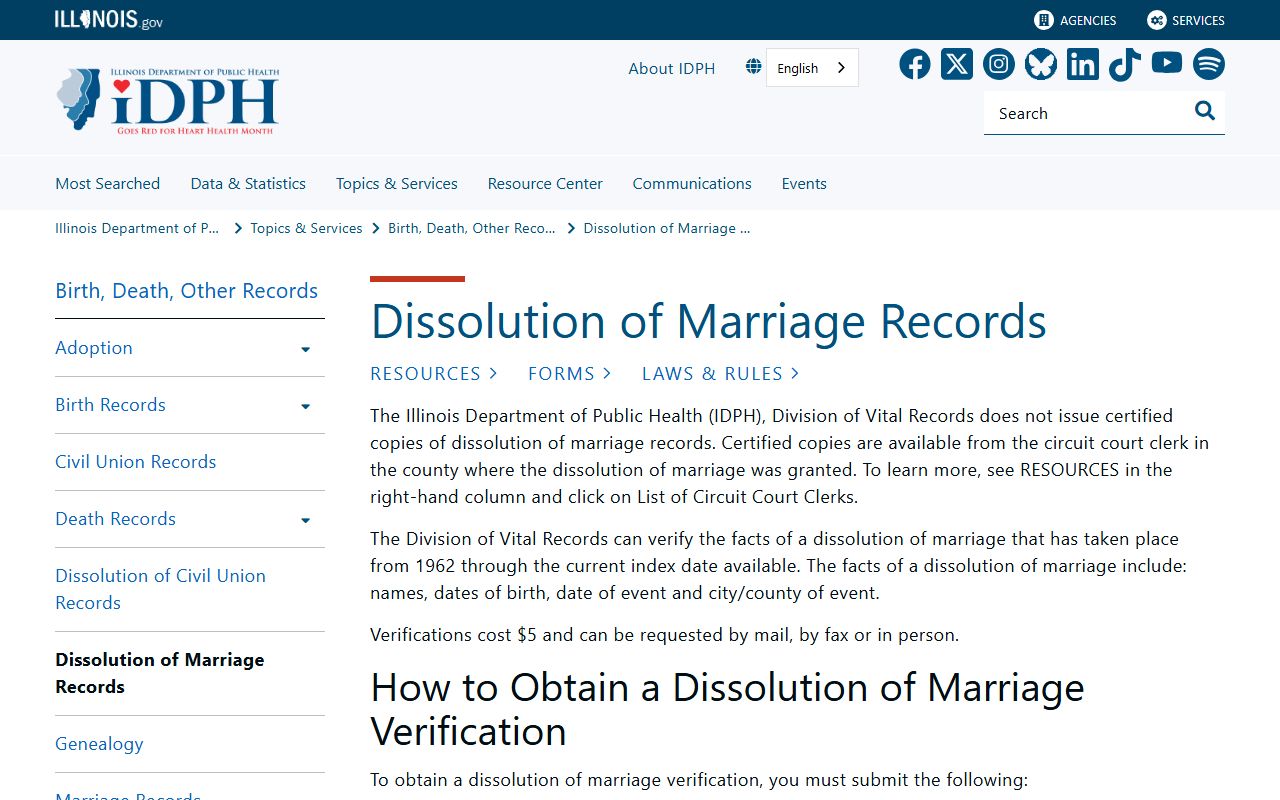 The page also clarifies what IDPH verifications are and are not, which helps avoid confusion when you are deciding whether to go to the state agency or straight to the county clerk.
Legal Help and Other Resources
People dealing with a dissolution in Lake County have several places to turn for help. The Illinois Courts website has a clerk directory and general information about how circuit courts work. It is a good starting point if you are new to the court system and are not sure where to begin.
For genealogy research, the Illinois Genealogical Society can help with older records that are not indexed online. The Illinois State Archives, reachable at (217) 782-4682, holds historical court records from across the state. If you are researching a Lake County divorce from before the 1960s, these are the resources most likely to help.
Lake County also has legal aid resources for low-income residents who cannot afford an attorney. The Clerk's office can sometimes point you toward self-help materials or refer you to local legal services organizations. Court forms for dissolution of marriage cases in Illinois are available through the Illinois Courts website for people who plan to represent themselves.
Cities in Lake County
Waukegan is the only city in Lake County that meets the qualifying population threshold and has a dedicated divorce records page:
Other cities in Lake County, such as Gurnee, Vernon Hills, Mundelein, and Libertyville, fall below the threshold. If you are searching for records related to a resident of those communities, the 19th Judicial Circuit Clerk in Waukegan handles those cases as well.
Nearby Counties
Lake County borders Cook County to the south and McHenry County to the west. It also shares a border with Wisconsin to the north, which is relevant if a party may have established residency across the state line before filing.