
Access Effingham County Divorce Records
Effingham County divorce records are held by the Circuit Court Clerk in Effingham, Illinois, where the 4th Judicial Circuit processes all dissolution of marriage filings for the county. This page explains how to request and search those records, what documents a typical case file contains, how Illinois statutes govern the process, and how the state health department maintains its own separate divorce index.
County Overview
The Circuit Court Clerk in Effingham County
John Niemerg is the Circuit Court Clerk for Effingham County. His office at Suite 101, 120 W. Jefferson Street in Effingham, is the official keeper of all divorce records in the county. Every dissolution of marriage case filed here, from the initial petition through any post-decree modifications, lives in that office. The clerk is not a legal advisor, but the staff can tell you what records exist and explain the process for requesting copies.
The 4th Judicial Circuit covers a cluster of central Illinois counties. Cases in Effingham County are heard by a circuit judge assigned to handle family law matters in the 4th Circuit. All filings pass through John Niemerg's office before going to the judge and remain there as the permanent case record afterward. The clerk's office is your starting point whether you need a copy of a decree, want to confirm a case was filed, or need details about what documents are on record.
The phone number is 217/342-4065. The fax is 217/342-6183 for documents. Check the clerk's website for current office hours, any online search capabilities, and updated fee information. The website is the best place to verify current procedures before making a trip or mailing a request.
Searching Effingham County Divorce Records
Walking into the clerk's office at 120 W. Jefferson in Effingham is the most direct way to find a specific divorce record. Staff can search by party name or case number. If you know the approximate year the case was filed, that helps staff narrow the results, particularly for older records that predate the electronic docket system. You can review documents during your visit and ask for copies on the spot.
Mail requests work if you cannot make the trip to Effingham. Write a letter that includes both parties' full legal names, the approximate filing year, and a phone number or email address where the office can reach you. Send it to Suite 101, 120 W. Jefferson, Effingham, IL 62401-0586. Include payment for copy fees. Call 217/342-4065 first to confirm what fees apply and what payment methods the office currently accepts, since these can change.
Phone inquiries at 217/342-4065 can sometimes confirm whether a specific case is on file and give you the case number. That number speeds up any further requests significantly. For actual document copies, though, you'll need to follow up in writing or in person. The Illinois Courts directory, shown in the image below, can help confirm the clerk's contact details and any online search tools the 4th Circuit currently offers.
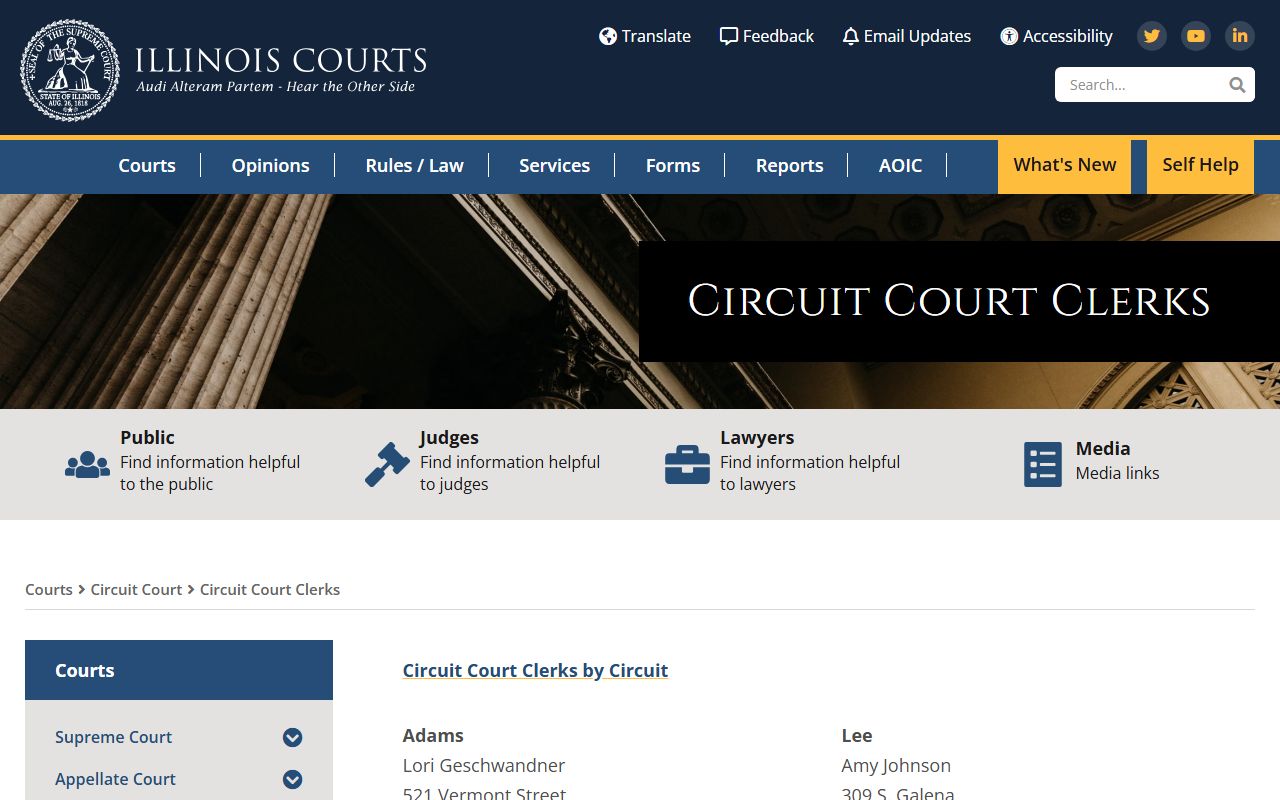
The Illinois Courts clerk directory lists all circuit clerks statewide, including Effingham County's 4th Circuit, with current contact details and any available search links.
What Divorce Case Files Include
An Effingham County divorce file begins with the petition for dissolution of marriage. The file then builds up over the course of the case. At the end is the judgment for dissolution of marriage, the official order that terminates the marriage. That judgment, often called the divorce decree, is the document most people are searching for when they contact the clerk's office after the fact.
Property division terms appear in the marital settlement agreement, which is usually incorporated into the final decree or filed as a separate exhibit. When the case involved children, parenting plans, child support orders, and custody rulings are also in the file. Post-decree actions, such as requests to change support amounts or modify parenting arrangements, are filed as separate cases in the same system. They are still accessible through the clerk's office, just under a different case number than the original divorce.
Access to some documents in a divorce file may be restricted. Judges can seal parts of a file, and records involving minor children are often limited in how much the public can view. Financial disclosure forms may also carry access restrictions. If you search for a case and find that some documents are missing, the clerk's staff can tell you whether anything in that case has been sealed or placed under a protective order.
Note: If you need a certified copy of the divorce decree for a legal or financial transaction, make sure to request a certified copy specifically, since uncertified copies are generally cheaper but not accepted everywhere.
Illinois Law and Effingham County Divorces
All dissolution of marriage cases filed in Effingham County are governed by the Illinois Marriage and Dissolution of Marriage Act, 750 ILCS 5. This is the primary state law on divorce. It covers grounds for dissolution, residency requirements, how marital property and debts get divided, and how judges handle matters involving children. Illinois is a no-fault divorce state. The only recognized ground is irreconcilable differences, so neither party has to establish fault to proceed.
The 90-day residency rule requires at least one spouse to have lived in Illinois for 90 days before filing. That applies in Effingham County as it does everywhere in the state. Once a petition is filed and the other party is served, the case timeline depends on whether the parties can agree on the major issues. Agreed or uncontested cases resolve faster. When property division, support, or custody becomes contested, the process can stretch considerably longer.
Illinois follows equitable distribution for marital property. That means a court divides assets and debts in a way that is fair given the circumstances, not automatically in half. Factors a judge considers include the duration of the marriage, each spouse's financial situation, contributions to the marriage, and any other relevant considerations outlined in 750 ILCS 5.
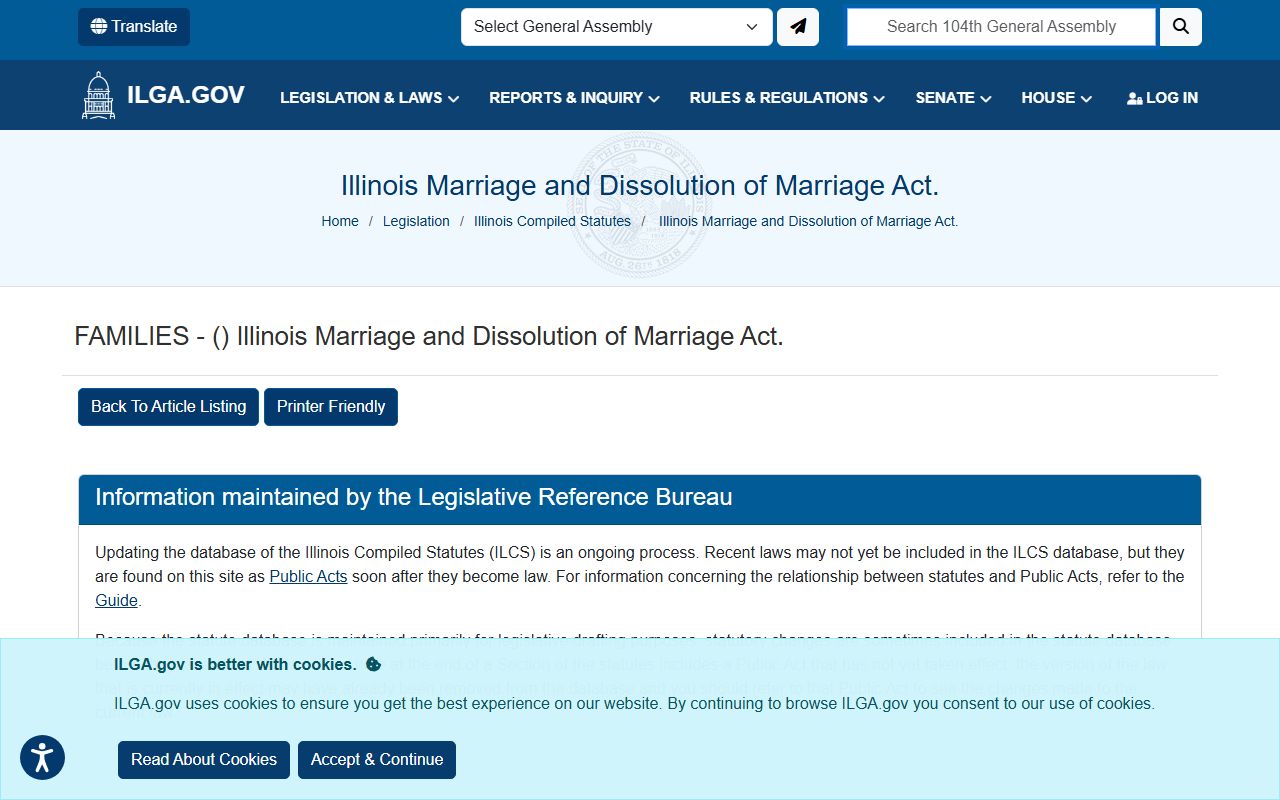
The full text of 750 ILCS 5 is available on the Illinois General Assembly website and governs every divorce case filed in Effingham County.
The state's separate record of divorces, maintained by the health department rather than the courts, falls under the Vital Records Act, 410 ILCS 535.
IDPH State Verification Records
The Illinois Department of Public Health has maintained a record of divorces granted in Illinois since 1962. IDPH offers a verification letter for $5 if you need to confirm that a dissolution occurred without getting the full court file. This verification letter is not a court document. It simply confirms the state has a record of the divorce in its index. For many situations, that is sufficient.
To request a verification, send your information to 925 E. Ridgely Ave., Springfield, IL 62702, or call (217) 782-6553. Include the names of both parties, the approximate year the divorce was granted in Effingham County, and a copy of a valid government-issued photo ID. Accepted ID forms are listed on the IDPH valid ID page. Full instructions and the request form are on the IDPH dissolution of marriage records page. Mail requests typically take four to six weeks to process.
Divorces that occurred before 1962 are not part of the IDPH index. For those older records, contact the Illinois State Archives at (217) 782-4682 or visit the Illinois Archives website. The Illinois State Genealogical Society can also help with older Effingham County records research.
Note: IDPH verification letters work fine for confirming a divorce took place, but they do not include the property settlement terms or parenting arrangements found in the actual court file.
Cities in Effingham County
No city in Effingham County meets the 50,000-person threshold for a dedicated city-level divorce records page. The city of Effingham, which shares its name with the county and serves as the county seat, has roughly 12,000 residents. Other communities include Altamont, Teutopolis, Dieterich, and Beecher City. Everyone in the county files divorce cases at the Circuit Court Clerk's office in the city of Effingham.
Nearby Counties
Effingham County borders several other Illinois counties in the central part of the state. Each has its own circuit court and clerk handling dissolution filings in their jurisdiction.