
Cumberland County Divorce Records
Cumberland County divorce records are filed with the Circuit Court Clerk in Toledo, Illinois, and cover all dissolution of marriage cases heard in the 5th Judicial Circuit. This page explains where those records are kept, how to search them, what they typically contain, and how state agencies tie into the process for anyone who needs to verify or obtain a copy of a dissolution record from this county.
County Overview
Circuit Court Clerk in Cumberland County
The Circuit Court Clerk in Toledo is the official keeper of divorce records for Cumberland County. All petitions for dissolution of marriage filed in this county go through the clerk's office, and the records stay there from the initial filing through the final decree and any post-decree motions that follow. The clerk maintains both the physical case files and whatever electronic records the 5th Circuit has made available for public access.
Cumberland County is part of the 5th Judicial Circuit, which also serves Clark, Coles, Edgar, and Moultrie counties. The circuit shares some administrative resources across those counties, but each county clerk's office handles its own local filings independently. If you need to reach the Cumberland County clerk, call 217/849-3601 during regular business hours. The clerk's office is located in the county courthouse in Toledo.
For a current list of circuit court clerks across Illinois, including updated addresses, phone numbers, and any online access links, the Illinois Courts circuit court clerk directory is the best starting point. That page lists every circuit clerk in the state and is updated when contact information changes.
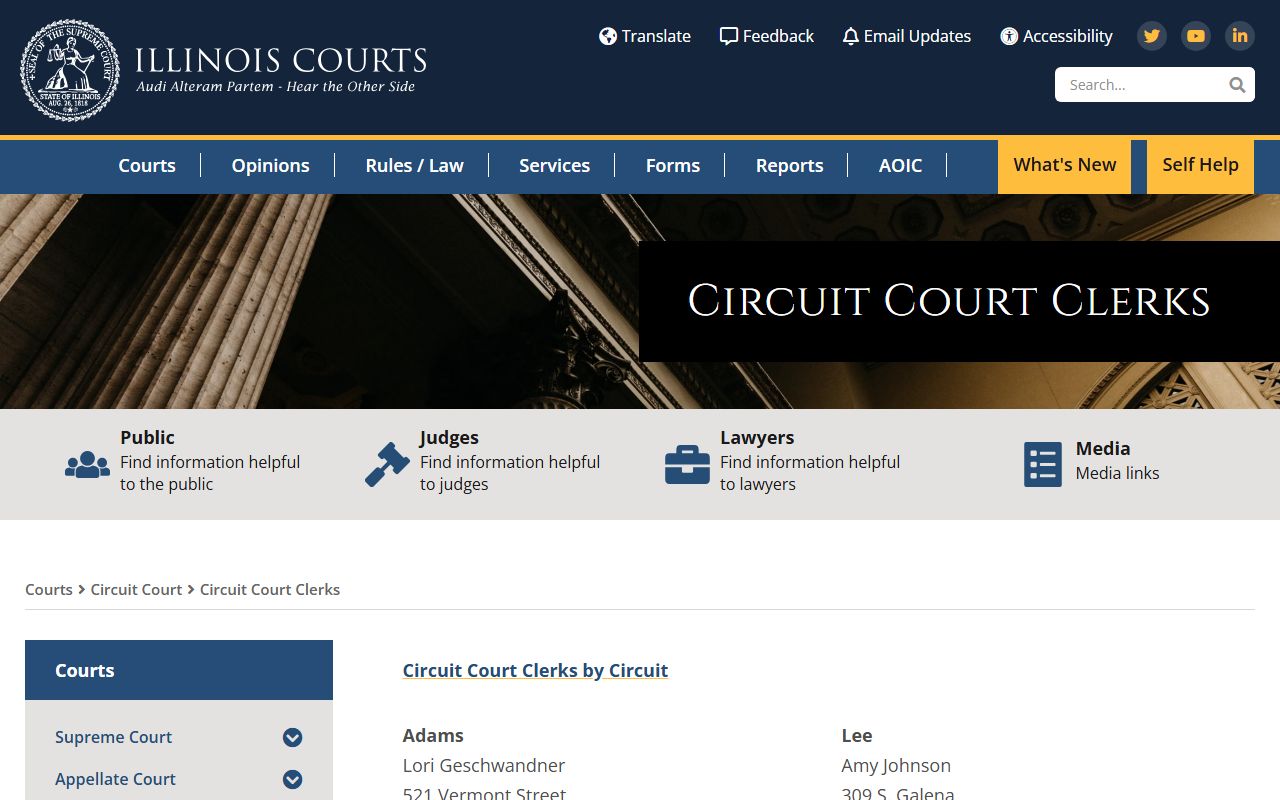
The Illinois Courts clerk directory covers all 102 counties in the state, including Cumberland County's 5th Circuit contact details.
Note: Office hours can vary and may change around holidays, so calling ahead before making an in-person visit saves time.
How to Search Divorce Records Here
The most direct way to find a divorce record in Cumberland County is to contact the clerk's office in Toledo. Staff can search by party name or case number. If you know approximately when the case was filed, that helps narrow the search. Visiting in person is usually fastest if you need copies the same day.
Mail requests are an option if you can't get to Toledo. Send a written request to the Cumberland County Circuit Court Clerk with the full names of both parties, the approximate filing year, and your return address and phone number. Include payment for any copy fees the office requires. Turnaround for mail requests varies depending on workload, so plan for at least a few weeks if you have a deadline.
Online access depends on what the 5th Circuit has made available. Some Illinois circuits allow public case searches through their own portals or through the Illinois Courts system. Check the Illinois Courts directory page for any links to online search tools connected to Cumberland County. Not every smaller county has a full public search portal, so calling the clerk first is a good idea before you spend time looking online.
If the divorce happened many years ago and you are not sure which county handled it, the state-level IDPH index is another tool. IDPH has records going back to 1962, and its index can confirm where a case was filed even if you don't have the full case number.
What the Records Contain
A divorce case file in Cumberland County includes the petition for dissolution of marriage, the summons, any responses from the other party, and all court orders entered during the case. The most important document for most people is the final judgment for dissolution of marriage, which is signed by the judge and officially ends the marriage. That document is what lenders, government agencies, and courts in other states typically want to see.
If the case involved property, you will find financial disclosure forms, property settlement agreements, and any orders dividing assets or debts. Cases with minor children will also include parenting plans, child support orders, and any custody arrangements the court approved. Those documents carry legal weight after the case closes, and certified copies may be needed to enforce them in other proceedings.
Post-decree modifications are filed separately. If either party went back to court to change a support amount or parenting schedule, those filings are in the system under a related case number. The clerk can look them up along with the original case.
Note: Some records in divorce files may be sealed by court order, particularly those involving minor children, and sealed documents will not appear in a standard public records search.
Illinois Law and Divorce Statutes
Illinois divorce law is set out in the Illinois Marriage and Dissolution of Marriage Act, 750 ILCS 5. That statute defines the grounds for divorce, the residency rules, and how courts handle property, support, and parenting matters. Illinois recognizes only one ground for divorce: irreconcilable differences. You don't need to prove fault to file.
To file for divorce in Cumberland County, at least one spouse must have lived in Illinois for 90 days before filing. That requirement is written into 750 ILCS 5. There is no mandatory waiting period after filing, but contested cases can take much longer than uncontested ones depending on how complex the issues are and how busy the 5th Circuit docket is at the time.
The state's authority over vital records, including the recording of divorce events, comes from the Vital Records Act, 410 ILCS 535. Under that statute, the IDPH maintains a statewide index of divorces recorded in Illinois going back to 1962. The IDPH record is separate from the court file and serves a different purpose.
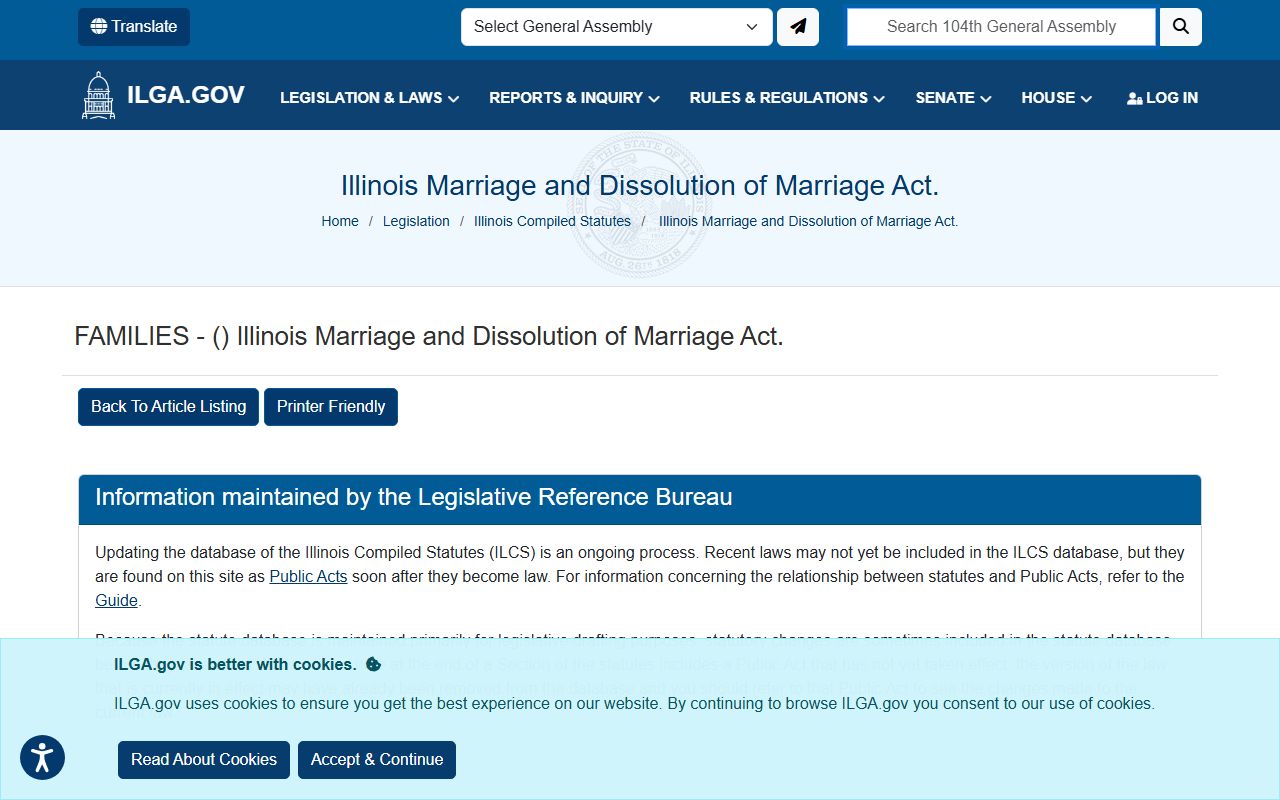
The Illinois General Assembly website hosts the full text of 750 ILCS 5, which governs every divorce case filed in Cumberland County and across Illinois.
IDPH State Verification Records
The Illinois Department of Public Health keeps a statewide index of divorces granted in Illinois from 1962 forward. If you only need to confirm that a divorce happened rather than get the full court file, the IDPH offers a verification letter for $5. That letter states that the state has a record of the dissolution. It is not a certified copy of the court decree, and it may not satisfy every legal need, but it works well for many situations where only basic confirmation is required.
To request a verification, mail your request to IDPH at 925 E. Ridgely Ave., Springfield, IL 62702. Call (217) 782-6553 if you have questions about the process. Plan for four to six weeks for mail requests to be processed and returned. You will need to include the names of both parties, the approximate year of the divorce, and a copy of a valid government-issued photo ID. The IDPH valid ID page explains which forms of identification are accepted.
The IDPH dissolution of marriage records page has the request form and full instructions. For pre-1962 records, the Illinois State Archives holds older dissolution documents and can be reached at (217) 782-4682 or through the Illinois Archives website.
Note: Confirm with whoever is requesting the record whether they need a court-certified copy or whether an IDPH verification letter is sufficient for their purpose.
Cities in Cumberland County
No city in Cumberland County exceeds the population threshold for a dedicated records page. Toledo is the county seat and the location of the Circuit Court Clerk's office where all divorce filings are held. Other small communities in the county include Greenup, Jewett, and Neoga. Residents throughout Cumberland County file dissolution cases at the clerk's office in Toledo.
Nearby Counties
Cumberland County borders several other Illinois counties in the east-central part of the state. Each of those counties has its own circuit court clerk handling divorce filings.