
Access Fayette County Divorce Records
Fayette County divorce records are held by the Circuit Court Clerk in Vandalia, the county seat, as part of the 4th Judicial Circuit. This page covers how to search dissolution of marriage records in Fayette County, what those case files contain, the Illinois laws that govern the process, and how the state IDPH system fits into the picture for people who need a verification of a dissolution that occurred here.
County Overview
The Circuit Court Clerk in Vandalia
Fayette County's divorce records are the responsibility of the Circuit Court Clerk in Vandalia. When someone files a petition for dissolution of marriage in this county, the clerk's office creates a case record and maintains every document related to that case, starting with the petition and continuing through the final judgment and any post-decree filings. The clerk is the official custodian of those records and the place to go when you need copies or certified documents.
Fayette County sits in the 4th Judicial Circuit, which covers a group of counties in south-central Illinois. Each county in the 4th Circuit has its own clerk's office handling local filings. So Fayette County records stay in Vandalia, not at a shared central office. Call the Fayette County clerk at 618/283-5009 to speak with staff about a specific case, ask about fees, or confirm what access options are available.
The county borders several others, which sometimes creates questions about where a particular case was filed, especially if parties lived near a county line. Cases are filed in the county where one spouse resided or where the parties last lived together as a married couple. If you're not sure which county handled a case, the IDPH statewide divorce index is a useful way to confirm the county of filing before you contact a clerk's office.
The Illinois Courts circuit court clerk directory has current contact information for Vandalia and every other county clerk in the state. That page is worth checking for links to any online access tools tied to Fayette County.
Note: The 4th Circuit covers a large geographic area, but each county clerk operates independently, so Fayette County records are only accessible through the Vandalia office.
Ways to Search Fayette County Records
In-person visits to the clerk's office in Vandalia are the most direct route. Staff can search by party name or case number. If you have the approximate filing year, that speeds up the search. In most cases, you can get certified copies the same day. The clerk's office is in the Fayette County courthouse in Vandalia.
Mail requests are available for people who can't visit Vandalia. A written request should include the full names of both parties, the approximate year of filing, your return mailing address, a phone number for follow-up, and payment for any required fees. Allow several weeks for mail requests to be processed. During busy periods it may take longer, so plan ahead if the documents are time-sensitive.
Online access varies by county. Some Illinois counties have public case search portals; others have little online availability. Whether Fayette County has an online tool is best confirmed by checking the Illinois Courts directory or calling the clerk at 618/283-5009 directly. That's the fastest way to find out what's currently available for remote records access.
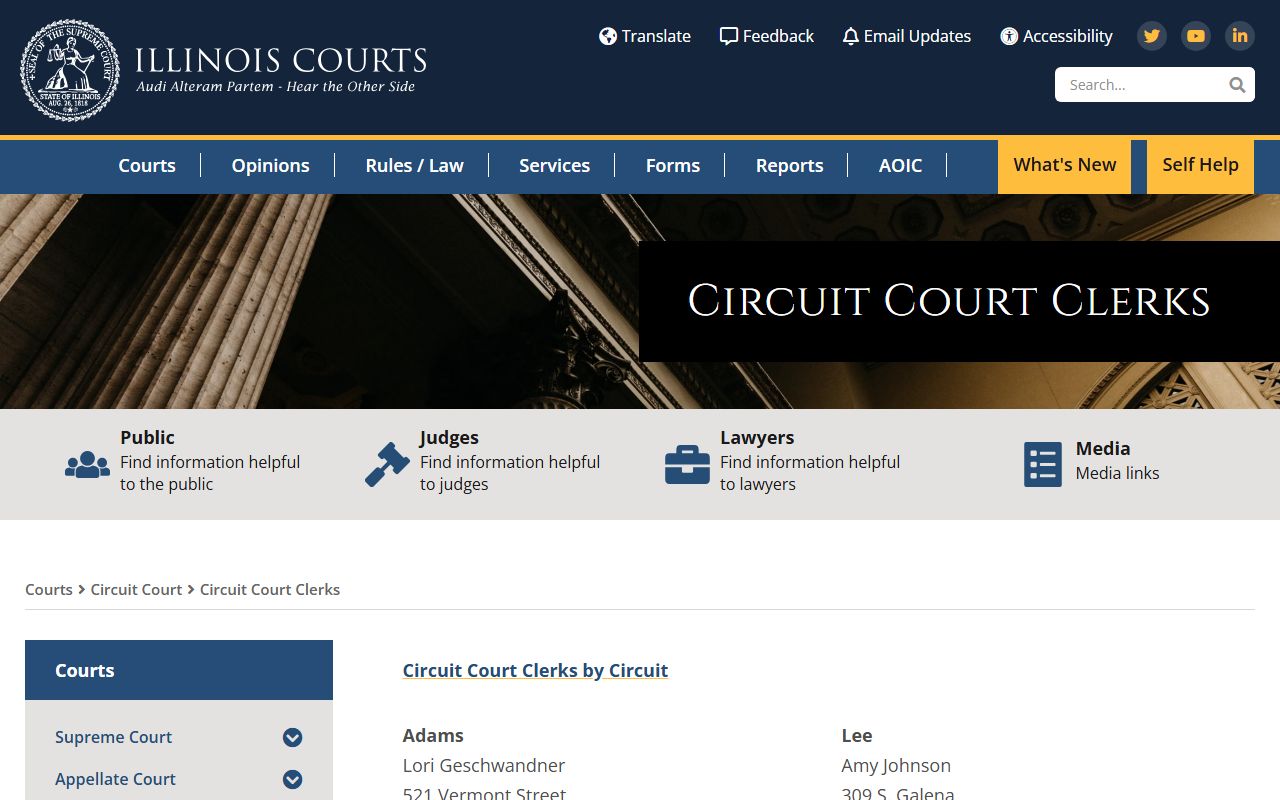
The Illinois Courts directory lists up-to-date contact information for the Fayette County Circuit Court Clerk in Vandalia and every other county in the state.
What's in a Divorce Case File
A Fayette County dissolution case file starts with the petition for dissolution of marriage. As the case progresses, the clerk adds each document to the record. That typically includes the summons, financial affidavits from both parties, any temporary orders entered during the case, and motions filed along the way. The final judgment for dissolution of marriage is the primary document most people need, since it is the signed court order that ends the marriage and lays out the terms both parties and the judge agreed to.
Property matters generate additional documents. Settlement agreements, orders for the transfer of real estate, and QDRO orders splitting retirement accounts are common attachments to the final judgment in cases involving significant marital property. These are part of the public record unless sealed. Cases with children add parenting plans, child support orders, and allocation of parental responsibilities judgments. Those documents remain enforceable after the case closes and may need to be enforced or modified later through the same court.
Post-decree filings, such as motions to modify support or parenting time, are stored under the original case number or a related number and are searchable through the same clerk's office. The clerk can pull both the original case and any subsequent filings during a single records request.
Note: If a document is listed as part of the case but cannot be located in the public file, it may have been sealed or transferred, and staff can help clarify the status.
Applicable Illinois Statutes
Divorce in Fayette County follows the rules set out in the Illinois Marriage and Dissolution of Marriage Act, 750 ILCS 5. This is the main statute for all divorce proceedings in Illinois. It covers the only recognized ground for divorce in the state, which is irreconcilable differences. It also sets out how property is divided, how maintenance is calculated, how child support works, and how courts allocate parental responsibilities when children are part of the case.
The 90-day residency rule applies to Fayette County just as it does throughout the state. One spouse must have lived in Illinois for 90 days before a petition for dissolution can be filed in an Illinois court. There's no mandatory waiting period after filing, though it can take time for a case to reach a final decree, particularly if any issues are contested. Uncontested cases where both parties agree on all terms can move through the court system faster.
The state's authority to maintain divorce records at the vital records level comes from the Vital Records Act, 410 ILCS 535. That statute is why IDPH collects and indexes dissolution records from every county in the state.
Verifying a Divorce Through IDPH
The Illinois Department of Public Health maintains a statewide index of divorces from 1962 to the present and offers a $5 verification letter for anyone who needs to confirm a divorce took place. The letter states that the state has a record of the dissolution on file. It does not reproduce the court documents, and it is separate from anything the Fayette County clerk provides. For many purposes, the verification letter is sufficient.
To request a verification, mail to IDPH at 925 E. Ridgely Ave., Springfield, IL 62702. Call (217) 782-6553 with questions. You'll need to include the full names of both parties, the year the divorce was granted, and a copy of a valid government-issued photo ID. Details about accepted ID types are at the IDPH valid ID page. Full request instructions and the form are on the IDPH dissolution of marriage records page. Processing by mail takes about four to six weeks.
Divorces granted before 1962 are outside the IDPH index. For those older records, contact the Illinois State Archives at (217) 782-4682 or through the Illinois Archives website. The Illinois State Genealogical Society is another resource for older dissolution records in southern Illinois counties like Fayette.
Note: Confirm whether a verification letter or a certified court copy is needed before submitting your request, since these are different documents with different costs and timelines.
Cities in Fayette County
No city in Fayette County has a population above the threshold for a dedicated records page. Vandalia is the county seat and the home of the Circuit Court Clerk's office where all dissolution of marriage cases are filed. Brownstown and St. Elmo are other communities in the county. All Fayette County residents file divorce cases at the clerk's office in Vandalia.
Nearby Counties
Fayette County borders several other Illinois counties in the south-central part of the state. Each has its own circuit court handling local divorce filings.