
Joliet Divorce Records Lookup
Divorce records for Joliet are maintained by the Will County Circuit Clerk, since most of Joliet sits within Will County, though the city extends into Kendall County along its western edge. Will County Circuit Clerk Andrea Chasteen handles the majority of Joliet dissolution cases from offices located in the city itself.
Joliet at a Glance
Which County Handles Joliet Divorce Records
Joliet is the county seat of Will County. Most of the city falls within Will County, and the Will County courthouse sits right in downtown Joliet at 100 West Jefferson Street. That is where the circuit court is located and where the vast majority of Joliet divorce cases are filed and stored. The city also extends into Kendall County along its western edge, so residents in that area may have cases in Kendall County instead.
Will County Circuit Clerk Andrea Chasteen maintains all dissolution of marriage records for Will County. Her office is at 100 West Jefferson Street, Joliet, IL 60432-4399. Phone: 815/727-8592. Website: willcountyillinois.com/circuit-clerk. Because the courthouse is in Joliet itself, in-person access is straightforward for most city residents.
Kendall County handles cases for Joliet residents whose addresses fall within Kendall County boundaries. The Kendall County Circuit Clerk's phone is 630/553-4183. If you are unsure which county your address falls in, check your county designation on your property tax bill, driver's license, or voter registration card. Most Joliet addresses will be Will County.
How to Get Divorce Records in Joliet
Will County is accessible through the Judici platform at judici.com. That free public tool lets you search Illinois court cases by party name or case number. Will County cases are included. You can verify that a case exists, see the filing date, and check the status without going to the courthouse. Judici shows docket information but not the full documents.
For actual copies, the Will County clerk's office at 100 West Jefferson Street in Joliet is your best option. Walk in with a photo ID and the names of the parties or the case number if you have it. Staff can pull the file and provide plain or certified copies. Call 815/727-8592 to ask about the current copy fee schedule before you go.
Mail requests work as well. Write to the Will County Circuit Clerk, 100 West Jefferson Street, Joliet, IL 60432-4399. Include the full names of both spouses, the approximate year of the divorce, a return address, and a check or money order to cover fees. Include a self-addressed stamped envelope. Mail requests may take several weeks to process.
Note: If you need a certified copy of the divorce judgment for a legal or official purpose, ask for a certified copy specifically. Plain copies cost less but may not be accepted by some agencies or courts that require certification.
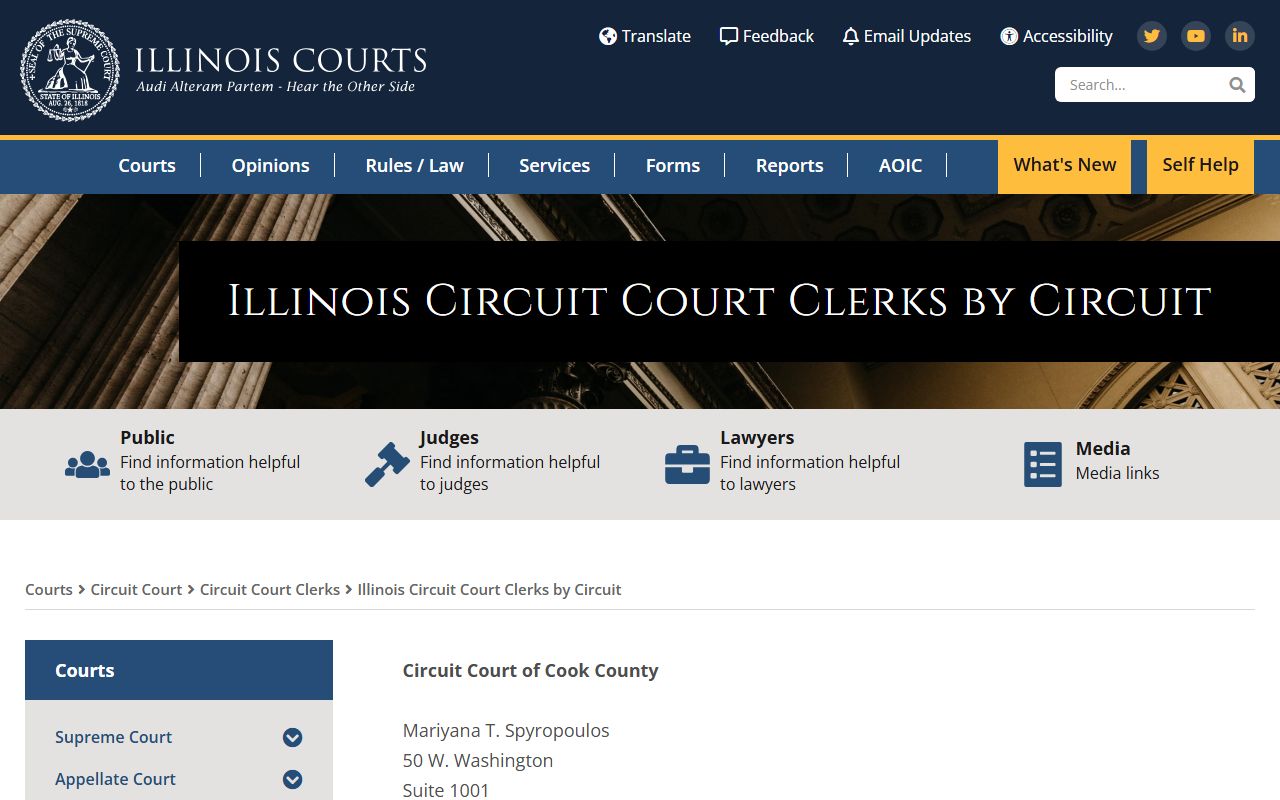
The Illinois Courts system maintains a full directory of circuit clerks at the Illinois Courts website, including Will County clerk contact information.
Will County is part of the 12th Judicial Circuit, which covers Will County only and is centered in Joliet.
What Joliet Divorce Files Contain
A Will County divorce file starts with the Petition for Dissolution of Marriage. That is the document that opens the case. It names both spouses, states that irreconcilable differences exist, and tells the court what the filer wants in terms of property division, support, and parenting arrangements. The other spouse files a written response. Both documents are in the public case file.
Financial disclosures are required from both parties. These forms list income, bank accounts, retirement accounts, real property, debts, and monthly expenses. They are part of the public record. If children are involved, a parenting plan or allocation judgment covers where the children will live, how parenting time is divided, and how child support is calculated. That document stays in the file even after the case closes.
Any property settlement agreement reached by the parties is also in the file. That document spells out how the couple is dividing assets and debts. Court orders issued during the case, such as temporary support or protection orders, are part of the record too.
The Judgment for Dissolution of Marriage is the final document. It is the court's signed order ending the marriage. The judgment may incorporate the property agreement and parenting plan, or it may attach them. The judgment is what most people need when they must prove a divorce took place. All of these documents are shaped by the Illinois Marriage and Dissolution of Marriage Act (750 ILCS 5).
IDPH Statewide Divorce Verification
Illinois maintains a statewide divorce index at the Department of Public Health. The index goes back to 1962. If you need to verify that a divorce occurred and don't need the full court file, the IDPH can issue a certificate of dissolution. That certificate is enough for many legal and administrative purposes.
The fee is $5. Mail requests to the Illinois Department of Public Health, Division of Vital Records, 925 E. Ridgely Ave., Springfield, IL 62702. Phone: (217) 782-6553. Processing takes four to six weeks by mail. Include a copy of a government-issued photo ID. The IDPH's list of accepted IDs is posted at dph.illinois.gov.
The dissolution of marriage records page is at dph.illinois.gov/topics-services/birth-death-other-records/dissolution-marriage-records.html. For Joliet divorces before 1962, contact the Will County Circuit Clerk directly.
Illinois Divorce Law Basics
Illinois uses a no-fault standard for divorce. The only ground is irreconcilable differences. No proof of fault is needed. If both spouses agree the marriage is over, the court can grant the divorce without a contested hearing. If one spouse disagrees, the court may still grant the divorce after finding that the marriage has broken down irretrievably.
At least one spouse must have lived in Illinois for 90 days before the filing date. Joliet residents who meet that requirement file in Will County (or Kendall County if they live in that part of the city). Once the judge signs the judgment, the divorce is final. There is no state-mandated cooling-off period after entry of the judgment.
The main law is the Illinois Marriage and Dissolution of Marriage Act (750 ILCS 5). It covers every stage of the divorce process. The Vital Records Act (410 ILCS 535) governs how the state records and stores dissolution data at the IDPH level.
Legal Resources for Joliet Residents
The Will County courthouse at 100 West Jefferson Street has clerk's office staff who can help you locate a case or get copies of documents. They cannot give legal advice, but they can point you to the right division and the right forms. If you need help with a divorce case, Prairie State Legal Services serves Will County and can assist qualifying low-income residents with family law matters.
Illinois Legal Aid Online at illinoislegalaid.org provides free self-help guides and court forms for divorce. The site walks through the steps for uncontested divorce, which is the most common type. People filing without a lawyer can find approved forms and instructions there.
The Illinois State Archives at illinois.gov/ihpa/Archives holds older court records and supports genealogical research. The Illinois Genealogical Society at ilgensoc.org is a resource for anyone researching historical divorce records. For a full list of Illinois circuit clerks and courthouses, the Illinois Courts site at illinoiscourts.gov is the best starting point.
Nearby Illinois Cities
These other Illinois cities also use the county court system to maintain divorce records: