
Marion County Divorce Records
Marion County divorce records are maintained by the 4th Judicial Circuit Court Clerk's office in Salem, Illinois. This page explains how to find dissolution of marriage records at the county courthouse, how the state IDPH verification service works, and where to turn for legal help if you need it.
County at a Glance
Reaching the Salem Courthouse
Tiffany Schicker serves as the Marion County Circuit Court Clerk. Her office at 100 East Main Street in Salem holds all dissolution of marriage case records filed in the county. That includes the initial petition, the other party's response, financial affidavits, parenting agreements when children are involved, and the final judgment of dissolution. When you need a divorce decree or want to confirm a filing, the clerk's office in Salem is the right place to contact.
The main phone line is 618/548-3856. Call before visiting to find out what case details the clerk needs to locate a record and what the current fees are for copies. Bringing a photo ID and knowing the full names of both parties and the approximate year of the divorce makes the search faster. The website at marionco.illinois.gov may also have information on hours and request procedures.
The Illinois IDPH vital records page covers dissolution of marriage records, including how courts report every divorce to the state for inclusion in the statewide index.
Certified copies of court documents carry an official seal and are accepted for legal purposes. Plain copies cost less and work fine for personal research or reference. When you call or visit the clerk, let them know which type you need so they can give you accurate pricing.
Note: The 4th Judicial Circuit serves a multi-county area in central and southern Illinois. If a divorce was filed in a different county, contact that county's circuit clerk directly. Each county keeps its own separate records.
Contents of a Marion County Divorce File
A Marion County divorce case file typically opens with the petition for dissolution of marriage. From there it includes the other spouse's written response and sworn financial affidavits from both sides disclosing income, assets, and debts. When minor children were involved in the marriage, the file will also contain an allocation of parental responsibilities agreement or a parenting plan, as well as child support orders. The final document is the judgment of dissolution, which is the decree that confirms the marriage ended and sets out the court's orders on all issues. This is the document most people are looking for when they contact the clerk.
Contested divorces where the parties disagreed on major issues can produce substantially longer files. You may find hearing transcripts, exhibits entered into evidence, expert reports, and multiple interim orders issued while the case was being decided. Uncontested cases are shorter. Either way, the clerk holds the complete record and you can request individual documents or the full file. Fees are based on the number of pages copied and whether you want certified or plain documents.
Records sealed by court order are not available to the public. Parts of files dealing with minor children may also carry some restrictions under state law. Most adult divorce case files in Marion County are open public records accessible to anyone who asks.
Illinois Law Governing Divorce
Divorce in Illinois is governed by the Illinois Marriage and Dissolution of Marriage Act (750 ILCS 5). The state uses a no-fault system, meaning the only recognized ground for divorce is irreconcilable differences. No one has to prove the other spouse did something wrong. The law only asks that both parties show the marriage has broken down with no real chance of repair.
Illinois also requires that at least one spouse live in the state for 90 days before filing, under 750 ILCS 5/413. Marion County residents file with the 4th Judicial Circuit in Salem. Cases where both sides agree on all issues tend to move through court more quickly than contested ones. Contested divorces with disputes over property, debts, children, or support take more time and typically involve several court appearances before the judge issues a final ruling.
Under the Illinois Vital Records Act (410 ILCS 535), courts are required to report every dissolution of marriage to the state. That reporting creates the statewide index maintained by IDPH, which covers divorces from 1962 forward.
IDPH Statewide Verification Service
Not everyone needs a full court file. If your goal is simply to confirm that a divorce happened, the Illinois Department of Public Health offers a faster and cheaper option. IDPH maintains statewide records of Illinois dissolutions of marriage granted since 1962. They can issue a verification letter showing that a dissolution was recorded in the state database for a specific person. This letter is not a certified court copy, but it confirms the basic fact of the divorce for many common purposes.
Send requests to IDPH at 925 E. Ridgely Avenue, Springfield, IL 62702, or call (217) 782-6553. The search fee is $5. Mail-in requests generally take four to six weeks. Visit the IDPH dissolution of marriage records page for the current form and instructions. A copy of a valid government-issued photo ID must be included with your request.
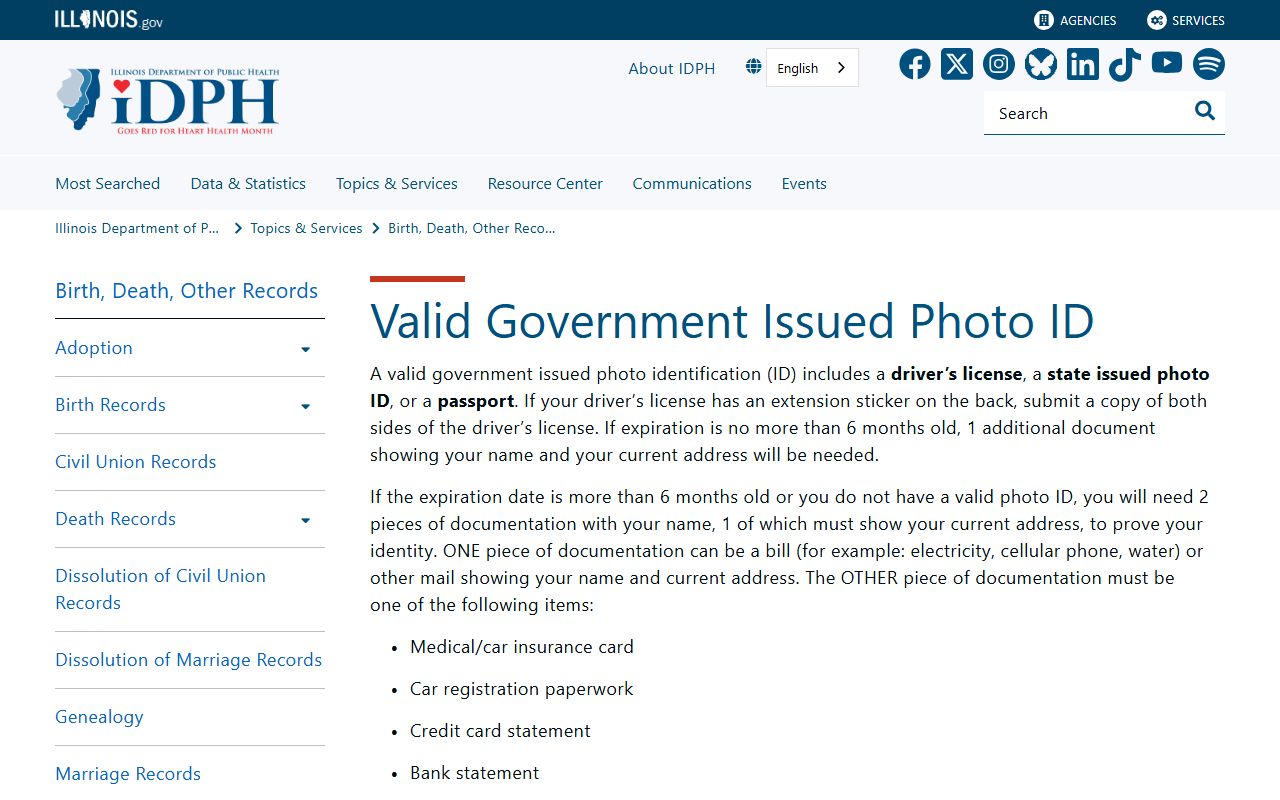
The IDPH valid ID page specifies which forms of identification are accepted with requests for dissolution of marriage records sent to the state office in Springfield.
Note: An IDPH verification is not the same as a certified court decree. For legal matters like name changes, estate filings, or remarriage documentation in certain jurisdictions, you need the certified copy from the Marion County Circuit Court Clerk in Salem.
Researching Older and Historical Records
Marion County divorce records from earlier eras may still be at the circuit clerk's office in Salem, or they may have been sent to the Illinois State Archives in Springfield. The Archives hold historical court records transferred from counties over many years. Call the Archives at (217) 782-4682 to find out whether records from a specific time period are in their collection and how to request access.
The Illinois State Genealogical Society maintains research guides and indexes that can help you track down older court records. Early Marion County divorces were typically entered in large bound docket books that were kept at the courthouse. Some of those records have been microfilmed. Regional libraries and genealogy collections in the Salem area may have finding aids or microfilm that can help you narrow down a search. Older records, particularly those from before 1920, were often indexed under the husband's name only, so searches can take more effort when you only know the wife's name.
Legal Help in Marion County
Residents who need assistance with a divorce case or have questions about court records have a few places to look. Land of Lincoln Legal Aid provides free civil legal help to income-qualifying individuals in southern Illinois, including Marion County. They handle family law matters such as divorce filings, modifications, and record access. For residents in the northern part of the county, Prairie State Legal Services may also be able to assist.
The clerk's office at 618/548-3856 can answer general procedural questions and explain fees, but staff cannot provide legal advice. People who represent themselves can find court forms on the Illinois Courts website. The Illinois Courts circuit clerk directory lists current contact information for all 102 Illinois county circuit clerks, which is useful when you need to find a case that may have been filed in a different county.
Cities in Marion County
Salem is the county seat with a population of approximately 7,000. Centralia, which sits partly in Marion County and partly in Clinton County, has around 13,000 residents. Neither city exceeds the qualifying population threshold for a dedicated city page. All divorce records for Marion County residents are handled through the circuit court clerk's office at 100 East Main Street in Salem, regardless of which community a person lives in.
Nearby Counties
Marion County sits in south-central Illinois, bordered by several counties that each maintain their own circuit court divorce records.