
Find Washington County Divorce Records
Washington County divorce records are on file at the Circuit Court Clerk's office in Nashville, Illinois, and cover every dissolution of marriage case decided in this county. This guide explains who holds those records, how to request them, what they contain, and where to go for statewide verification of Washington County divorce information.
Washington County at a Glance
Washington County Circuit Court Clerk
The Circuit Court Clerk in Nashville, Illinois serves as the official record keeper for all Washington County court cases, including divorces. This is not to be confused with Nashville, Tennessee. Washington County, Illinois is a rural county in the southern part of the state, and its seat is a small city that shares a name with the famous Tennessee city but operates entirely under Illinois law and jurisdiction.
When a petition for dissolution of marriage is filed in Washington County, the clerk's office in Nashville receives it, stamps it with the date, assigns a case number, and opens a file. That file grows throughout the case to include every motion, order, and agreement the parties and judge produce. The clerk's office holds the file permanently after the case closes.
You can reach the clerk by phone at (618) 327-4800. Staff can look up cases by name and tell you whether a record exists in the Washington County system. They can also give you the case number and describe what documents are in the file. For current mailing address and office hours, the Illinois Courts circuit clerk directory is the best place to confirm details before submitting a request. This directory is updated by the Illinois Supreme Court and is reliable for verifying clerk contact information statewide.
Note: Nashville, Illinois is a small community, and the clerk's office reflects that scale. Staff may be limited, so calling ahead before visiting saves time if your schedule is tight.
How to Search Washington County Divorce Records
Washington County does not operate a public online portal for court record searches. All searches go through the clerk's office in Nashville. You have three options: in person, by phone, or by mail. Each works, and the best choice depends on where you are, what you know about the case, and how quickly you need the information.
In-person visits to the courthouse in Nashville are the most productive if you need to review the file or order multiple documents. Bring a government-issued photo ID and the names of both parties. Staff will search the case index and, for public records, allow you to view the file and request copies. Copy fees apply, and the clerk can tell you the current rates when you arrive.
Calling first makes sense when you are not sure whether the case was filed in Washington County. A brief phone call can confirm whether a record exists without any travel involved. If the case is found, get the case number. That makes any subsequent request, whether in person or by mail, faster and more precise.
Mail requests work when distance makes an in-person visit impractical. Write to the Washington County Circuit Court Clerk in Nashville, include both party names, approximate dates, the case number if you have it, and specify what you need. Enclose payment for copy fees. If you are unsure of the exact amount, call first to ask. A self-addressed stamped envelope speeds up the return of documents.
Contents of a Washington County Divorce File
Divorce files in Washington County follow the same structure as those in every Illinois county, since state law governs the process uniformly. The petition for dissolution of marriage is always the first document. It names both spouses, identifies the grounds for dissolution (Illinois is a no-fault state under the Illinois Marriage and Dissolution of Marriage Act (750 ILCS 5)), identifies any children, and sets out what the petitioner is asking for. The other party's response follows.
Financial affidavits are required in all Illinois divorce cases. Both spouses must disclose income, assets, and debts. These disclosures are part of the public file unless a judge orders them sealed. Interim orders covering support or custody during the case are also part of the file. If the parties reach a property settlement agreement, that document is included as well.
The file closes when the judge enters the final judgment of dissolution of marriage. This document sets out the court's final decisions on all issues: property division, any maintenance award, and if applicable, parenting time and the allocation of parental responsibilities. The judgment is the document most often needed for legal purposes such as name changes, estate matters, or confirming marital status.
Note: Uncontested divorces where the parties agree on all issues typically produce thinner files than contested cases that went to hearing.
Verifying a Divorce Through IDPH
The Illinois Department of Public Health keeps a statewide index of divorces granted in Illinois going back to 1962. If you want a quick confirmation of whether a dissolution of marriage occurred, and you are not sure which county handled the case, the IDPH index is a good first stop. A search costs $5 and is processed by mail. The average turnaround time is four to six weeks.
IDPH sends a verification letter, not a certified copy of the court judgment. The letter confirms the basic facts: party names, date of the divorce, and the county where it was granted. For many purposes, this is all that is needed. But when a legal proceeding requires the actual certified judgment, you must request a copy from the Washington County Circuit Court Clerk in Nashville.
IDPH can be reached at (217) 782-6553. Their dissolution of marriage records page has current request forms and instructions. All IDPH requests require a valid government-issued photo ID.
The IDPH vital records page explains how to request a dissolution of marriage verification for Illinois divorces from 1962 through the present.
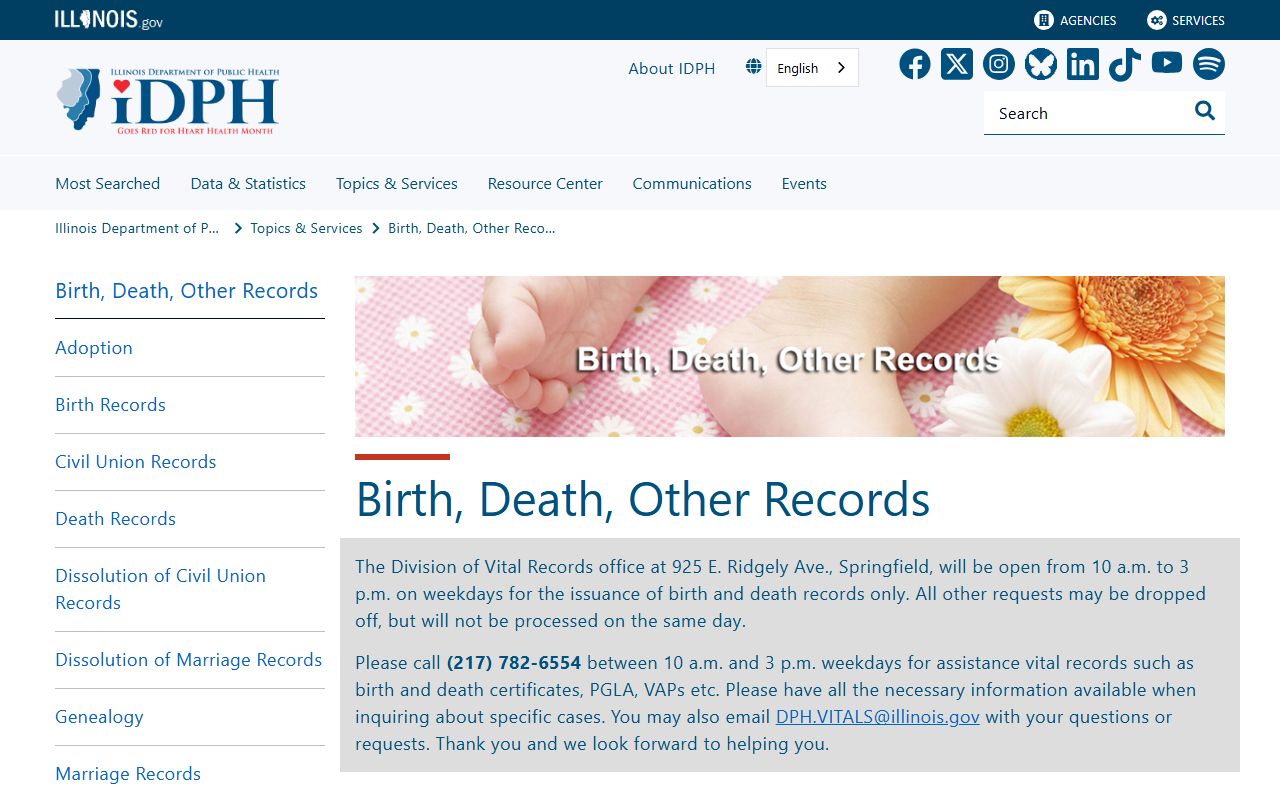
Requests can be submitted by mail with a $5 fee and a copy of a valid ID. Processing takes four to six weeks on average.
Illinois Law and Public Record Access
Illinois law makes most court records, including divorce records, available to the public. The Vital Records Act (410 ILCS 535) covers what IDPH collects and provides. Illinois Supreme Court rules and the Marriage and Dissolution of Marriage Act govern the court-side records. Under this framework, divorce records are presumptively public. Anyone can go to the Washington County Courthouse and request to see a divorce file.
Exceptions exist. Information about minor children may be partially redacted. Financial data containing Social Security numbers may be withheld. In unusual cases, a judge may seal a file entirely. These situations are uncommon in standard divorce cases. When a restriction applies, the clerk will let you know the basis for it and whether there is a process to seek access through the court.
Historical Records and Genealogy
Washington County was established in 1818 and has court records going back nearly two centuries. Older divorce files, particularly those predating the IDPH index that starts in 1962, are held at the courthouse in Nashville or may have been transferred to the Illinois State Archives. Search the Archives catalog at illinois.gov/ihpa/Archives to see what is available. The Illinois State Genealogical Society also provides resources and indexes useful for researching older Washington County family records.
Legal Aid and Resources
Land of Lincoln Legal Aid serves Washington County and provides free civil legal assistance to qualifying residents, including help with family law matters. The Illinois State Bar Association's lawyer referral service can connect you with a private family law attorney. Court forms for dissolution of marriage cases are available at no charge through the Illinois Courts website.
Neighboring Counties
If a divorce may have been filed in a county bordering Washington County, contact those circuit court clerks: