
Search Knox County Divorce Records
Knox County divorce records are kept by the Circuit Court Clerk in Galesburg and cover every dissolution of marriage case filed in the 9th Judicial Circuit for Knox County. This guide explains where to look up records, how to request copies, what the files include, and how Illinois law affects cases filed here.
County Overview
Knox County Circuit Court Clerk
Mary Ostrander serves as the Circuit Court Clerk for Knox County, operating out of 200 South Cherry Street in Galesburg. The clerk's office is the primary custodian of all court records in Knox County, including every divorce and dissolution of marriage case filed since the county's circuit court records began. Any time a dissolution petition is filed in Knox County, it becomes part of the clerk's permanent record.
The 9th Judicial Circuit is one of Illinois's larger circuits by geography. It covers Knox, Fulton, Peoria, Warren, Stark, Henderson, Mercer, Rock Island, and Henry counties. While each county has its own clerk's office, Knox County's records are held exclusively in Galesburg. You cannot obtain Knox County divorce records from a neighboring county's office. If you are unsure which county a case was filed in, start with where the petitioner lived at the time of filing.
The clerk's office can be reached by phone at 309/345-6719. Staff can confirm whether a case exists and what documents are available, but they typically cannot provide legal advice about the records or the proceedings they document. For copies of specific documents, you will need to either visit in person or submit a written request.
Ways to Look Up Divorce Cases
Searching Knox County divorce records starts with the clerk's office in Galesburg. In person is the most reliable method, especially for older cases that may not be indexed electronically. Bring as much identifying information as you can, including the full legal names of both parties and the year the divorce was finalized or filed. Case numbers speed things up considerably if you have one.
Online access varies by circuit in Illinois. The Illinois Courts clerk directory is a good starting point to check what the 9th Circuit currently offers online. The Knox County clerk's page at knoxcountyillinois.gov may also link to any available case search tools. Online access typically shows basic docket information, such as filing dates and case status, but does not always provide the actual documents.
Mail requests work too, though they take longer. Write to the clerk at 200 South Cherry Street, Galesburg, IL 61401. Include the names of both parties, the approximate filing year, and a daytime contact number. Ask for a fee schedule before submitting payment, since copy fees can vary depending on the number of pages and whether you need a certified copy.
Note: Older records from Knox County may have limited electronic availability, and in-person visits or mail requests may be the only option for cases filed before the court's digital systems were put in place.
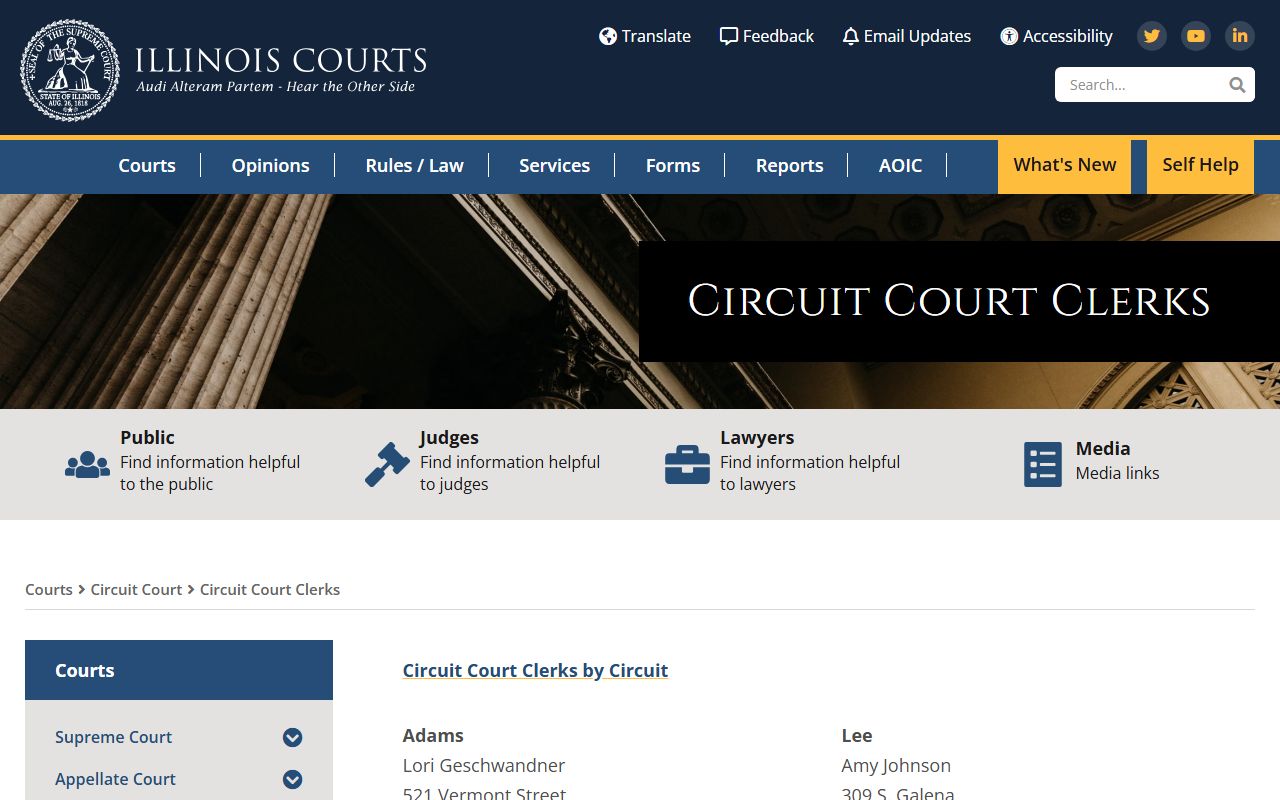
The Illinois Courts website lists all circuit court clerks by district and circuit, including the 9th Circuit clerk for Knox County.
What's Inside a Divorce File
A Knox County divorce record is more than just the final decree. The complete court file begins with the petition for dissolution of marriage and includes every document filed by either party during the case. That typically means financial affidavits, proof of service, court orders from any interim hearings, and the final judgment for dissolution of marriage signed by the judge.
Cases involving children will also include a parenting plan or custody agreement, child support worksheets, and any orders from guardianship proceedings if those were part of the case. Property division is handled through a marital settlement agreement, which is usually attached to or made part of the final decree. If either party filed motions to modify support or parenting time after the divorce was granted, those post-decree filings are also part of the court record and are searchable through the same clerk's office.
Some documents may be sealed. Courts can restrict access to records that involve sensitive financial information, minors, or other protected content. If a document you expect to find is not in the file, ask the clerk whether any portion of the case has been sealed.
Illinois Dissolution Law
Illinois handles divorce under the Illinois Marriage and Dissolution of Marriage Act, 750 ILCS 5. The state uses a no-fault framework, which means the only recognized ground for divorce is irreconcilable differences. Fault-based grounds like adultery or cruelty are no longer used in Illinois courts.
Before filing in Knox County, at least one spouse must have lived in Illinois for 90 days. That residency period is a condition of the court's jurisdiction over the case. The 90 days does not have to be continuous leading up to the filing date, but courts will look at whether the residency requirement is genuinely met.
Knox County's 9th Circuit judges apply the same substantive law as every other Illinois circuit. The major issues in most contested cases, such as division of marital property, spousal support, and allocation of parental responsibilities, are all decided under 750 ILCS 5. Knowing the statute is useful if you are trying to understand what a court order in a divorce file actually means.
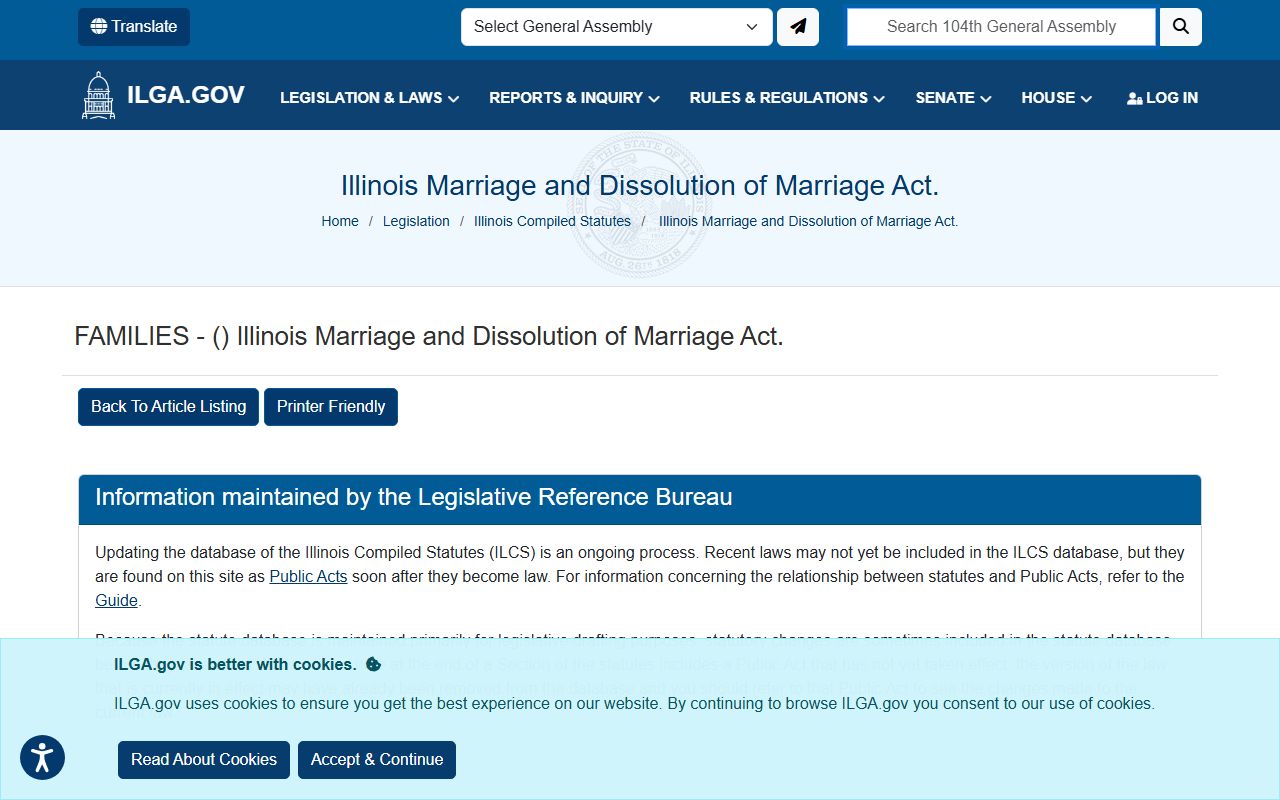
The Illinois General Assembly hosts the full text of 750 ILCS 5, the statute governing divorce law in Knox County and across the state.
Note: The Vital Records Act, 410 ILCS 535, governs the IDPH's role in tracking divorce records at the state level, separate from the circuit court clerk's file.
Getting a State Verification from IDPH
The Illinois Department of Public Health keeps a statewide index of divorces granted in Illinois from 1962 to the present. If you need a quick confirmation that a divorce occurred and don't need the actual court file, the IDPH offers a verification letter for $5. This letter confirms the state has a record of the dissolution but does not include the full case documents.
To request a verification, mail a written request to IDPH at 925 E. Ridgely Ave., Springfield, IL 62702. Call (217) 782-6553 with questions. Mail requests generally take four to six weeks. You will need the names of both parties, the approximate year the divorce was granted, and a valid government-issued photo ID. Details about what ID is accepted are on the IDPH valid ID page.
The full instructions for requesting a dissolution of marriage verification are on the IDPH dissolution records page. For divorces that happened before 1962, contact the Illinois State Archives at (217) 782-4682. Genealogy researchers can also try the Illinois State Genealogical Society for older records.
Cities in Knox County
Knox County has no city with a population over 50,000, so there are no city-level divorce records pages for this county. Galesburg is the county seat and largest city, with a population of around 31,000. Other communities in Knox County include Knoxville, Abingdon, Oneida, and Alexis. All divorce cases filed by residents of these towns are handled by the Circuit Court Clerk in Galesburg.
Nearby Counties
Knox County shares borders with several other Illinois counties, each with its own circuit court records for dissolution cases.