
Search Fulton County Divorce Records
Fulton County divorce records are filed with the Circuit Court Clerk in Lewistown, Illinois, where the 9th Judicial Circuit handles all dissolution of marriage cases for the county. This page explains how to find those records, what the files contain, how to request copies, and how the state health department's separate verification system works.
County Overview
About the Fulton County Circuit Clerk
Charlene Markley is the Circuit Court Clerk for Fulton County. Her office, located at 100 N. Main Street in Lewistown, is the legal custodian of every divorce case filed in the county. That includes the initial petition, all motions and orders entered during the case, and the final decree. The mailing address is P.O. Box 152, Lewistown, IL 61542-0152, which is worth noting if you plan to send documents or requests by mail.
Fulton County sits in the 9th Judicial Circuit, which also covers Knox, Peoria, Warren, and several other counties in west-central Illinois. A circuit judge handling family law matters in Fulton County applies the same state statutes as every other Illinois court, but the local docket and procedures can differ from those in neighboring circuits. The clerk's office at 309/547-3041 is the right first call if you have questions about how Fulton County handles specific filings.
Lewistown is a small community, and the courthouse serves a relatively rural county. Walk-in service is the norm, and staff tend to be reachable by phone. If you are planning a visit, it's worth calling ahead to confirm hours and whether the records you need are held onsite or have been archived.
Note: The clerk's mailing address and physical address differ, so double-check which one to use depending on whether you are mailing a request or showing up in person.
How to Find Fulton County Divorce Cases
In-person searches at the clerk's office in Lewistown are the most direct approach. Staff can look up cases by the names of the parties or by case number. Knowing the approximate filing year helps narrow the search, especially for older records that may not be in an electronic database. The office is at 100 N. Main Street, and you can call 309/547-3041 to confirm current walk-in hours before you go.
Mail requests are another option for people who can't travel to Lewistown. Write a letter that includes the full legal names of both parties, the approximate year the case was filed, and your contact information. Send it to P.O. Box 152, Lewistown, IL 61542-0152. Include payment for any applicable copy fees; call the office first to confirm the current fee schedule and accepted payment methods. Mail turnaround time depends on office volume and how easy the record is to locate.
The Illinois Courts website provides a statewide directory of circuit court clerks. You can use that directory to confirm contact details and see whether the 9th Circuit offers any online case search tools. The image below shows the statewide clerk directory page.
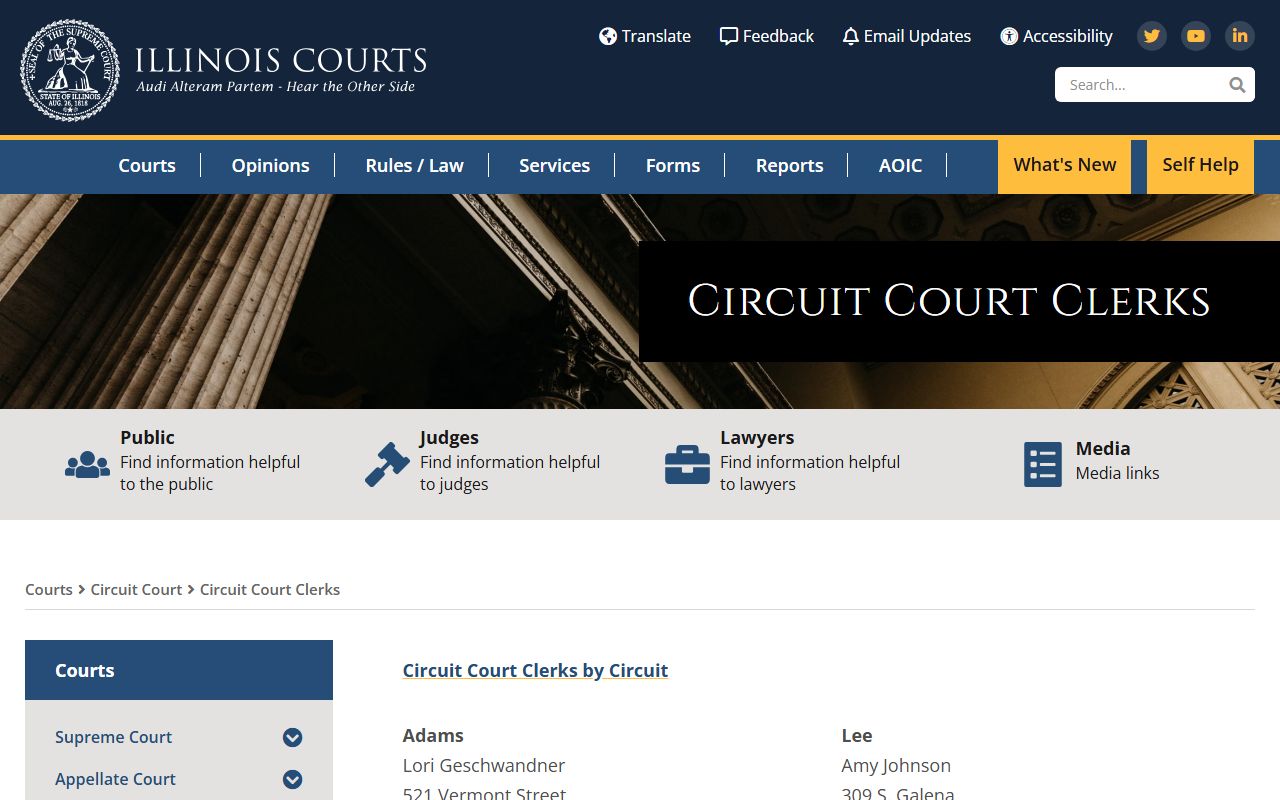
The Illinois Courts directory lists every circuit clerk in the state with contact details, including Fulton County's 9th Circuit clerk office.
Phone inquiries are sometimes enough to get basic case information. Call 309/547-3041 and ask whether staff can confirm a case by name and give you a case number. From there you can submit a formal request for copies. Not all offices handle phone lookups the same way, so follow up with written documentation if the phone inquiry does not give you everything you need.
What Divorce Records Contain
A divorce case file in Fulton County starts with the petition for dissolution of marriage and includes every document filed after that. The final piece is the judgment for dissolution of marriage, commonly called the divorce decree. That document officially ends the marriage and is often what people need years later for purposes like remarriage, name changes, Social Security claims, or estate matters.
Marital settlement agreements, which spell out how property and debts are divided, are usually part of the file. When the divorce involved children, you'll find parenting plans, child support orders, and any custody rulings the court made. Post-decree filings, such as motions to modify child support or parenting time, are separate cases in the same court system and are accessible through the same clerk's office.
Illinois courts can restrict access to certain documents. Records involving minor children may be limited, and judges can seal portions of a file on request. Financial disclosure forms filed during the case may also have restricted access. If a document you expect to find isn't turning up in a search, sealed or restricted status is worth asking about when you contact the clerk's office.
Illinois Statutes That Apply
Every divorce filed in Fulton County is governed by the Illinois Marriage and Dissolution of Marriage Act, 750 ILCS 5. This law defines the only recognized ground for divorce in Illinois, which is irreconcilable differences. It also sets out residency requirements, the rules for dividing marital property, and the standards courts use when deciding child custody, parenting time, and support.
At least one spouse must have lived in Illinois for 90 days before a case can be filed here. That requirement comes from 750 ILCS 5 and applies in Fulton County just as it does everywhere else in the state. There is no mandatory waiting period written into the statute, though the actual timeline from filing to final decree depends heavily on whether the case is contested and how full the local docket is.
The state's record of the divorce, separate from the court file, is maintained under the Vital Records Act, 410 ILCS 535. That statute gives the Illinois Department of Public Health authority to maintain a statewide index of divorces from 1962 forward and to issue verification letters confirming a dissolution took place.
Note: Property division in Illinois follows equitable distribution, meaning a judge divides marital property fairly but not automatically equally, based on the factors outlined in 750 ILCS 5.
State-Level Verification Through IDPH
The Illinois Department of Public Health has maintained records of divorces granted in Illinois since 1962. If you need only a basic confirmation that a divorce took place, IDPH offers a verification letter for $5. This is different from a certified court copy. The IDPH letter simply confirms the state has a record of the dissolution; it does not include the full case file or the details of the decree.
Send requests to 925 E. Ridgely Ave., Springfield, IL 62702, or call (217) 782-6553. Include both parties' names, the approximate year of the divorce, and a copy of a valid government-issued photo ID. The IDPH valid ID page lists acceptable forms. Mail requests typically take four to six weeks. The IDPH dissolution of marriage records page has the request form and current instructions.
Divorces from before 1962 are not in the IDPH index. Those older records may be held by the Illinois State Archives, reachable at (217) 782-4682 or via the Illinois Archives website. The Illinois State Genealogical Society can also help with historical research on Fulton County dissolution records.
Note: Confirm with whoever is requesting the record whether they need the IDPH verification letter or a certified copy of the actual court decree, since the two documents serve different purposes.
Cities in Fulton County
No city in Fulton County meets the 50,000-person population threshold for a dedicated divorce records page. Canton is the largest city in the county with roughly 14,000 residents. Lewistown, the county seat, has about 2,500 people. Other communities include Astoria, Ipava, Table Grove, and Vermont. All residents of Fulton County file divorce cases at the clerk's office in Lewistown regardless of which town they live in.
Nearby Counties
Fulton County shares borders with several other Illinois counties, each maintaining its own circuit court and divorce records. Contact those clerks directly for records from cases filed outside Fulton County.