
Christian County Divorce Records
Christian County divorce records are kept by the Circuit Court Clerk in Taylorville, Illinois, covering all dissolution of marriage cases handled in the 4th Judicial Circuit. This page covers how to access those records, what case files typically contain, how Illinois statutes shape the process, and how the Illinois Department of Public Health maintains a separate statewide verification index for divorces granted in Christian County.
County Overview
Circuit Court Clerk's Office in Taylorville
Jeffrey A. Voorhees is the Circuit Court Clerk for Christian County. His office at 101 South Main Street in Taylorville holds the official record of every divorce case filed in the county. The physical address is 101 South Main; for mail, use P.O. Box 617, Taylorville, IL 62568-0617. From the initial petition through the final decree and any later post-decree actions, all of those documents live in the clerk's office. Staff there can help you search for a case and explain how to get copies of specific documents.
Christian County is part of the 4th Judicial Circuit, which covers a number of counties in central Illinois. Dissolution of marriage cases in the county go before a circuit judge assigned to the family law docket in the 4th Circuit. Every filing passes through Jeffrey Voorhees's office, which serves as both the intake point and the permanent record-keeper for the case. The clerk's office is not a legal advice service, but staff can tell you what's in the system and walk you through the request process.
Reach the clerk's office at 217/824-4966 by phone or 217/824-5030 by fax. The clerk's website may list current office hours, any online search tools, and fee information. It is worth checking the website before you visit or mail a request to make sure you have the most current details.
Note: The mailing and physical addresses for the clerk's office differ, so make sure to use the P.O. Box for correspondence and the street address when visiting in person.
How to Search Christian County Divorce Cases
In-person visits to the clerk's office at 101 South Main in Taylorville are the most reliable way to find a specific divorce record. Staff can search by the names of the parties or by case number. Knowing the approximate year the case was filed helps staff locate the record faster, especially for older cases that may exist only in paper form. You can review records during your visit and request copies on the spot.
If traveling to Taylorville is not practical, a written mail request is a good alternative. Address your request to P.O. Box 617, Taylorville, IL 62568-0617. Include the full legal names of both parties, the approximate filing year, and contact information so staff can follow up if they have questions. Include payment for copy fees. Call 217/824-4966 before mailing to confirm what the current fees are and which payment methods the office accepts.
Quick phone inquiries can sometimes get you a case number or confirm that a record exists. Call 217/824-4966 and ask if staff can locate the case by party names. Once you have the case number, submitting a formal request for documents goes faster. For actual copies, you'll still need to either visit in person or mail a written request.
The Illinois Courts statewide directory covers all circuit court clerks, including those in the 4th Circuit. The image below shows the IDPH dissolution of marriage records page, which is part of the state's parallel record-keeping system separate from the court file.
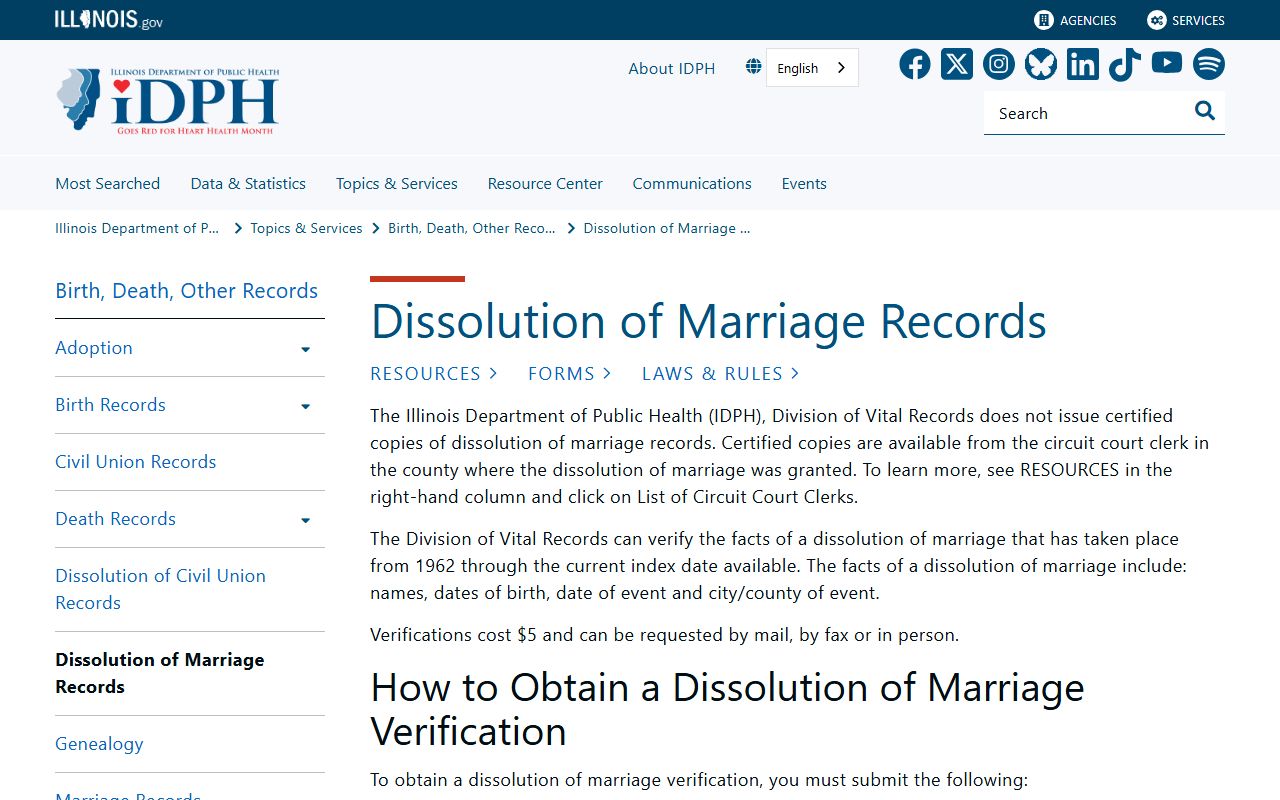
The IDPH dissolution of marriage records page shows how to request a state-level verification for a Christian County divorce, separate from the court records held by the clerk's office.
Documents in a Christian County Divorce File
A divorce file in Christian County starts with the petition for dissolution of marriage and builds from there. The key document at the end is the judgment for dissolution of marriage, commonly called the divorce decree. That order formally ends the marriage and is what most people are looking for when they contact the clerk's office years after the divorce was finalized. It's needed for name changes, remarriage licenses, estate matters, and various legal or financial transactions.
If the divorce involved shared property, a marital settlement agreement will be in the file, either incorporated into the decree or attached as a separate exhibit. That document covers how assets and debts were divided. Cases involving children will also have parenting plans, child support orders, and custody determinations. Any modifications to those original orders, filed after the case closed, are entered as post-decree motions and kept in the same court system under the original or a related case number.
Some parts of a divorce file are not open to everyone. Courts can seal documents, and records tied to minor children are often restricted. Financial disclosures filed during the case may carry access limits as well. If you search for a case and certain documents appear to be missing, ask the clerk's office whether any restrictions are in place on that specific file.
State Law Governing Christian County Divorces
Every dissolution of marriage filed in Christian County falls under the Illinois Marriage and Dissolution of Marriage Act, 750 ILCS 5. This is the core state statute on divorce. It defines grounds for dissolution, sets out residency requirements, and provides the framework courts use when dividing property, awarding support, and handling matters involving children. Illinois is no-fault. The only recognized ground is irreconcilable differences.
The residency requirement in 750 ILCS 5 requires that at least one spouse have lived in Illinois for 90 days before filing. That rule applies in Christian County as it does everywhere in the state. There is no mandatory waiting period built into the statute itself, though the actual timeline from filing to decree depends on the complexity of the case and the court's docket. Uncontested divorces, where both parties agree on all terms before filing, often move through the system much faster than contested cases.
Marital property division in Illinois is governed by equitable distribution. A judge decides how to divide assets and debts fairly, taking into account factors like the length of the marriage, each spouse's contribution, and their respective financial situations. Equitable does not always mean equal.
The state's vital records record of the dissolution, separate from the court file, is maintained under the Vital Records Act, 410 ILCS 535, which gives IDPH authority over the statewide divorce index.
Note: Spousal support, sometimes called maintenance, is also addressed in 750 ILCS 5, and whether a court awards it depends on factors specific to each case rather than a fixed formula.
IDPH Verification for Christian County Divorces
The Illinois Department of Public Health has kept track of divorces granted in Illinois since 1962. If you need a basic confirmation that a dissolution of marriage took place without getting the full court file, IDPH offers a verification letter for $5. This letter is not a certified copy of anything the court issued. It simply confirms that a record exists in the state's divorce index. For some purposes, that is all you need.
To request the letter, mail your information to 925 E. Ridgely Ave., Springfield, IL 62702, or call (217) 782-6553. Provide both parties' full legal names, the approximate year the divorce was granted in Christian County, and a copy of a valid government-issued photo ID. The IDPH valid ID page lists accepted forms of identification. The full request form and instructions are on the IDPH dissolution of marriage records page. Most mail requests take four to six weeks.
Divorces from before 1962 are not covered by the IDPH index. For older cases, contact the Illinois State Archives at (217) 782-4682 or visit the Illinois Archives website. The Illinois State Genealogical Society can also assist with older Christian County dissolution records research.
Note: The IDPH verification letter is separate from the certified court decree; make sure you know which document is required before requesting either one.
Cities in Christian County
No city in Christian County has a population of 50,000 or more, so there are no dedicated city-level divorce records pages for this county. Taylorville is the county seat and largest city, with around 10,500 residents, and it is where the Circuit Court Clerk's office is located. Other communities in the county include Kincaid, Pana, Morrisonville, and Edinburg. All county residents file divorce cases at the clerk's office in Taylorville.
Nearby Counties
Christian County sits in central Illinois and borders several counties, each with its own circuit court and clerk handling dissolution filings. If a case was filed in a neighboring county, contact that county's clerk directly.