
Access Whiteside County Divorce Records
Whiteside County divorce records are maintained by the 14th Judicial Circuit Clerk in Morrison, Illinois. All dissolution of marriage cases filed in the county are held by that office. This page explains how to search for records, what documents a typical case file includes, how Illinois law applies to divorces in Whiteside County, and where to get official copies or state-level verification.
County at a Glance
Whiteside County Circuit Clerk
Sue Scott serves as Circuit Clerk for Whiteside County. Her office in Morrison is the official keeper of all court records in the county, including every dissolution of marriage case that has been filed here. The Clerk's office accepts new petitions for filing, tracks cases from start to judgment, and provides records to those who need them. You can call the office, visit in person during courthouse hours, or check the county website for online search options.
Whiteside County is one of five counties in the 14th Judicial Circuit, which also covers Rock Island, Henry, Mercer, and Carroll counties in northwestern Illinois. Each county keeps its own records separately. A divorce filed in Whiteside County is held only in Morrison. You would not find Whiteside County filings at any other 14th Circuit county office.
Note: Morrison is a smaller county seat, and courthouse parking is generally available near the Knox Street address. Calling ahead before a visit can confirm current hours and any closures.
How to Search Whiteside County Divorce Records
The Circuit Clerk's website is a good place to start. Many Illinois clerks offer a public case lookup tool that lets you search by name or case number and view basic case information. Check the Whiteside County Clerk's site to see what online search options are currently available and whether in-person or mail requests are needed for document copies.
When you need official certified documents, you must request them from the Clerk's office. Certified copies carry the court's seal and are required by banks, government agencies, Social Security offices, and courts in other states when they need written proof of a divorce. The Clerk can tell you the current fee per page or per document and what payment methods are accepted. In-person requests are usually handled the fastest. Mail requests require a written request and payment, and turnaround time depends on office volume.
A case number makes searching easier. Illinois case numbers follow a standard format with the filing year and a case type code. Dissolution of marriage cases use a "D" code. Without a case number, Clerk staff can search by party names. If you have both full names and an approximate year the divorce was filed, the search goes much faster and reduces the chance of pulling the wrong case.
Note: Electronic records may not cover all past decades. Ask the Whiteside County Clerk's office how far back their digital case system goes if you are looking for an older filing.
What a Whiteside County Divorce File Contains
Divorce records in Whiteside County are public court records. What is in any given file depends on how complex the case was and whether the divorce was contested or agreed. A simple uncontested dissolution may have only a few pages. A heavily contested case can fill a large binder with motions, orders, transcripts, and financial exhibits.
A typical Whiteside County dissolution file includes the original petition for dissolution of marriage, the summons sent to the other party, proof that service was carried out, financial disclosure forms from both spouses, any motions either party submitted and the responses to those motions, temporary orders entered during the case for things like support or parenting time, a marital settlement agreement when both parties agreed on terms, a parenting plan if children are involved, and the final judgment of dissolution of marriage. If post-judgment motions were filed, such as motions to modify support or parenting time, those filings may also appear in the ongoing case record.
Illinois Divorce Law in Whiteside County
All divorce cases in Whiteside County are governed by the Illinois Marriage and Dissolution of Marriage Act (750 ILCS 5). Illinois is a no-fault divorce state. The only ground for dissolution is irreconcilable differences, as set out under 750 ILCS 5/401. This means neither spouse has to prove wrongdoing or fault. The court only needs to find that the marriage is broken and cannot be saved.
To file in Whiteside County, at least one spouse must meet the 90-day Illinois residency requirement under 750 ILCS 5/413. There is no mandatory waiting period or separation requirement in Illinois. Parties can file as soon as the decision to divorce is made, provided the residency rule is met. The court process then moves at whatever pace the case requires, which depends on whether it is contested and how many issues need to be resolved.
Property division in Illinois uses equitable distribution, not a strict equal split. Whiteside County judges weigh factors including the length of the marriage, each spouse's economic situation after the divorce, contributions each made to marital assets, and other statutory criteria. The same statute governs spousal maintenance and child support, with child support calculated using income-based guidelines set by the state. Contested cases can take longer to resolve because the judge must hold hearings and enter findings on each disputed issue.
IDPH Divorce Record Verification
The Illinois Department of Public Health keeps a statewide index of dissolution of marriage records going back to 1962. The index is a verification tool rather than a source of full case documents. A verification from IDPH confirms that a divorce occurred in Illinois, the county where it was filed, and approximately when. Government agencies, lenders, and foreign embassies commonly accept IDPH verification letters as proof of a prior divorce.
To request a verification, mail a written request and payment to the Division of Vital Records, 925 E. Ridgely Ave., Springfield, IL 62702. The fee is $5. You must include valid government-issued photo ID. Details on accepted ID types appear on the IDPH valid ID page. Reach the office by phone at (217) 782-6553. Mail processing typically takes 4 to 6 weeks.
Illinois Department of Public Health - Dissolution of Marriage Records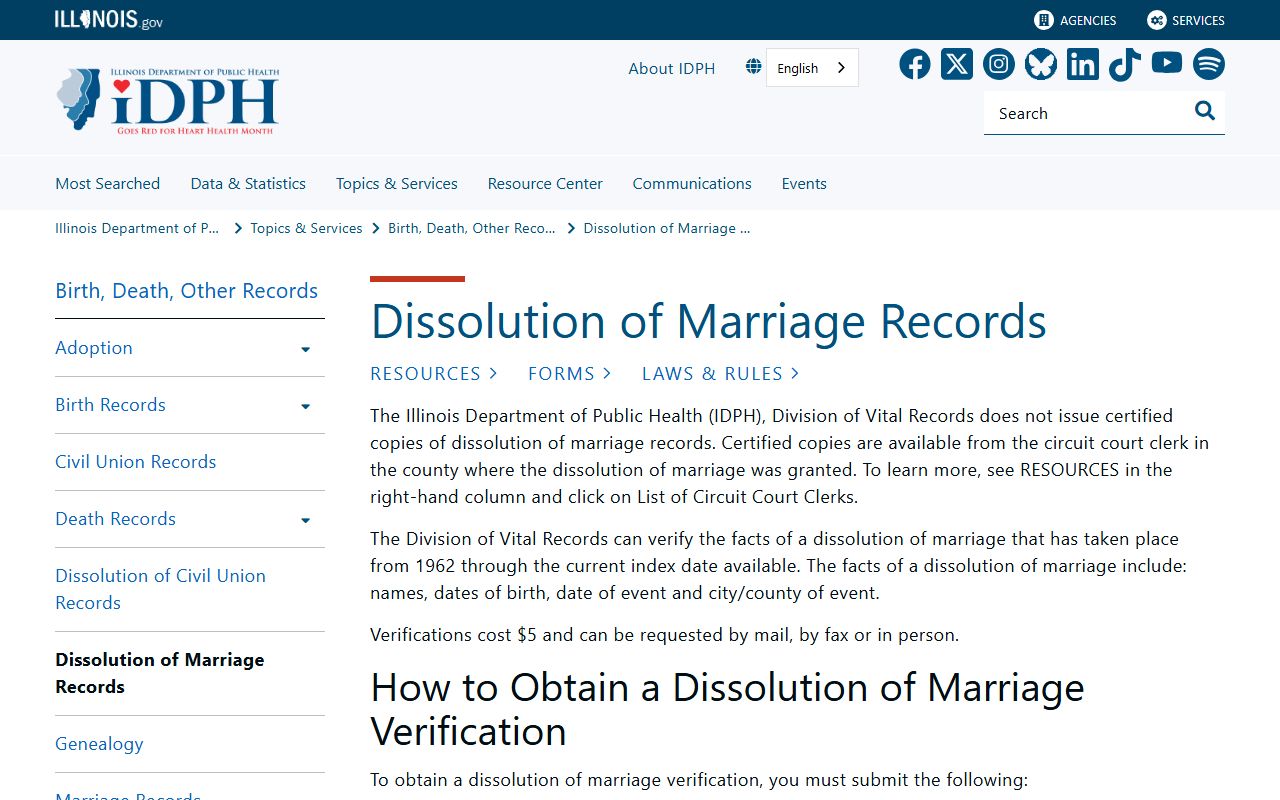
The IDPH page shown here explains what a dissolution of marriage verification includes and how to submit a request. If you need the actual divorce decree or other specific court documents from a Whiteside County case, you must contact the Circuit Clerk in Morrison.
Note: Divorces before 1962 are not in the IDPH index. For those older cases, contact the Whiteside County Circuit Clerk or the Illinois State Archives in Springfield.
Vital Records Act and Record Access
The Illinois Vital Records Act (410 ILCS 535) governs how vital records, including dissolution of marriage records, are maintained and accessed across Illinois. The Act establishes who can request records, what identification must be shown, and how agencies are to respond to access requests.
Illinois court records are public by default, but a judge can restrict access to specific portions of a case file. Common restricted items include financial affidavits with sensitive account information, records involving the welfare of minor children, and any documents sealed by court order. When you contact the Whiteside County Circuit Clerk, staff will tell you which sections of a particular file are available to the public and which require additional authorization. The Clerk follows the Vital Records Act and the local court rules for the 14th Judicial Circuit in handling these requests.
Historical Records and Genealogy
For Whiteside County divorces from many decades ago, the Clerk's office may hold only paper records, and some older materials may have been transferred to the state. The Illinois State Archives in Springfield can be reached at (217) 782-4682. Staff at the Archives can tell you whether older Whiteside County court records are held there or are still maintained at the Morrison courthouse.
The Illinois State Genealogical Society is another resource for researchers working on Whiteside County family history. The society provides guidance on finding historical court and vital records across all 102 Illinois counties. Local genealogical societies in northwestern Illinois and the Whiteside County public library may also hold index records, microfilm, and other materials useful for historical divorce research.
Illinois Courts Circuit Clerk Directory
The Illinois Courts website provides a directory of all circuit court clerks, organized by judicial district and circuit number. If you need to verify contact information for the Whiteside County Clerk or find clerks in other 14th Circuit counties, the directory is the most reliable source.
Illinois Courts - Circuit Court Clerks Directory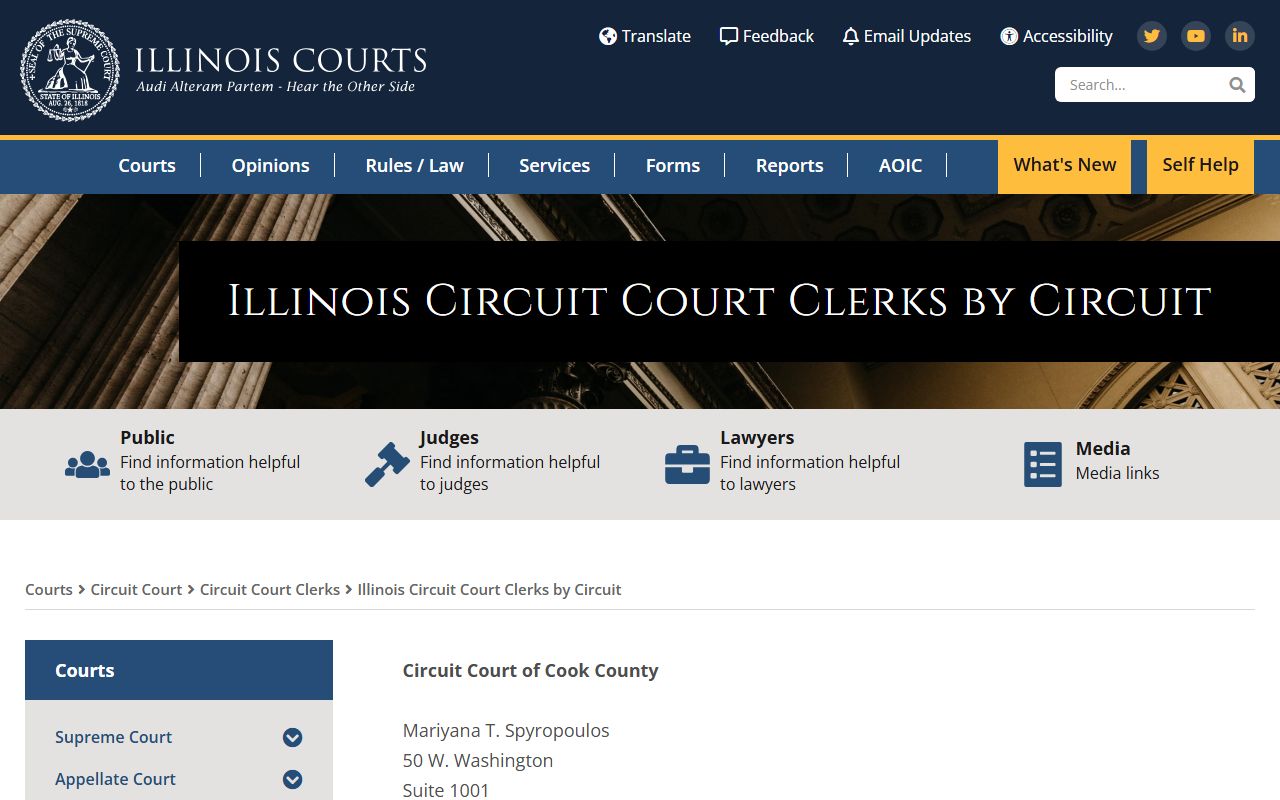
Whiteside County appears under the 14th Judicial Circuit in the directory. The listing includes the clerk's current contact information and a link to the county court website, so you can confirm details before calling or visiting.
Cities in Whiteside County
No city in Whiteside County reaches the 100,000-resident threshold, so the county does not have separate city-level divorce records pages. Sterling is the largest city with around 15,000 residents, and Rock Falls has roughly 9,000. Other communities in the county include Morrison (the county seat), Prophetstown, and Erie. Divorce records for residents of all Whiteside County communities are filed and held at the Circuit Clerk's office in Morrison.
Nearby Counties
If a case may have been filed in a county that borders Whiteside, the links below connect you to those circuit clerk offices. Whiteside County borders Carroll to the north, Lee and Ogle to the east, Henry to the south, and Rock Island County to the southwest. Iowa lies across the Mississippi River to the west.