
Rock Island County Divorce Records
Rock Island County divorce records are maintained by the Circuit Court Clerk for the 14th Judicial Circuit and cover every dissolution of marriage case filed in the county. This page explains how to search for cases, request copies of filed documents, and verify records through state and local channels. The Clerk's office in Rock Island city is the main point of contact for all court-filed divorce matters in the county.
County at a Glance
Circuit Court Clerk Office
Tammy Weikert serves as the Circuit Court Clerk for Rock Island County. Her office is the official keeper of all divorce case filings in the county, including petitions, judgments, decrees, and related orders. The main office sits at 1317 3rd Avenue in Rock Island. Mailing should go to the P.O. Box address listed below.
| Clerk | Tammy Weikert |
|---|---|
| Mailing Address | P.O. Box 5230, Rock Island, IL 61201-5230 |
| Physical Address | 1317 3rd Avenue, Rock Island, IL 61201 |
| Phone | (309) 558-3538 |
| Fax | (309) 786-3029 |
| Website | rockislandcounty.org/189/Circuit-Clerk |
| Judicial Circuit | 14th Judicial Circuit |
The 14th Judicial Circuit covers Rock Island, Whiteside, Henry, Mercer, and Carroll counties. Rock Island County is the most populous of the five, so the clerk's office here handles the largest share of dissolution filings in the circuit. If you are not certain which county a case was filed in, the Clerk can help confirm based on the party names and approximate year.
Office hours are standard business hours on weekdays. If you plan to visit in person, call ahead to confirm current hours and whether staff can pull older archived files the same day. Some older cases may require additional time to retrieve from storage.
Note: The physical courthouse at 1317 3rd Avenue is where in-person file inspections and copy requests take place. The P.O. Box is for mail only.Searching for Divorce Cases
There are a few ways to find Rock Island County divorce records. The method that works best depends on what you already know and what you need from the record.
The Rock Island County Circuit Clerk's website is the first place to check for online access. Many Illinois circuit courts have made basic case search available online, and you can look up a case by party name or case number. This gives you filing dates, case status, and the list of documents on record. It does not let you download full document images in most cases, so you will still need to contact the Clerk if you need a copy of the actual decree or any filed pleadings.
In-person searches are the most reliable way to get full records. Visit the courthouse at 1317 3rd Avenue with a valid photo ID. Staff can search by name or case number and pull the file. If the case is relatively recent, the file may still be in the courthouse. Older cases are archived. Bring the case number if you have it. If you only have names and an approximate year, staff can still search, though it may take a bit longer. Copy fees apply to any documents you take.
Mail requests are an option if you cannot come in person. Write to the P.O. Box address and include both party names, the approximate filing year, and a check or money order for the copy fee. Include a self-addressed stamped envelope. Processing time varies depending on how busy the office is and whether the file needs to be retrieved from off-site storage.
The Illinois Courts website maintains a directory of all circuit court clerks, including Rock Island County, with current contact details.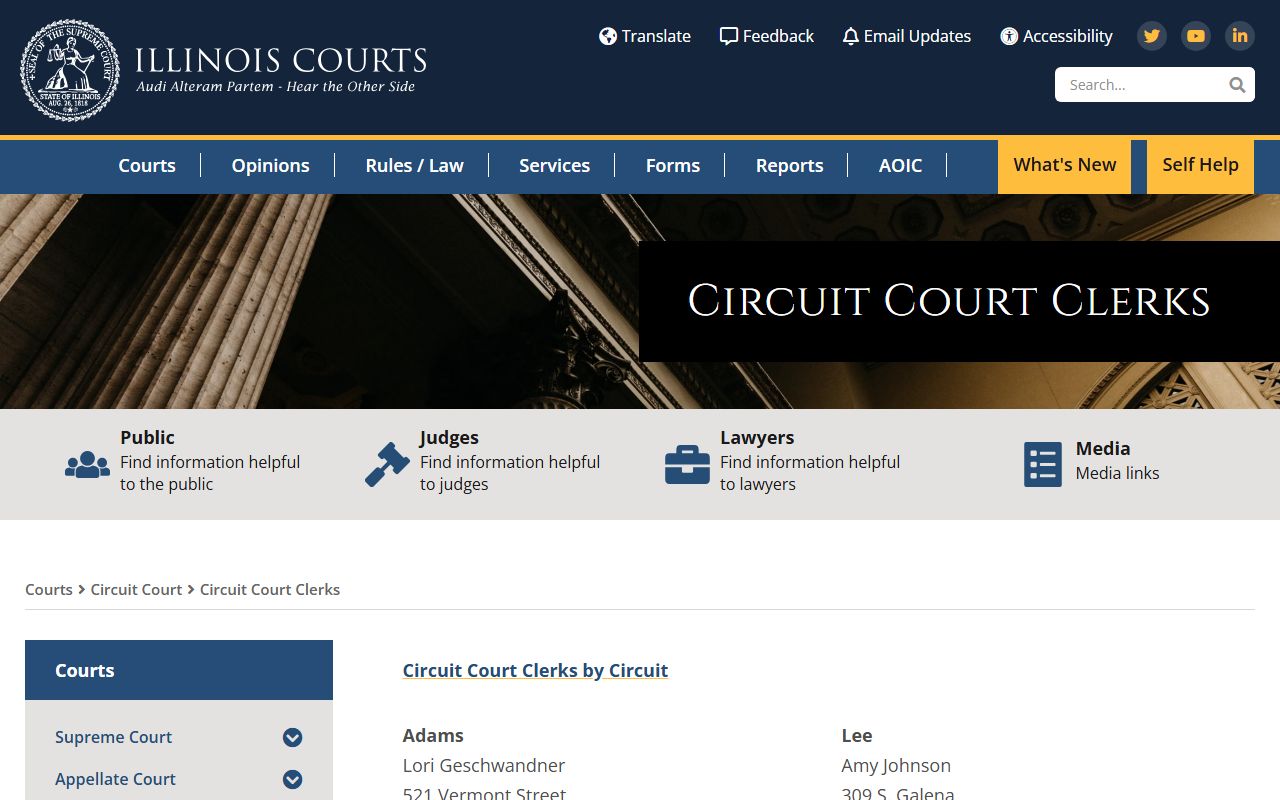 That directory is useful if you need to reach the Clerk by phone before making a trip to the courthouse.
Illinois Divorce Law Overview
Illinois is a no-fault divorce state. The only recognized ground for dissolution of marriage is irreconcilable differences, as established under 750 ILCS 5 of the Illinois Marriage and Dissolution of Marriage Act. Fault-based grounds were removed from Illinois law in 2016. Courts now presume irreconcilable differences if spouses have lived apart for at least six months before the judgment is entered.
One spouse must have lived in Illinois for at least 90 days before filing. Cases are filed in the county where at least one spouse resides. In Rock Island County, that means filing with Tammy Weikert's office at the 14th Circuit courthouse. If both spouses have left the state since the divorce, the records still remain at the court where the case was filed.
A final divorce judgment in Illinois is called a judgment for dissolution of marriage. It sets out the legal end of the marriage, property division terms, spousal support if ordered, and any parenting plan when children are involved. All of these items become part of the public court record and can be accessed through the Clerk's office.
Note: The six-month separation period is a presumption, not a hard waiting rule. Courts can find irreconcilable differences without the full six months if both parties agree.State-Level Verification Through IDPH
The Illinois Department of Public Health keeps a statewide index of dissolution of marriage records going back to 1962. IDPH does not issue certified copies of divorce decrees. Instead, they provide verifications: official letters confirming that a dissolution record for two named individuals exists in their files.
A verification costs $5 per search. Send your written request to IDPH Division of Vital Records, 925 E. Ridgely Ave., Springfield, IL 62702. You can also call them at (217) 782-6553 to ask about the process before mailing. Allow four to six weeks for mail requests to be processed. Provide the full names of both parties and the approximate year of the divorce so staff can locate the record.
IDPH verification is useful when you need a quick confirmation that a divorce happened and do not need the full case file. It is commonly used for administrative purposes such as updating a name on a government ID. For actual certified copies of the decree or any court orders, you need to go through the Rock Island County Circuit Court Clerk directly.
The IDPH page on dissolution of marriage records lays out what a verification includes and how to submit a request.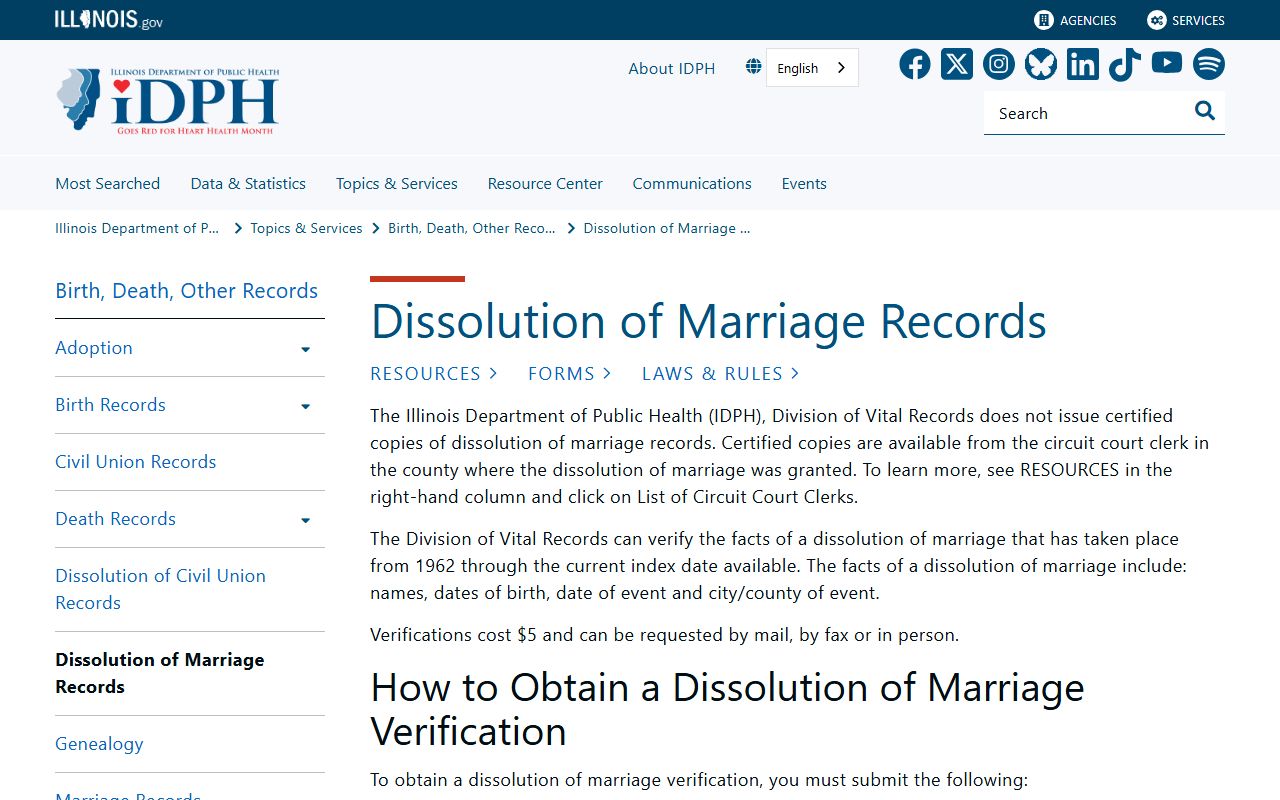 The page also notes that verifications reflect only what is in the IDPH index and may not capture every case, particularly older ones from before 1962.
What the Records Include
A Rock Island County divorce file can range from a thin folder to a large binder, depending on whether the case was contested. An uncontested dissolution with no children and minimal assets may consist of just the petition, a settlement agreement, and the final judgment. A contested case involving property disputes or a parenting plan fight can run to hundreds of pages.
The core documents in any divorce file are the petition for dissolution, the proof of service on the other spouse, any financial disclosures filed by either party, and the final judgment for dissolution of marriage. Cases involving children will also include a parenting plan, any agreed or ordered child support worksheet, and sometimes a guardian ad litem report. Temporary orders entered during the case, such as a temporary support or possession order, are also kept in the file.
Some items may be sealed or restricted. Minor children's personal information, certain financial data, and records that a judge ordered sealed are not publicly accessible. If you request a copy and find some pages missing or blacked out, that is standard practice. The Clerk can tell you which documents are available for public inspection.
Legal and Research Resources
If you need help understanding the divorce process or finding legal assistance in Rock Island County, a few resources are worth knowing. The Illinois Courts website lists all circuit clerks and can help if you need to reach another county's records office. The state courts site also links to self-help resources for people who are not represented by an attorney.
The Illinois State Archives at (217) 782-4682 holds some older court records and may be useful for historical research going back before the IDPH index starts in 1962. The Illinois Genealogical Society is another useful contact for people tracing family history through old court records. They can point you toward county-level historical collections that may not appear in online databases.
For those needing legal aid, Rock Island County is served by Prairie State Legal Services, which provides civil legal help to low-income residents. The Illinois Courts self-help center can also direct you to forms and guidance for unrepresented filers. Check the 14th Circuit's website for any locally available court forms specific to Rock Island County.
Note: Forms and procedures can change. Always confirm current requirements with the Clerk's office before filing or submitting a records request.Cities in Rock Island County
Rock Island County has several cities, but none currently exceed the population threshold for a dedicated records page. Rock Island city, Moline, and East Moline are the largest communities in the county. All divorce filings for residents of these cities go through the same Circuit Court Clerk's office at 1317 3rd Avenue.
Nearby Counties
Rock Island County borders Iowa to the west and several Illinois counties. If you are not certain where a divorce was filed, check these neighboring county pages: