
St. Clair County Divorce Records
St. Clair County divorce records are held by the 20th Judicial Circuit Court and managed through the Circuit Court Clerk's office in Belleville. This page covers how to search, request, and verify dissolution of marriage records filed in St. Clair County, along with the state-level options available through Illinois Department of Public Health.
County Overview
How to Search St. Clair County Divorce Records
The Circuit Court Clerk's office at 10 Public Square in Belleville is the primary place to search for St. Clair County divorce records. The clerk maintains case files for all dissolution of marriage proceedings filed within the county. You can visit in person during normal business hours, call the office at 618/277-6832, or check the clerk's website for any online case search tools that may be available.
When you search in person, bring the full names of both parties and an approximate filing year if you know it. The clerk's staff can look up cases by party name or case number. Certified copies of divorce decrees and other court documents are available for a fee set by the clerk's office. Plain (uncertified) copies cost less but carry no official stamp. If you need a document for legal purposes, always ask for a certified copy.
The 20th Judicial Circuit covers both St. Clair and Monroe counties. If you are not sure which county a case was filed in, start with St. Clair, since Belleville is the larger seat and most cases in the area go through this office.
The St. Clair County Circuit Court Clerk handles all divorce case filings and records requests for the 20th Judicial Circuit.
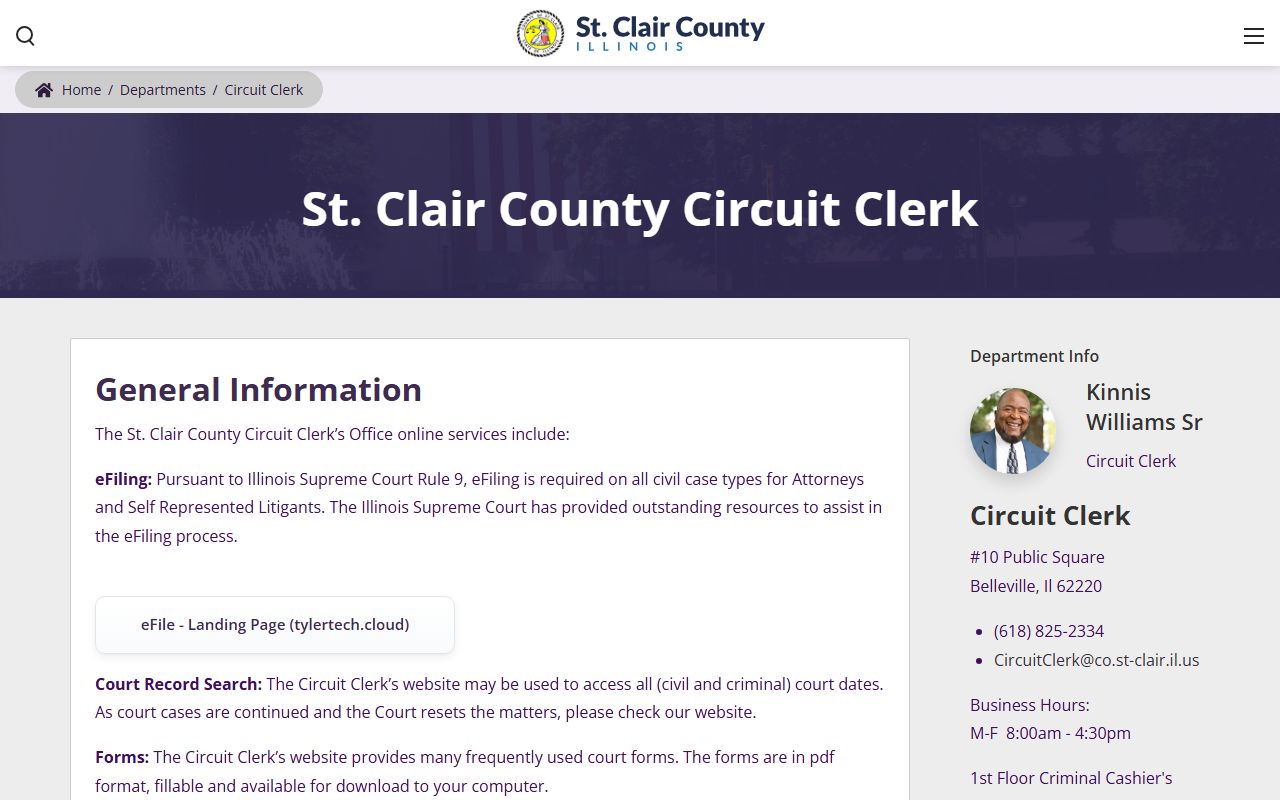
Note: Online case search availability may change. Always confirm current options directly with the clerk's office before making a trip.
What St. Clair County Divorce Records Contain
A divorce case file in St. Clair County typically holds the original petition for dissolution of marriage, any responses filed by the other party, financial disclosure forms, parenting plans or custody agreements if children are involved, and the final judgment of dissolution. Property settlement agreements and any orders related to support are also part of the record. The file may span many documents if the case was contested.
The final decree is the most requested document. It states that the marriage is legally dissolved, sets the date, and outlines the terms agreed to or ordered by the court. You will need this document to change your name, update financial accounts, or handle other legal matters after a divorce is complete. The clerk's office can provide a certified copy on request.
Case records that are sealed or subject to a protective order are not available to the public. Most divorce cases in Illinois are civil matters and the files are open unless a judge has restricted access to specific documents.
Note: Some older cases from the 1960s through 1980s may be stored off-site. Allow extra time when requesting documents from those years.
Illinois Law on Divorce
Illinois divorce law falls under the Illinois Marriage and Dissolution of Marriage Act (750 ILCS 5). The state uses a no-fault approach. The only ground for divorce in Illinois is irreconcilable differences. Neither spouse needs to prove fault by the other party.
Under 750 ILCS 5/413, at least one spouse must have lived in Illinois for 90 days before filing. St. Clair County is the proper place to file if either party lives there. Once filed, the case proceeds through the 20th Judicial Circuit and a judge in Belleville will handle the matter. If both parties agree on all issues, an uncontested case can resolve relatively quickly. Contested cases involving property or children take longer.
The Illinois Vital Records Act (410 ILCS 535) governs the collection and release of vital statistics, including divorce data sent from courts to the state. Courts are required to report dissolutions to the Illinois Department of Public Health.
State-Level Verification Through IDPH
The Illinois Department of Public Health maintains a statewide index of divorces granted in Illinois from 1962 to the present. IDPH does not issue certified copies of divorce decrees. What they offer is a verification letter that confirms a dissolution of marriage occurred. This is different from a full copy of the case file.
To request a verification, contact IDPH at 925 E. Ridgely Avenue, Springfield, IL 62702, or call (217) 782-6553. The fee is $5 per search. Mail requests typically take four to six weeks to process. Online and in-person options may also be available. See the IDPH dissolution of marriage records page for current details and the required form.
You will need to provide a valid government-issued photo ID with your request. IDPH uses this to confirm your identity before releasing any record information.
The Illinois Department of Public Health provides statewide dissolution of marriage verifications dating back to 1962.
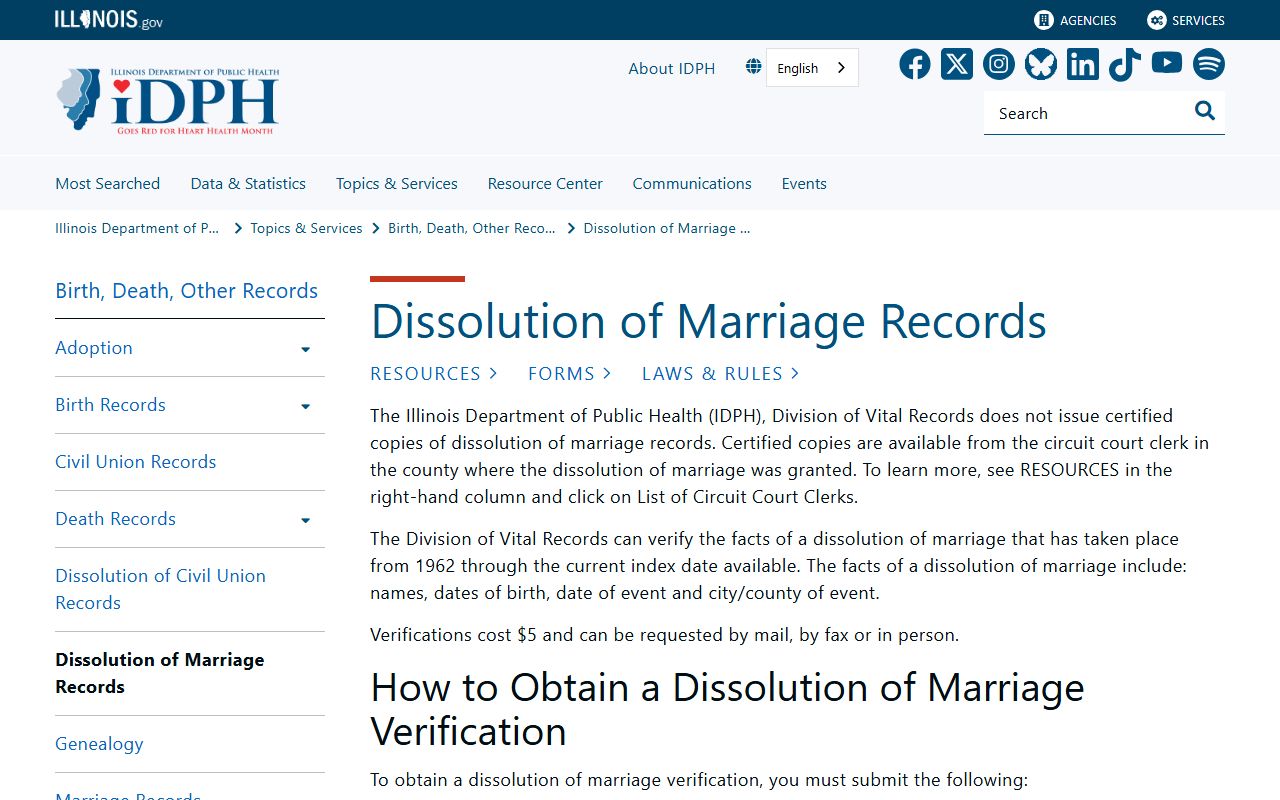
Note: IDPH verifications are not the same as certified court copies. If you need the actual decree, request it from the St. Clair County Circuit Court Clerk.
Genealogy and Historical Research
Researchers looking for older St. Clair County divorce records have a few options beyond the clerk's office. The Illinois State Archives holds historical court records that have been transferred from counties over time. The Archives can be reached at (217) 782-4682 or through the Illinois State Archives website. Not all county records have been transferred, so check with the clerk first.
The Illinois State Genealogical Society is another resource. They maintain indexes and guides to help researchers locate records across the state. Divorce records from the late 1800s through the mid-1900s can sometimes be found in older court docket books, which the clerk or the archives may hold in physical form. Microfilm copies of some records exist at regional libraries as well.
Legal Help in St. Clair County
If you need legal advice about a divorce case or help understanding a court record, several resources serve St. Clair County residents. Land of Lincoln Legal Aid provides free civil legal services to people who qualify based on income. Prairie State Legal Services also covers parts of the metro east region. Both organizations can help with family law questions.
The Illinois Courts website includes a directory of circuit court clerks for all counties. You can find updated contact information for the St. Clair County clerk and other nearby clerks through that directory.
Self-represented litigants can find Illinois divorce forms and guides on the Illinois Courts website. The clerk's office can tell you which forms are used locally, though staff cannot give legal advice.
Cities in St. Clair County
No cities in St. Clair County meet the 100,000 population threshold for individual city pages. Belleville (approximately 42,000 residents) and O'Fallon (approximately 35,000 residents) are the largest municipalities. Divorce records for both cities are handled through the Circuit Court Clerk in Belleville.
Nearby Counties
St. Clair County borders several counties in southwestern Illinois. Each has its own circuit court clerk handling divorce records.