
Find Divorce Records in Morgan County
Morgan County divorce records are held by the Circuit Court Clerk in Jacksonville, Illinois, covering all dissolution of marriage proceedings handled in the 7th Judicial Circuit. This page walks through how to access those records, what they typically include, the applicable Illinois statutes, and how the state health department's separate divorce index works for Morgan County filings.
County Overview
The Circuit Court Clerk's Role
Jennifer Bonjean serves as Circuit Court Clerk for Morgan County. Her office at 300 W. State Street in Jacksonville holds the official record of every divorce case filed in the county. From the initial petition through the final decree and any later modifications, the clerk's office is where you go to find Morgan County dissolution records. The office is not a law firm and cannot give legal advice, but staff can tell you what exists in the system and how to get copies.
Morgan County is part of the 7th Judicial Circuit, which is one of the larger circuits in downstate Illinois. It covers Morgan, Sangamon, Macoupin, Greene, Jersey, Scott, Cass, and Menard counties. Family law cases in Morgan County are heard by a circuit judge assigned to that docket. All filings for those cases go through Jennifer Bonjean's office, which acts as the gatekeeper and record-keeper for the entire case history.
The phone number for the clerk's office is 217/243-5419. You can reach the fax at 217/243-2009. The clerk's website may list current hours, any online search tools, and updated information about fees or procedures. It's worth checking the site before you make a trip to Jacksonville.
Searching for Morgan County Divorce Cases
The most straightforward way to find a divorce record in Morgan County is to visit the clerk's office in person. The office is at 300 W. State Street in Jacksonville. Staff can search by the names of the parties or by case number. If you have an approximate filing year, that will help narrow the results quickly. In-person visits also let you review documents on the spot and request copies right away.
If an in-person visit is not practical, you can send a written request by mail. Include the full legal names of both parties, the approximate year the case was filed, and a daytime phone number or return address for the response. Send payment for copy fees along with your request. Call 217/243-5419 first to confirm the current fee schedule and accepted payment methods. Mail turnaround time varies based on workload at the office.
The Illinois Courts site maintains a directory of all circuit court clerks across the state. The image below shows that directory, which is a useful resource for confirming contact details and finding out what online access options each circuit currently offers.
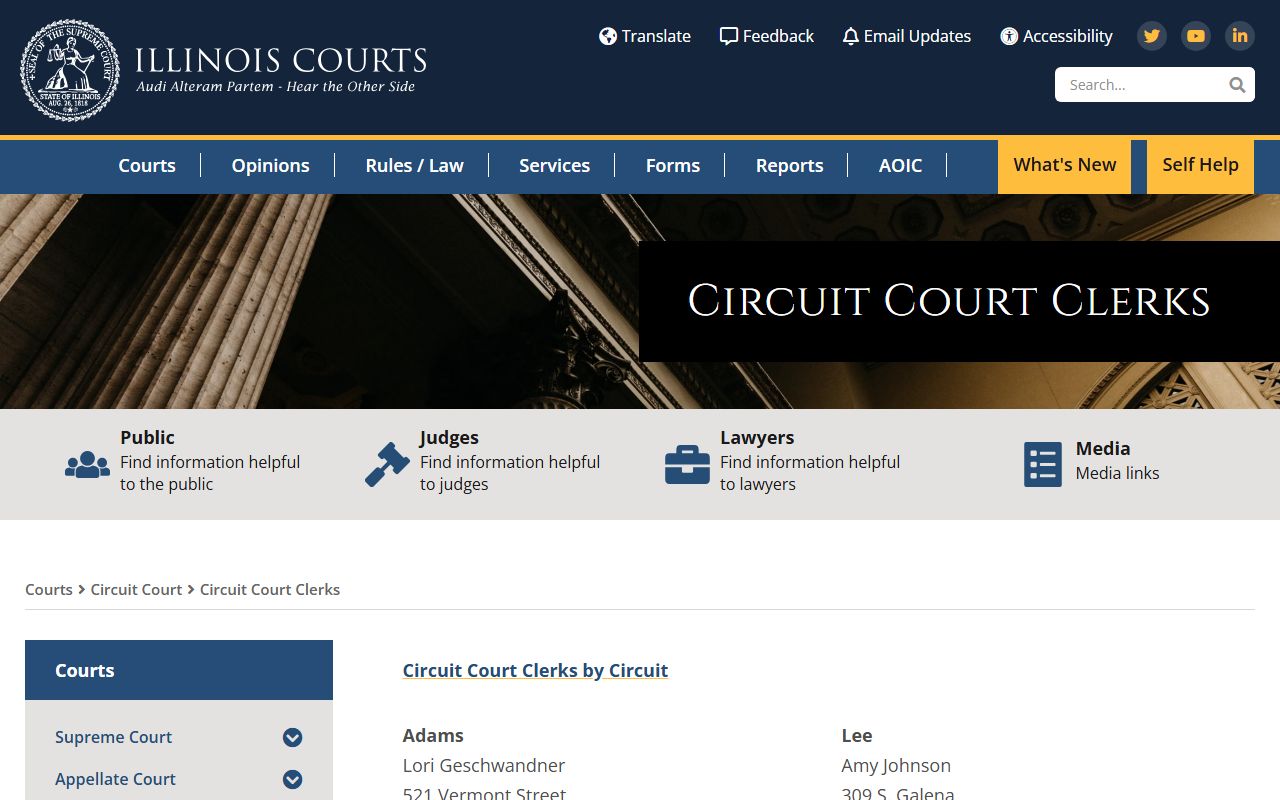
The Illinois Courts clerk directory is a good starting point for confirming the 7th Circuit's contact details and available search tools before submitting a request.
Phone inquiries can sometimes resolve basic questions. Call 217/243-5419 and ask if staff can confirm a case exists by party name. In some cases they can give you a case number over the phone, which speeds up any follow-up request. That said, document requests generally need to be made in writing or in person.
Documents Found in a Divorce File
A Morgan County divorce file opens with the petition for dissolution of marriage. It then grows to include responses from the other party, any temporary orders entered during the case, and eventually the final judgment for dissolution of marriage. That final judgment, or divorce decree, is the key document. It is what formally ends the marriage and is often needed years later for legal, financial, or administrative purposes.
Property and debt division terms appear in the marital settlement agreement, which is usually incorporated into the final decree. Cases that involved children will have parenting plans, child support orders, and custody decisions in the file. If either party returned to court after the original case closed to modify support or parenting arrangements, those motions and orders are filed as separate post-decree matters but remain accessible through the same clerk's office.
Not every page of a divorce file is open to the general public. Financial disclosure statements, records involving minor children, and documents sealed by court order may be restricted or unavailable to outside parties. If you search for a case and find that certain documents are missing, contact the clerk's office to ask about any restrictions on that specific file.
Note: Certified copies of the divorce decree are typically needed for legal transactions; uncertified copies are usually cheaper but may not be accepted by banks, courts, or government agencies.
Illinois Divorce Law Basics
Divorce cases in Morgan County are governed by the Illinois Marriage and Dissolution of Marriage Act, 750 ILCS 5. This is the main statute covering grounds for divorce, residency requirements, property division, and rules for child-related matters. Illinois is a no-fault divorce state. The only recognized ground is irreconcilable differences, meaning neither party has to prove wrongdoing to get a divorce.
The residency rule requires that at least one spouse live in Illinois for 90 days before filing. That rule applies in Morgan County the same as everywhere else in the state. Once a case is filed, how long it takes to reach a final decree depends on whether both parties agree on the terms. Uncontested cases move faster. Contested ones, especially those involving disputes over property, support, or children, can take considerably longer.
Records at the state level fall under the Vital Records Act, 410 ILCS 535, which authorizes the Illinois Department of Public Health to maintain a statewide divorce index separate from the court record system.
IDPH Verification for Morgan County Divorces
The Illinois Department of Public Health has tracked divorces granted in the state since 1962. If you only need to confirm that a divorce occurred rather than get the full court file, IDPH provides a verification letter for $5. This letter is not a certified copy of anything the court issued; it just confirms the state has a record of the dissolution. For many purposes, that confirmation is enough.
To request the letter, mail your information to 925 E. Ridgely Ave., Springfield, IL 62702, or call (217) 782-6553. Include the names of both parties and the approximate year the divorce was granted in Morgan County. You also need to submit a copy of a valid government-issued photo ID. The IDPH valid ID page lists what forms of ID are accepted. The IDPH dissolution of marriage records page has the current request form and instructions. Mail requests take roughly four to six weeks.
For divorces before 1962, the Illinois State Archives holds older records. You can reach the archives at (217) 782-4682 or through the Illinois Archives website. The Illinois State Genealogical Society is also a resource for older Morgan County records research.
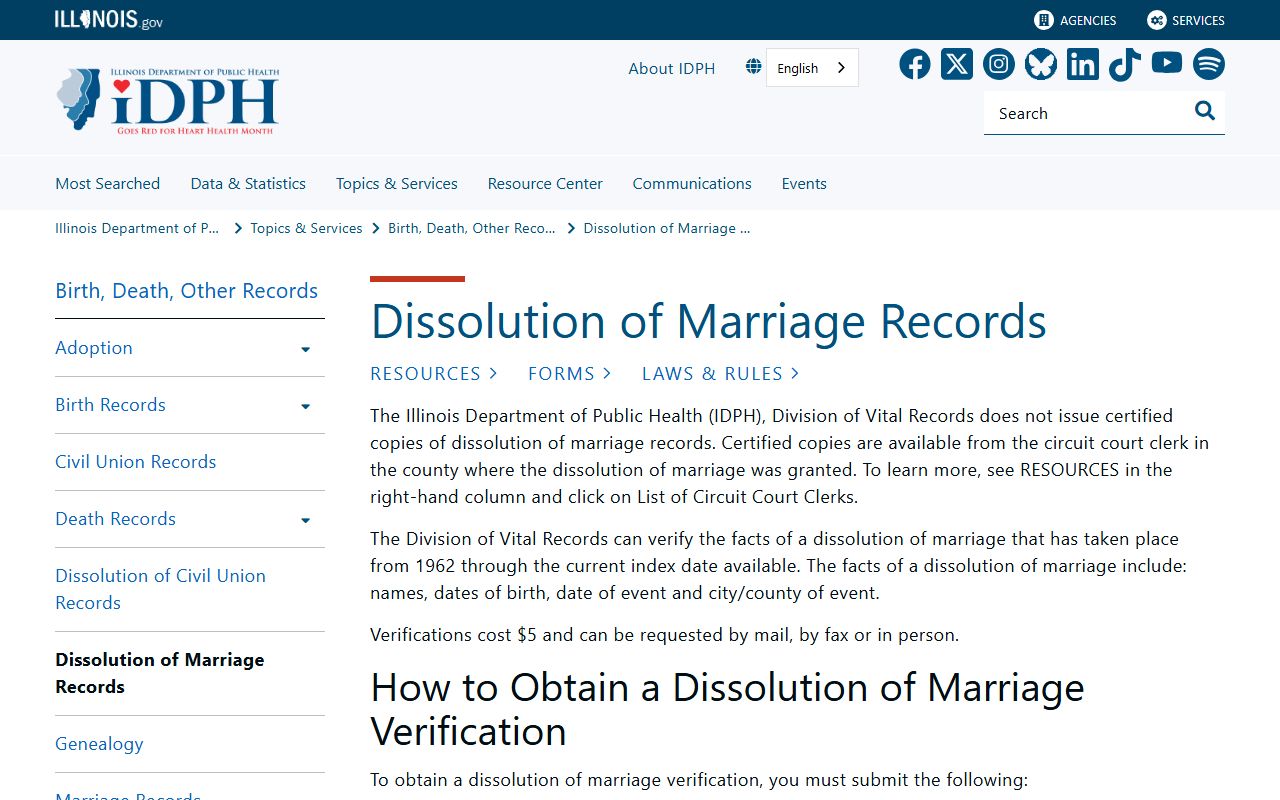
The IDPH dissolution of marriage records page provides the request form and instructions for getting a state verification letter for a Morgan County divorce.
Note: Pre-1962 divorces are not in the IDPH index at all; for those older cases, the Illinois State Archives or the Morgan County clerk's historical records are the right places to look.
Cities in Morgan County
Morgan County has no city with a population over 50,000, so no city-level divorce records pages exist for this county. Jacksonville is the county seat and largest city, with around 19,000 residents, and it is where the courthouse and clerk's office are located. Other communities in the county include Waverly, Franklin, Chapin, and Murrayville. Everyone in the county files dissolution cases at the clerk's office on State Street in Jacksonville.
Nearby Counties
Morgan County is surrounded by several Illinois counties, each with its own circuit court handling divorce filings. If a case was filed outside Morgan County, contact the clerk in the relevant county for records.