
Search Greene County Divorce Records
Greene County divorce records are filed with and maintained by the Circuit Court Clerk in Carrollton, Illinois, as part of the 7th Judicial Circuit. This page explains how to search dissolution of marriage records from Greene County, what those case files hold, what Illinois statutes govern the process, and how the IDPH state verification system works for confirming a divorce on record in this county.
County Overview
The Circuit Court Clerk in Carrollton
The Circuit Court Clerk in Carrollton is the official custodian of Greene County's divorce records. All dissolution of marriage cases filed in this county are managed by that office, from the initial petition through the final decree and any post-decree proceedings. The clerk maintains both the physical case files and whatever electronic records the 7th Circuit has built for public or internal access.
Greene County is part of the 7th Judicial Circuit, which covers several counties in west-central Illinois including Sangamon, which contains the state capital. Each county in the circuit runs its own clerk's office. The Carrollton office handles only Greene County filings, so records from this county are not mixed with those from Morgan, Scott, or other neighboring counties in the circuit.
To reach the Greene County clerk, call 217/942-3421 during regular business hours. Staff can tell you whether a specific case is on file, what documents are available, and what fees apply for copies or certifications. For an updated address and any links to online access tools, the Illinois Courts circuit court clerk directory lists current information for every county in the state.
Note: Some small counties in the 7th Circuit may have limited online access, so calling the clerk before visiting or mailing a request is always a good first step.
How to Search Greene County Records
Visiting the clerk's office in Carrollton in person is the most direct route. Staff can search by party name or case number. Give them the full names of both parties and the approximate year the case was filed and they can usually locate the record quickly. Certified copies can be prepared while you wait in most situations.
Mail requests work if you can't make the trip to Carrollton. Write to the Greene County Circuit Court Clerk with the full names of both parties, the approximate filing year, your return address, and a contact phone number. Include payment for any fees the office charges for copies or certifications. Processing times vary and can take several weeks, so plan accordingly if you have a deadline.
Whether online search access exists for Greene County records depends on what the 7th Circuit has built out. Some Illinois circuits have public portal access; others do not. Check the Illinois Courts directory for any links to Greene County tools, or call 217/942-3421 and ask directly. The clerk's office can tell you in one phone call what your options are for remote access.
For cases where the county of filing is uncertain, the IDPH statewide index covering 1962 to the present is a useful tool to confirm where a case was filed. That can save you from sending a request to the wrong county clerk.
Contents of a Dissolution Case File
A Greene County divorce file starts with the petition for dissolution of marriage and grows as the case moves through the court. Standard contents include the summons, any answer or counter-petition from the other spouse, financial disclosure statements, temporary orders entered while the case was pending, and ultimately the final judgment for dissolution of marriage. The final judgment is what most people need. It is the signed court order from the 7th Circuit judge that legally ends the marriage and addresses property, support, and parenting.
Property-related documents are common in cases involving a marital home, retirement accounts, or significant debts. Settlement agreements, deeds, QDRO orders, and debt allocation orders often appear as attachments to or as part of the final judgment. Cases with minor children include additional documents: a parenting plan or allocation of parental responsibilities, child support worksheets, and any agreed or ordered modifications to those arrangements after the original case closed.
Note: Documents sealed by court order will not show up in a public records search; if you believe a document should be in the file but is not visible, ask the clerk's staff about the record's status.
Illinois Divorce Laws and Statutes
All divorce proceedings in Greene County are governed by the Illinois Marriage and Dissolution of Marriage Act, 750 ILCS 5. This statute covers the entire framework for divorce in Illinois: the only recognized ground, which is irreconcilable differences; the 90-day residency requirement before filing; how courts divide marital property; how maintenance is determined; how child support is calculated; and how parental responsibilities are allocated when children are involved.
Illinois dropped fault-based grounds for divorce when it modernized 750 ILCS 5. Today, only irreconcilable differences is recognized, and the statute provides that this ground is established when the marriage has broken down irretrievably. Courts do not require either spouse to prove the other did something wrong. There is no mandatory post-filing waiting period, though uncontested cases generally resolve faster than contested ones.
The Vital Records Act, 410 ILCS 535, is the statute that authorizes IDPH to collect and maintain the statewide divorce index. That system is separate from the circuit court records the clerk holds.
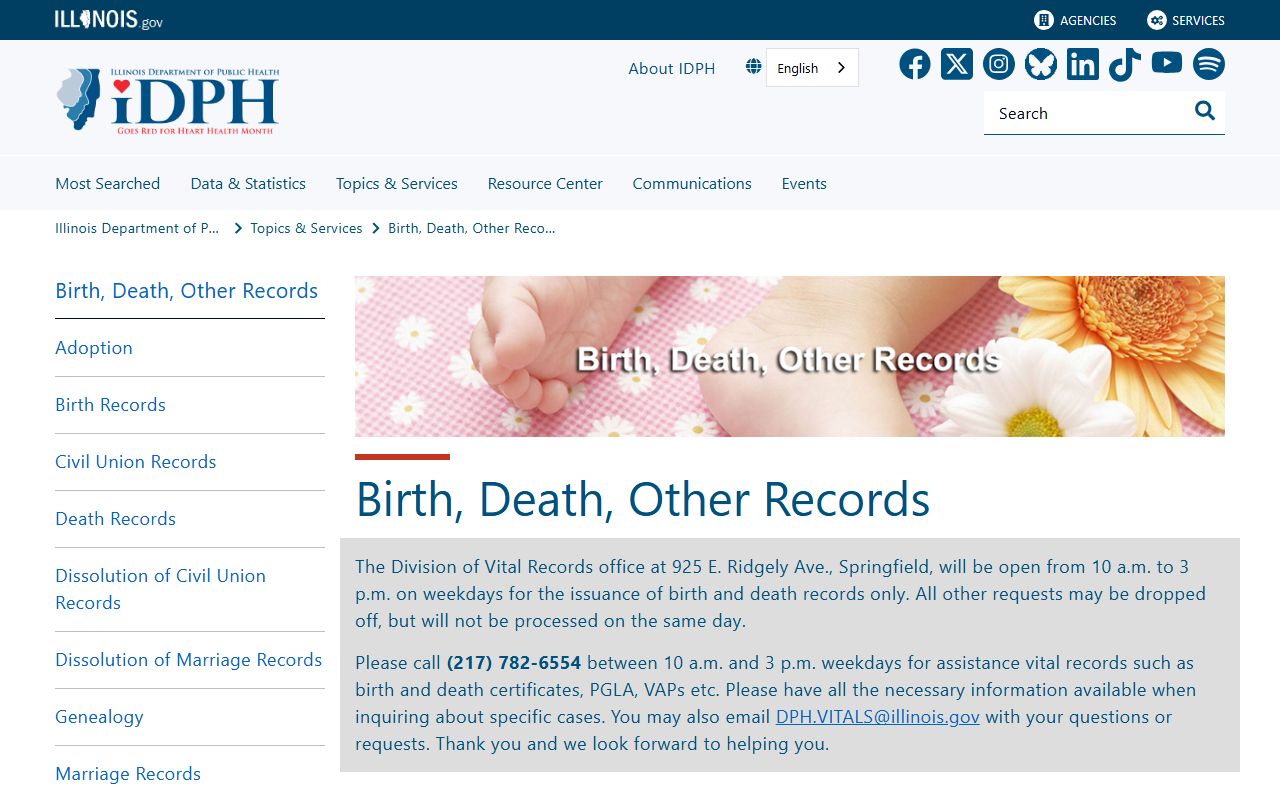
The IDPH vital records page covers the state's dissolution of marriage records index, which includes divorces granted in Illinois from 1962 to the present, including those filed in Greene County.
IDPH State Verification Records
The Illinois Department of Public Health offers a $5 verification letter for divorces in its statewide index, which covers divorces granted from 1962 to the present. This letter confirms the state has a record of the dissolution. It is not a court-certified copy, and it does not reproduce the terms of the decree. But for many purposes, such as confirming marital status with a government agency or updating a name on federal records, the verification letter is enough.
Mail your request to IDPH at 925 E. Ridgely Ave., Springfield, IL 62702. Include the names of both parties, the year the divorce was granted, your return address, and a copy of a valid government-issued photo ID per the requirements on the IDPH valid ID page. Call (217) 782-6553 with questions. Processing takes about four to six weeks for mail requests. Full instructions and the form are on the IDPH dissolution of marriage records page.
Pre-1962 divorces are not in the IDPH system. For older records, contact the Illinois State Archives at (217) 782-4682 or visit the Illinois Archives website. The Illinois State Genealogical Society can also help with research into older dissolution records in Greene County and nearby areas of west-central Illinois.
Note: IDPH verification letters are separate from and serve different purposes than certified copies from the Circuit Court Clerk; check which one is needed for your situation before submitting a request.
Cities in Greene County
No city in Greene County has a population over the threshold for a dedicated records page. Carrollton is the county seat and is where the Circuit Court Clerk's office handles all divorce filings in the county. White Hall is the other main community in Greene County. All residents file dissolution of marriage cases at the clerk's office in Carrollton.
Nearby Counties
Greene County is surrounded by several other Illinois counties in the west-central part of the state. Each has its own circuit court managing local divorce filings.