
Access McLean County Divorce Records
McLean County divorce records are kept by the 11th Judicial Circuit Court Clerk in Bloomington, Illinois. The clerk's office at 104 West Front Street handles all dissolution of marriage filings for the county, including requests for certified copies and case searches. This page explains how to find McLean County divorce records at the local courthouse and through the Illinois Department of Public Health's statewide system.
County at a Glance
Requesting Divorce Records from the Circuit Court
Donald R. Everhart, Jr. serves as circuit clerk for McLean County. His office at 104 West Front Street, Room 404 in Bloomington is where all county divorce records are filed and stored. You can reach the clerk by phone at 309/888-5301 or visit the office website at mcleancountyil.gov to see what online access options are available.
To search for a record, bring the full names of one or both parties and an approximate filing year if you have it. The clerk's staff can look up the case by party name or docket number. Once the case is found, you can order plain or certified copies of documents. Certified copies cost more but are required for legal purposes. Ask what the current fees are at the time you make your request, since copy costs can change.
The 11th Judicial Circuit covers McLean, Livingston, Ford, De Witt, and Woodford counties. If you are not sure which county a case was filed in, contact the clerk's office in Bloomington first, especially if one party lived in the Bloomington-Normal area.
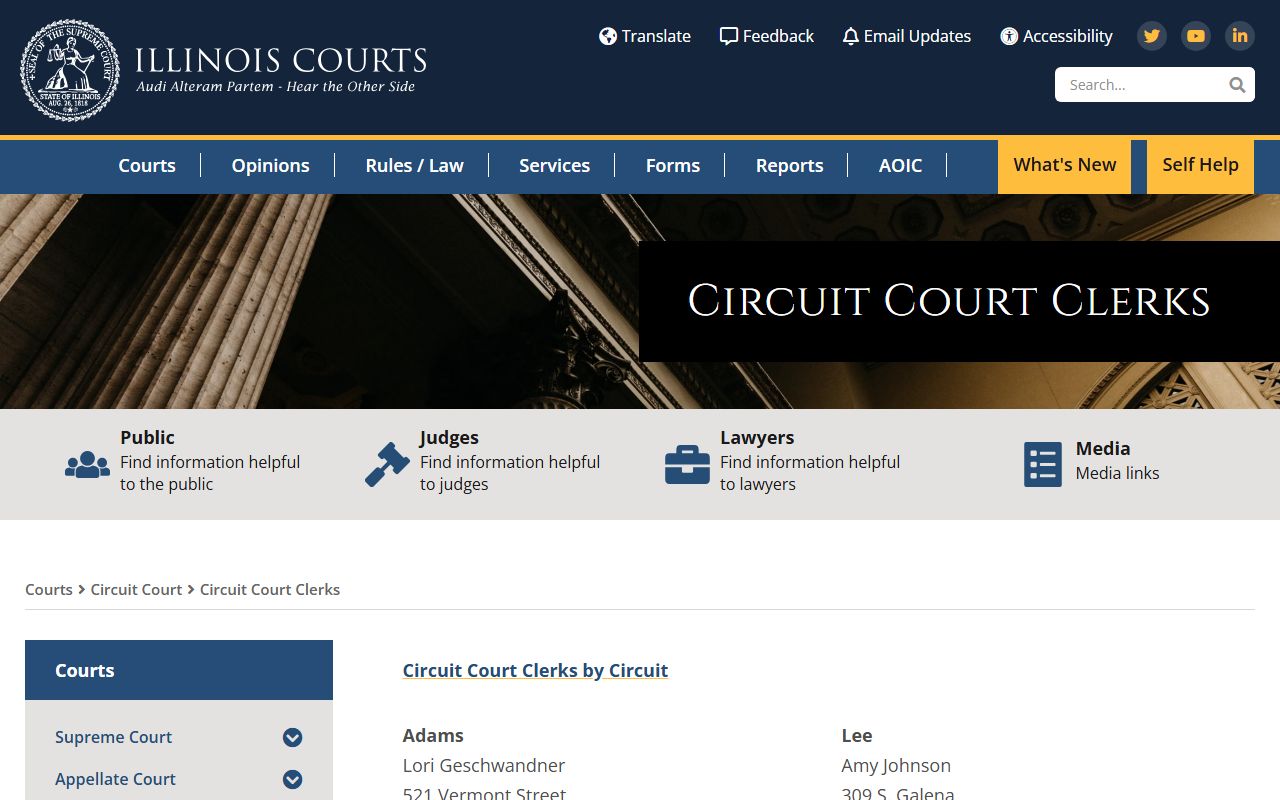
The Illinois Courts website provides a directory of all circuit court clerks, including the McLean County clerk in Bloomington.
Note: Online case search tools differ by county. Confirm what is available with the McLean County clerk before relying on web-based lookup for your research.
What McLean County Divorce Records Contain
A typical McLean County divorce case file includes the original petition for dissolution of marriage, the response from the other party, any motions filed during the case, financial disclosure affidavits, parenting allocation agreements or plans if children are involved, and the final judgment of dissolution. The final decree is the key document. It sets the date the marriage was legally dissolved and outlines any binding court orders on property, support, or parenting.
Files from contested cases, where the spouses disagreed on property division or child-related issues, are generally larger. They can contain hearing transcripts, exhibits, expert reports, and multiple interim court orders. Uncontested cases where both sides reached an agreement quickly tend to be shorter. Both kinds are public records. Access is open to the general public unless a court order has restricted specific documents.
Later modifications to a decree, such as changes to a support amount or parenting time schedule, are filed with the same case number and become part of the existing case record. The clerk can pull up both the original case and any post-decree filings when you make your request.
Note: Certain documents in cases involving children may be restricted. The clerk can advise you on what is publicly accessible in a specific file.
How Illinois Divorce Law Works
Illinois law on divorce falls under the Illinois Marriage and Dissolution of Marriage Act (750 ILCS 5). The state uses a no-fault system. Irreconcilable differences is the only ground for divorce. There is no need to show fault by either spouse. The law only asks that the marriage has broken down with no real chance of repair.
The 90-day residency rule under 750 ILCS 5/413 requires that at least one spouse have lived in Illinois for 90 days before filing. If that condition is met and one party lives in McLean County, the case is filed here and handled by a 11th Judicial Circuit judge in Bloomington. Cases where both parties agree on everything can move through the system in a matter of months. Contested cases that involve disputed property or parenting issues take longer and may require several court appearances before a final decree is entered.
All dissolutions must be reported to the state under the Illinois Vital Records Act (410 ILCS 535). This requirement is what allows the Illinois Department of Public Health to maintain a statewide index of divorce records going back to 1962.
Statewide IDPH Verification
The Illinois Department of Public Health runs a statewide dissolution of marriage verification service. Their index covers Illinois divorces from 1962 to the present. An IDPH verification confirms that a dissolution record exists in the state system for a named individual. It is not the same as a court-certified copy of the decree. For the full legal document, you need to go to the McLean County Circuit Court Clerk.
To request a verification, contact IDPH at 925 E. Ridgely Avenue, Springfield, IL 62702, or call (217) 782-6553. The fee is $5 per search and mail processing typically takes four to six weeks. Full details are on the IDPH dissolution of marriage records page. You must include a valid government-issued photo ID with every request.
The IDPH dissolution of marriage service complements local county court records by providing statewide verification going back to 1962.
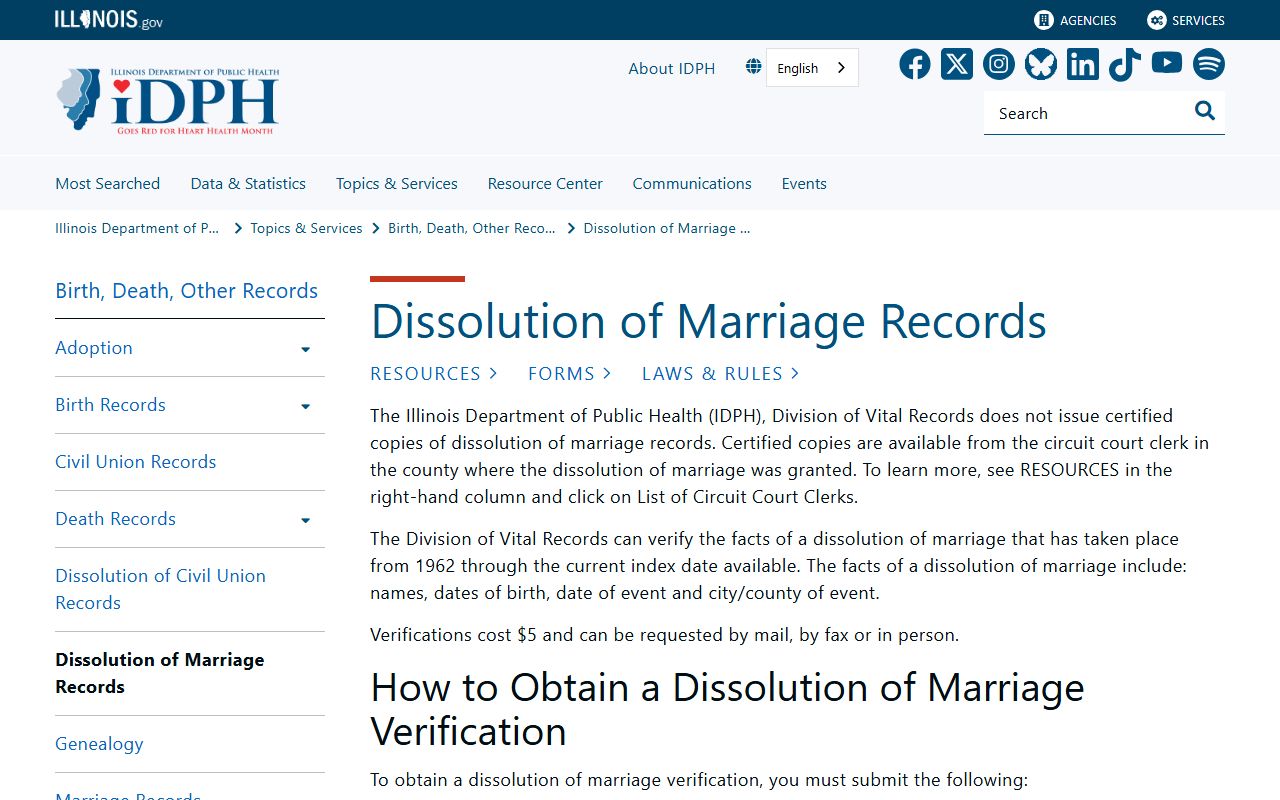
Note: IDPH does not issue certified copies of divorce decrees. If you need a certified copy for legal use, request it from the McLean County Circuit Court Clerk in Bloomington.
Historical and Genealogy Research
Older McLean County divorce records that are no longer in the active clerk's system may be held at the Illinois State Archives in Springfield. Call (217) 782-4682 to ask whether McLean County materials from a specific time period are available there. Some records from the late 1800s and early 1900s were transferred to the Archives years ago and may not be accessible through the clerk's office.
The Illinois State Genealogical Society offers research tools and indexes that can help track down older Illinois divorce records. McLean County genealogy collections at the Bloomington Public Library and the McLean County Museum of History are also worth checking. Both hold local historical materials, including old court indexes and record guides, that can help point researchers toward specific case files or microfilm copies.
Legal Aid and Support Resources
McLean County residents who need help with a divorce case or have questions about court records can contact Prairie State Legal Services, which serves the Bloomington-Normal area. They offer free civil legal help to people who qualify based on income and can assist with family law questions including how to access divorce records and what to do with them.
The McLean County Bar Association can help you find a private family law attorney if you need representation. The clerk's office at 309/888-5301 can answer questions about procedures and copying fees but cannot provide legal advice. The Illinois Courts circuit clerk directory is updated regularly and provides contact details for all county clerks across Illinois if you need to check a neighboring county.
Cities in McLean County
McLean County includes two qualifying cities. Bloomington has a population of approximately 78,907 and Normal has approximately 53,569 residents. Both cities are served by the county circuit court in Bloomington. See the Bloomington divorce records page and the Normal divorce records page for city-level details.
Nearby Counties
McLean County is surrounded by several central Illinois counties. Each maintains its own circuit court divorce records.