
Livingston County Divorce Records
Livingston County divorce records are maintained by the Circuit Court Clerk in Pontiac, Illinois, where all dissolution of marriage cases filed in the 11th Judicial Circuit are kept on file. This page covers how to search those records, what they include, how to request copies, and what state-level resources apply to divorces granted in Livingston County.
County Overview
The Circuit Court Clerk's Office
Jacquelyn Gragson serves as Circuit Court Clerk for Livingston County. Her office at 110 N. Main Street in Pontiac is the official custodian of all divorce records filed in the county. That means every petition, order, decree, and post-decree motion from dissolution of marriage cases in Livingston County is held there. The clerk's office is not a legal advice office, but staff can tell you what case records exist and how to get copies.
The 11th Judicial Circuit covers Livingston County along with McLean, Ford, De Witt, and Woodford counties. A circuit judge assigned to family law matters handles dissolution cases filed in Livingston. All filings go through the clerk's office regardless of which judge hears the case. If you are not sure whether a case was filed in Livingston or an adjacent county, the clerk's staff can usually help you figure that out.
You can reach the clerk's office by phone at 815/844-2602 during regular business hours. The fax number is 815/844-2322 if you need to send documents. The clerk's website may have updated hours and any online search tools the office currently offers.
Note: The 11th Circuit spans five counties, so some circuit-level administrative functions are shared, but each county clerk keeps its own case records independently.
Ways to Search Divorce Records in Livingston County
The most reliable way to find a divorce record in Livingston County is to contact the clerk's office directly. In-person visits to 110 N. Main Street in Pontiac let you work with staff to search by party name or case number. If you know the approximate year the case was filed, that will speed things up considerably. Staff can pull the physical file or check the electronic docket, depending on when the case was filed.
Mail requests are accepted if you can't get to Pontiac in person. Send a written request that includes both parties' full names, the filing year if known, and a daytime phone number where staff can reach you with questions. Include payment for copy fees with your request. Checks or money orders are the typical payment method; call ahead at 815/844-2602 to confirm current accepted payment forms and the fee schedule before you send anything.
The Illinois Courts website provides a directory of circuit court clerks across the state. The page shown below lists contact details for every circuit, including the 11th, and links to whatever online tools each clerk's office makes available.
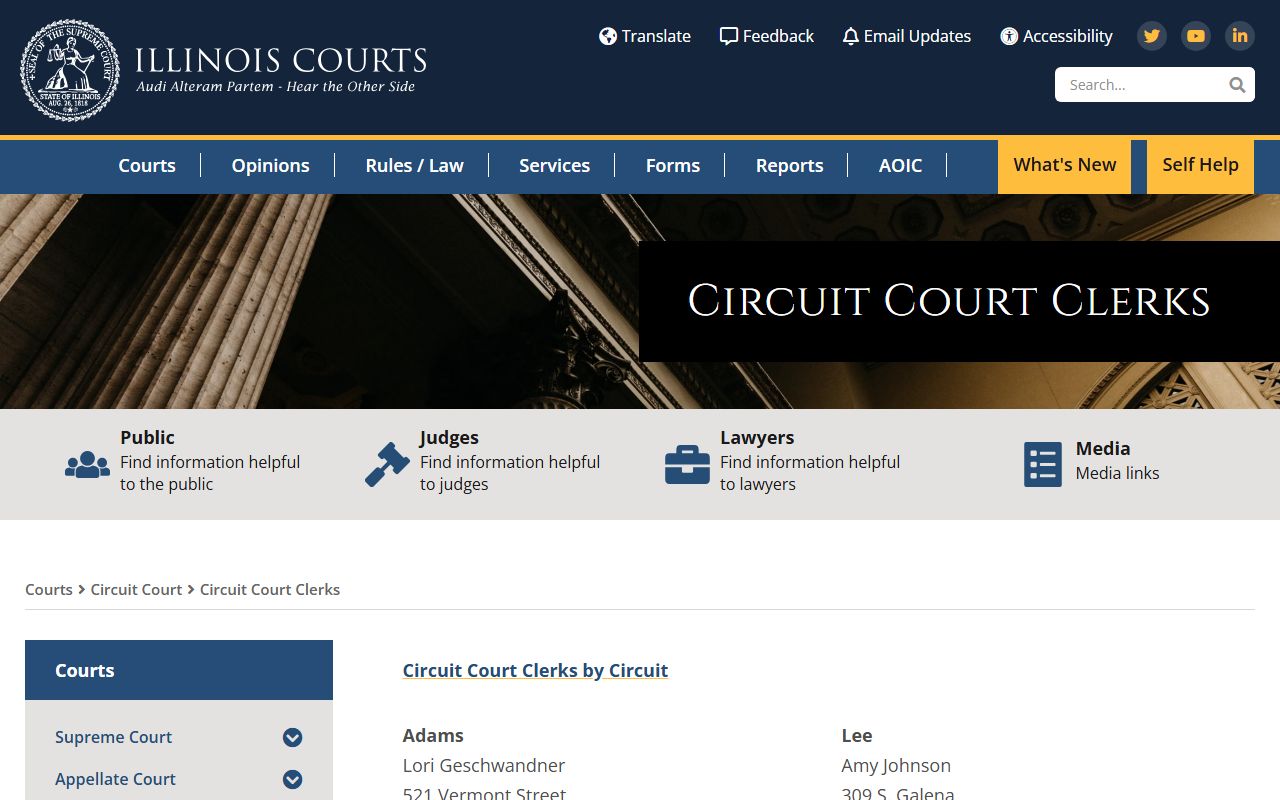
The Illinois Courts clerk directory is a useful starting point when you need to confirm contact details or find out what online search options are available for a specific circuit.
Phone searches are possible for quick checks. Call 815/844-2602 and ask whether staff can confirm a case exists by name. The office may be able to give you a case number over the phone, which you can then use to request copies. Not every office handles phone searches the same way, so be prepared to follow up with a written or in-person request if needed.
What's Inside a Divorce Case File
A typical divorce file in Livingston County contains the original petition for dissolution of marriage, any answer or counter-petition filed by the other party, and all court orders issued during the case. The final judgment for dissolution of marriage, sometimes called the divorce decree, is the document that legally ends the marriage. That decree is what most people are looking for when they contact the clerk's office.
If the couple had marital property, a marital settlement agreement will usually be attached to or incorporated into the decree. That agreement spells out how assets and debts were divided. Cases involving children will also have parenting plans, child support orders, and custody rulings in the file. Any changes made to those orders after the original case closed, such as modifications to support amounts or parenting schedules, are filed as separate post-decree matters and are kept in the court system as part of the ongoing case record.
Some documents in a divorce file may not be accessible to the public. Judges can seal specific records, and items related to minor children are sometimes restricted. Financial affidavits and other sensitive disclosures may also be limited in what the public can view. If you search for a case and can't find certain documents, sealed status may be the reason.
Note: Court records from the clerk's office and vital records from the state health department are two different systems that serve different purposes, though both relate to the same divorce event.
Illinois Law Governing Divorce
All divorce cases in Livingston County, like those in every other Illinois county, are governed by the Illinois Marriage and Dissolution of Marriage Act, 750 ILCS 5. This statute sets the rules for how a divorce case must be filed, what grounds are recognized, how property gets divided, and how child-related matters are handled. Illinois uses a no-fault system, meaning a couple can divorce based on irreconcilable differences without proving fault on either side.
The residency rule under 750 ILCS 5 requires that at least one spouse have lived in Illinois for 90 days before filing. There is no fixed waiting period once the case is filed, though contested cases can take much longer than uncontested ones. A judge in the 11th Circuit hears Livingston County dissolution cases and applies the same statutory standards as courts across the state.
The statute also covers spousal support, formerly called alimony, and sets out the factors a judge considers when deciding whether to award it and for how long. Property division in Illinois follows an equitable distribution model, which means fair but not necessarily equal. Debt allocation, retirement accounts, and business interests are all addressed under 750 ILCS 5 as well.
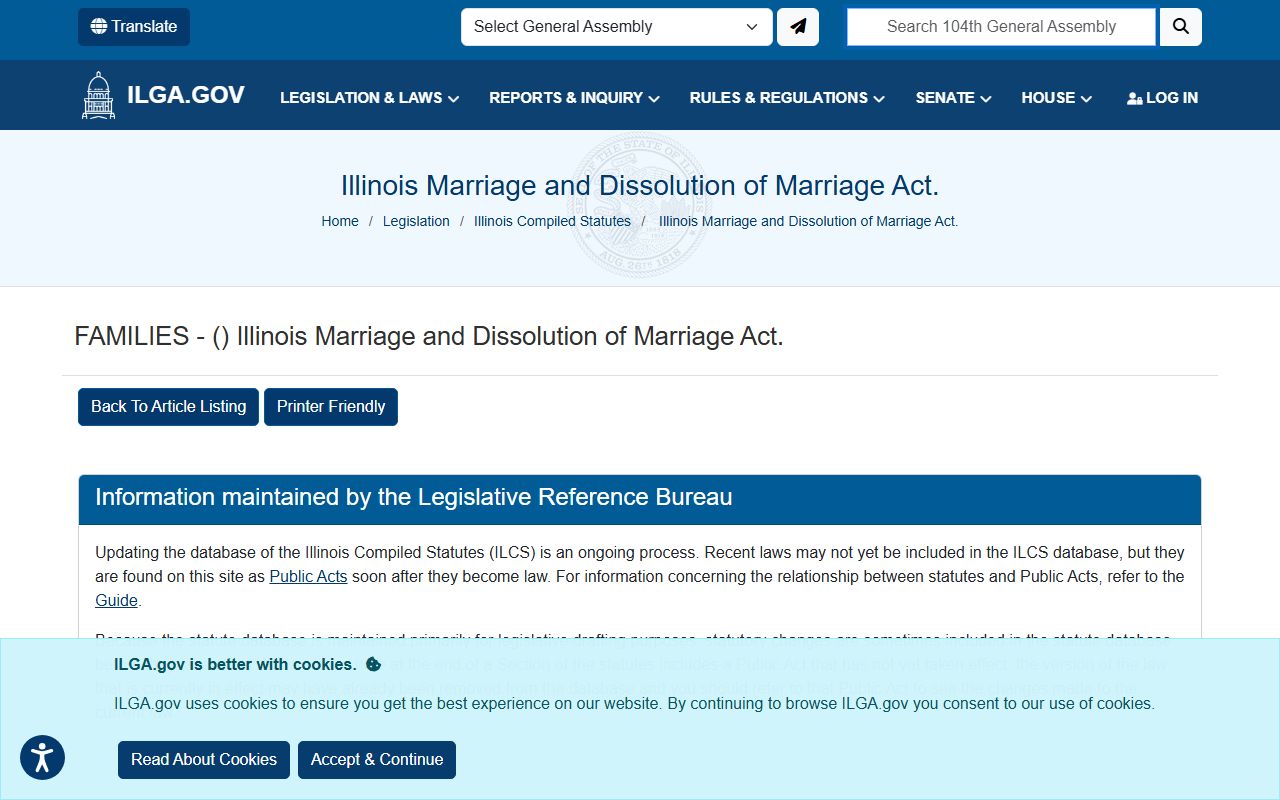
The Illinois General Assembly site hosts the full text of 750 ILCS 5, which governs all dissolution of marriage proceedings filed in Livingston County.
Getting Verification from the State Health Department
The Illinois Department of Public Health keeps a statewide index of divorces granted in Illinois from 1962 to the present. If your goal is simply to confirm that a divorce happened, rather than get the full court file, IDPH can issue a verification letter for $5. This letter is not a certified copy of the court record; it just confirms the state has a record of the dissolution event.
To request IDPH verification, write to 925 E. Ridgely Ave., Springfield, IL 62702, or call (217) 782-6553. Provide both parties' full names and the approximate year the divorce was granted. You will also need to include a copy of a valid government-issued photo ID. The IDPH valid ID page lists which forms of ID are accepted. Mail requests generally take four to six weeks. The IDPH dissolution of marriage records page has the current request form and full instructions.
For divorces that took place before 1962, the Illinois State Archives may have the records. The archives can be reached at (217) 782-4682 or through the Illinois Archives website. Historical and genealogical research on older Livingston County divorces may also be supported by the Illinois State Genealogical Society.
Note: IDPH verification letters confirm a divorce occurred but are not substitutes for a certified copy of the court decree if that is what a lender, agency, or foreign government requires.
Cities in Livingston County
No city in Livingston County has a population over 50,000, so no city-level divorce records pages exist for this county. Pontiac is the largest community and serves as both the county seat and the location of the Circuit Court Clerk's office. Other towns in the county include Dwight, Streator (which straddles the LaSalle County line), Cornell, Chatsworth, Flanagan, and Chenoa. Residents from all these communities file divorce cases at the clerk's office in Pontiac.
Nearby Counties
Livingston County borders several other Illinois counties, each with its own circuit court handling dissolution filings. Records for neighboring counties can be found through their respective clerk offices.