
Marshall County Divorce Records Search
Marshall County divorce records are filed with the Circuit Court Clerk in Lacon, a small county seat along the Illinois River in central Illinois. The county is part of the 10th Judicial Circuit, and all dissolutions of marriage for Marshall County residents go through the Lacon courthouse. The state's IDPH office in Springfield also maintains a searchable index for divorces granted throughout Illinois since 1962.
Marshall County At a Glance
Circuit Court Clerk, Lacon
The Marshall County Circuit Court Clerk's office in Lacon maintains the official record of every divorce case filed in the county. This is the correct office for requesting certified copies of divorce decrees, looking up case numbers, or getting copies of orders and agreements filed during a divorce proceeding. Call 309/246-6435 to reach the clerk's office directly.
When you call, have both parties' names and the approximate year of the divorce ready. The clerk can search by name and will let you know what is on file, what copy fees apply, and how you can submit your request, whether by phone, mail, or in person. The Illinois Courts clerk directory has the mailing address and any additional contact details for the Marshall County office.
Marshall County is one of Illinois's smaller counties, with a population around 11,500. The clerk's office here handles a modest caseload compared to larger counties, but the process for requesting records is the same across the state. Show valid ID when you visit or include a copy with a mail request.
Note: Certified copies carry the court seal and are generally required for legal proceedings, while plain copies are enough for personal reference.
Understanding Your Record Request
The most common request the clerk receives is for a copy of the final decree of dissolution of marriage. This document is what the judge signed to officially end the marriage. It includes the names of both parties, the date the divorce was granted, and the terms the court ordered. If the divorce was uncontested, the decree may be brief. A contested divorce often has a longer decree and a more extensive case file behind it.
Divorce records in Marshall County are public documents under Illinois law, which means any member of the public can request them, not just the parties to the divorce. You do not need to explain why you want the record. You do need to pay the copy fee and provide enough identifying information so the clerk can locate the correct file.
Some case files also contain documents beyond the final decree: the original petition, financial affidavits, parenting plans, and any temporary orders the court issued before the final hearing. You can ask for the complete file or just specific documents. The clerk will let you know what is included and the cost for each item.
IDPH Verification Option
The Illinois Department of Public Health offers a statewide divorce verification service. For $5 per search, IDPH will check their index of Illinois divorces from 1962 to the present and send a letter confirming the divorce occurred. The letter identifies the parties and the county but does not include the terms of the divorce or serve as a certified copy of the decree.
This service is mail-only. Send your completed request form and a copy of valid government-issued ID to IDPH in Springfield. The IDPH valid ID page lists what forms of identification are accepted. Allow 4 to 6 weeks for the response. IDPH can be reached at (217) 782-6553 if you have questions before you mail your request.
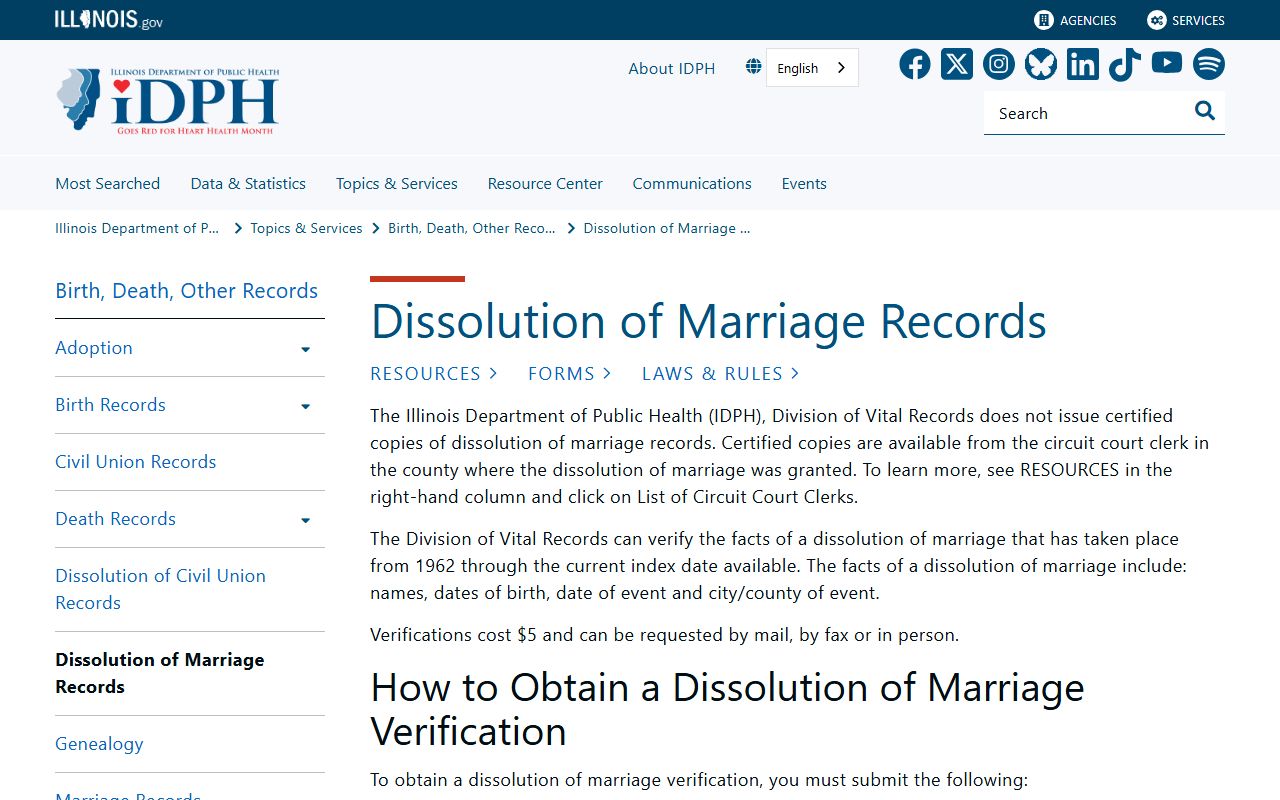
The IDPH page on dissolution of marriage records explains the verification process, required ID, and the $5 mail-in fee.
State Law and Public Access
Divorce proceedings in Marshall County are governed by the Illinois Marriage and Dissolution of Marriage Act, 750 ILCS 5. This law covers how and where divorces are filed, what must be in a divorce petition, and how the court handles property, debts, children, and support. Illinois uses a no-fault standard, meaning either party can seek a divorce based on irreconcilable differences without proving the other spouse did something wrong.
Record access is covered by the Vital Records Act, 410 ILCS 535. Divorce records are treated as public records in Illinois except in cases where a court has specifically ordered them sealed. Sealing is rare. The default rule is open access, which is why anyone can request these records from the circuit court clerk.
Older Records and Genealogy Research
Marshall County has been around since 1839, so there are divorce records going back well into the 19th century. Records that old are unlikely to still be at the Lacon courthouse. The Illinois State Archives at (217) 782-4682, available online at illinois.gov/ihpa/Archives, is the right place to look for pre-20th-century divorce cases. Staff there can advise whether a particular record has been transferred to state custody.
The Illinois State Genealogical Society offers research guidance for people tracing family history through central Illinois counties. Their databases and member expertise can be helpful when you know a divorce happened in this area but are not certain exactly when or where it was filed.
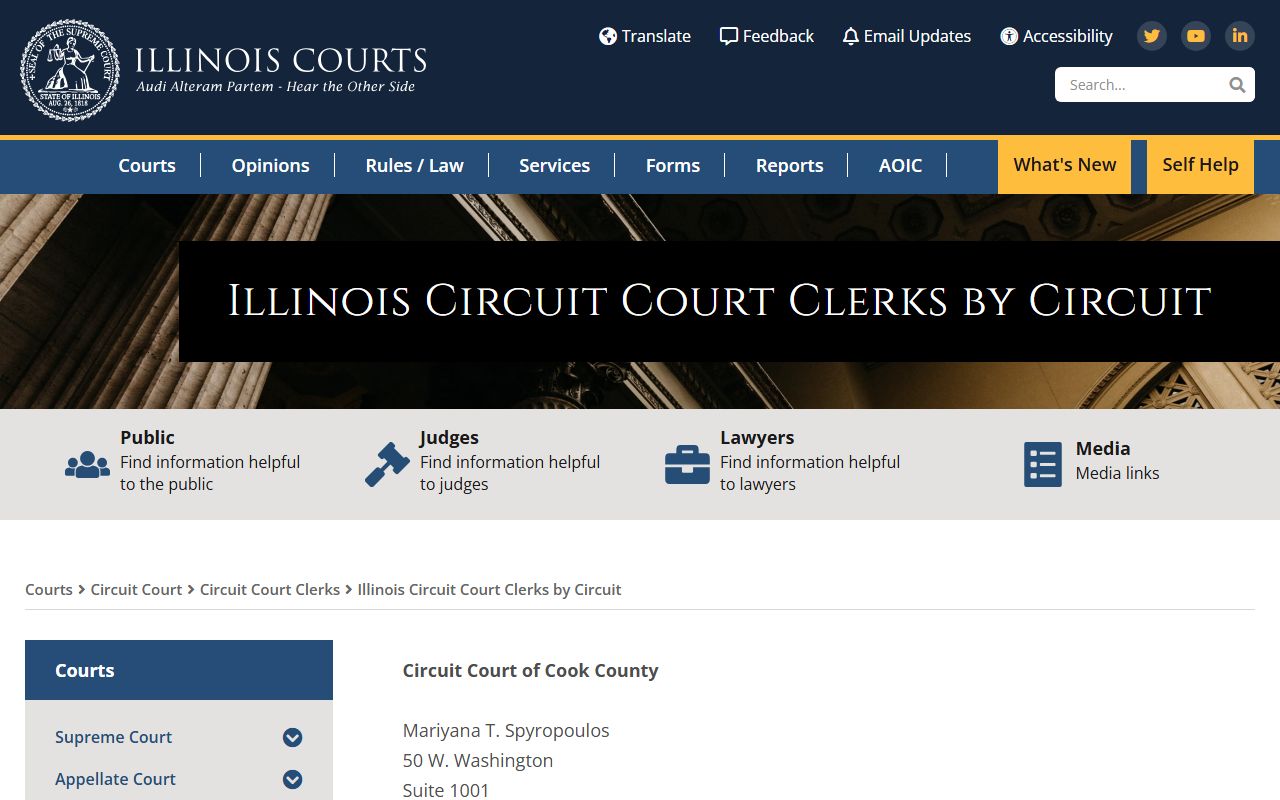
The Illinois Courts site shows circuit court clerks organized by district and circuit, making it easy to identify which office covers Marshall County.
Making Your Request
Call 309/246-6435 and describe what you need. If you are after a certified copy of a specific decree, the clerk will confirm whether the file is on hand and give you the current fee. Most copy fees in Illinois county courts are modest, but they vary slightly by county. Pay by check or money order if mailing in a request, and always include a self-addressed envelope to speed up the return.
If you are visiting in person, bring your ID and be ready to fill out a brief request form. For mail requests, check the Illinois Courts clerk directory for the current mailing address before you send anything in.
Neighboring Counties
Marshall County is bordered by several central Illinois counties. If a case you are looking for is not in Marshall County's records, it may have been filed in one of these neighboring courts: Peoria County, Woodford County, Livingston County, Bureau County, Putnam County, or Stark County.