
Find Divorce Records in Franklin County
Franklin County divorce records are kept by the 1st Judicial Circuit Court Clerk's office in Benton, Illinois. Whether you need a certified copy of a dissolution decree, want to look up a past case, or are trying to confirm a divorce for personal or legal reasons, this page covers the main access points at the county and state level.
County at a Glance
The Circuit Court Clerk in Benton
James Muir serves as the Franklin County Circuit Court Clerk. His office at 200 W. Main Street in Benton handles every divorce case filed in the county. The clerk maintains the full record for each dissolution of marriage case, including the original petition, responses, motions, temporary orders, and the final judgment. When you need a divorce decree or want to confirm a case exists, this office is where to start.
The phone number is 618/439-2011. Before visiting, call ahead to find out what information the clerk needs to locate the case and what the current fees are for copies. Bring a photo ID when you go in person. Case searches are generally done by party name or case number. For more information, check the clerk's website at franklincountyil.gov.
Certified copies carry an official court seal. Courts and government agencies often require them for legal transactions. Plain uncertified copies cost less and work for personal research or reference. Make sure you know which type you need before you place your order.
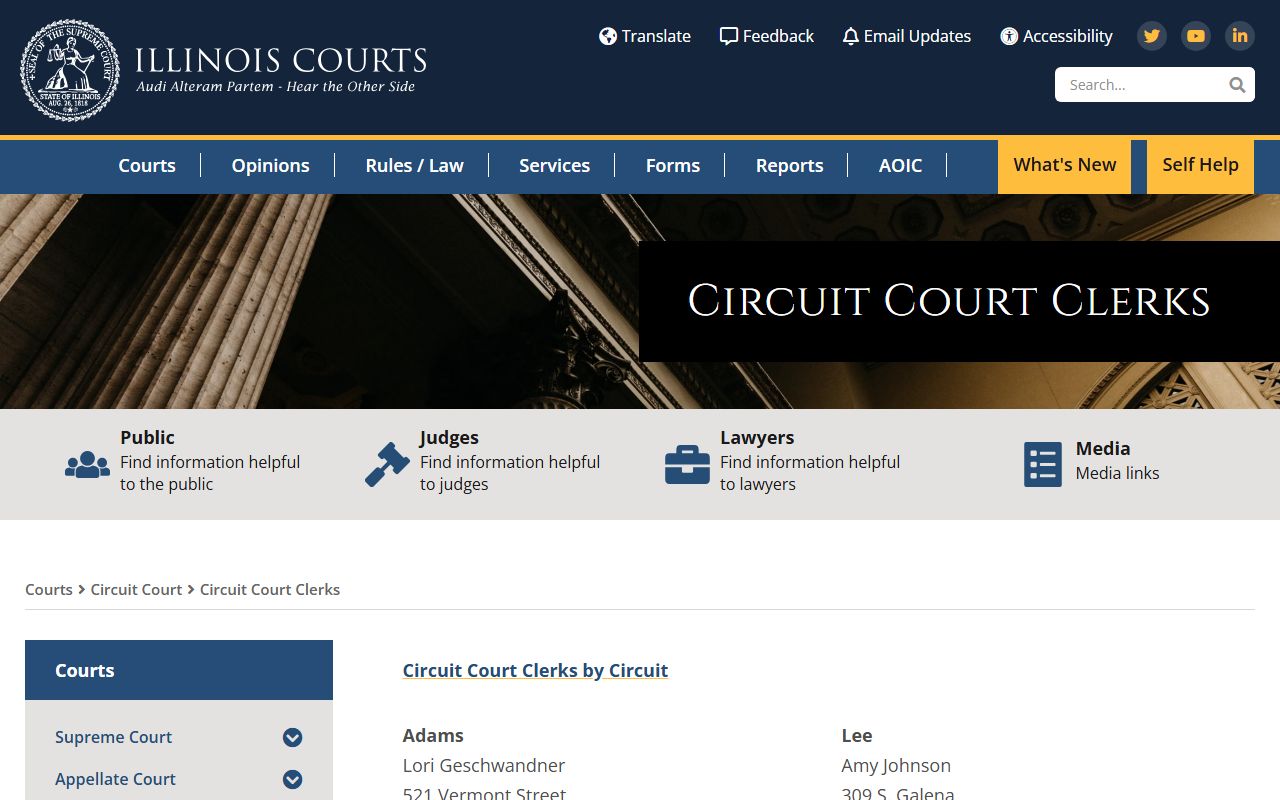
The Illinois Courts website maintains a current directory of all circuit court clerks, including the 1st Judicial Circuit serving Franklin County in southern Illinois.
Note: The 1st Judicial Circuit covers southern Illinois. If a divorce was filed in a neighboring county rather than Franklin, you will need to contact that county's circuit clerk. Each county keeps its own separate records.
What Franklin County Divorce Files Contain
Franklin County divorce case files typically include the petition for dissolution of marriage, the other party's response, and financial affidavits disclosing income and assets from both spouses. If children were involved in the case, there will be a parenting plan or an allocation of parental responsibilities document, along with any child support orders. The final judgment of dissolution is the core document most people are after. It confirms the marriage ended, gives the date, and contains the court's orders on property, debt, and any ongoing obligations.
Contested divorces tend to produce longer, more complex files. Those cases may include transcripts from hearings, exhibits, expert reports, and multiple court orders issued over the course of the proceeding. Uncontested cases where both parties agreed on everything are shorter. Either way, the clerk has the complete file on record. You can ask for one specific document or a copy of the entire case file. Fees depend on the number of pages copied and whether you want certified or plain copies.
Most divorce records in Franklin County are open to the public. Some documents may be sealed by court order. Portions of files related to minor children may also be restricted under state law. When in doubt, call the clerk's office at 618/439-2011 and ask what is available in a particular case.
Illinois Divorce Law and the 1st Circuit
Illinois uses a no-fault divorce system under the Illinois Marriage and Dissolution of Marriage Act (750 ILCS 5). Irreconcilable differences is the only ground for divorce recognized in Illinois. No one has to prove wrongdoing. The law requires only that both parties show the marriage has broken down beyond any reasonable prospect of repair.
The residency requirement under 750 ILCS 5/413 says at least one spouse must have lived in Illinois for 90 days before a case can be filed. Franklin County residents file with the 1st Judicial Circuit in Benton. Uncontested cases where both sides agree on all issues tend to move through the court more quickly. Contested cases with disputes over property, finances, or children take longer and usually require multiple hearings before a judge.
Illinois law also requires courts to report every dissolution of marriage to the state under the Illinois Vital Records Act (410 ILCS 535). That requirement is what makes the IDPH statewide divorce index possible. Cases from 1962 onward are included in the state database.
Getting a Verification From the State
If you only need to confirm that a divorce happened and don't need the full court file, the Illinois Department of Public Health can help. IDPH maintains statewide records of Illinois dissolutions of marriage from 1962 to the present. They issue a verification letter that confirms whether a dissolution was recorded in the state database. This is not a certified court copy, but it serves many purposes where you just need proof a divorce occurred.
Mail your request to IDPH at 925 E. Ridgely Avenue, Springfield, IL 62702. Call (217) 782-6553 with questions. The fee is $5 per search. Mail requests typically take four to six weeks to process. The IDPH dissolution of marriage records page has the request form and full instructions. You must include a copy of a valid government-issued photo ID with your submission.
IDPH has maintained records of Illinois divorce filings since 1962, giving the public a statewide option for confirming dissolution of marriage cases.
Note: IDPH verification letters do not replace a certified court copy. For name changes, estate matters, or formal legal proceedings, you need the certified decree from the Franklin County Circuit Court Clerk in Benton.
Genealogy and Historical Records
Older Franklin County divorce records may still be held by the circuit clerk's office, or they may have been sent to the Illinois State Archives in Springfield. The Archives hold historical court records that counties have transferred over the years. Call (217) 782-4682 to ask whether Franklin County records from a particular era are in their collection and how to request copies.
The Illinois State Genealogical Society maintains research guides that can help with older records. Early divorce cases in southern Illinois were often entered in large handwritten docket books. Some of those records have been microfilmed. Regional libraries and genealogy collections in the Benton area may have indexes or finding aids that can help you figure out where to look before contacting the clerk or the archives. If you're looking for records from the late 1800s or early 1900s, note that older indexes frequently listed cases under the husband's name only.
Legal Resources in Franklin County
Residents who need help with a divorce case or have questions about accessing court records can turn to a few sources. Land of Lincoln Legal Aid serves the southern Illinois area and provides free or low-cost civil legal assistance to income-qualifying individuals. They handle family law matters including divorce proceedings and questions about court records. The clerk's office at 618/439-2011 can explain procedures and fee schedules, but staff cannot provide legal advice.
Self-represented parties can find court forms on the Illinois Courts website. The Illinois Courts circuit clerk directory lists contact information for every county in the state and is useful when you need to track down a case that may have been filed in a different county. The directory is kept current by the Illinois Courts administrative office.
Cities in Franklin County
Benton serves as the county seat with a population of approximately 7,000. West Frankfort is another significant community in the county, with around 8,000 residents. Neither city exceeds the qualifying population threshold for a dedicated city page. All divorce records for Franklin County residents, regardless of which city or town they live in, are maintained by the circuit court clerk's office in Benton.
Nearby Counties
Franklin County is located in southern Illinois and shares borders with several counties, each of which keeps its own circuit court divorce records.