
Find Divorce Records in Saline County
Saline County divorce records are held by the Circuit Court Clerk in Harrisburg and include all dissolution of marriage cases decided under Illinois law in this county. If you need to locate a divorce filing, get a certified copy of a decree, or verify that a divorce occurred, this guide covers the key steps and sources for Saline County.
Saline County at a Glance
Circuit Court Clerk in Harrisburg
The Saline County Circuit Court Clerk in Harrisburg is the official keeper of divorce records for the county. Every dissolution of marriage case filed in Saline County goes through this office. The clerk receives the initial petition, stamps it with the filing date, assigns a case number, and maintains the file as it moves through the court system. By the time a case closes, the file contains every document the court received, including the final judgment of dissolution.
You can contact the clerk at (618) 253-5096. Office staff can check whether a divorce was filed in Saline County, confirm the case number, and explain how to get copies. For more detailed contact information, including the current mailing address and office hours, the Illinois Courts circuit clerk directory is a dependable source. The directory is updated by the Illinois Supreme Court and lists current information for every circuit clerk in the state.
Saline County is part of the 1st Judicial Circuit, which covers several counties in the far southern part of Illinois. That circuit has its own administrative judges and local rules that apply to how dissolution cases are handled procedurally, though the underlying state law is the same statewide.
Note: Office hours may vary, and it is worth calling ahead before making a trip to the courthouse.
How to Get Saline County Divorce Records
Getting a divorce record from Saline County generally takes one of three paths: in-person at the courthouse, by phone for basic information, or by mail for copies you need sent to you. The in-person option is usually the fastest. You walk into the Circuit Court Clerk's office in Harrisburg, give the names of the parties and an approximate year, and staff will search the index. If the file is public, you can review it there or request copies on the spot.
Phone calls work well for an initial search. The clerk's staff can confirm whether a case was filed, give you the case number, and tell you what documents are in the file. This step is worth doing before you drive to the courthouse or send a mail request. It saves time if the record turns out to be in a different county.
Mail requests require a written letter to the clerk's office. Include the full names of both parties, any dates you know, and a clear explanation of what you need. Enclose a self-addressed stamped envelope. Payment for copy fees should accompany the request, but call first if you are unsure of the exact amount. Processing times by mail are typically longer, so plan for at least two to three weeks before following up.
Contents of a Saline County Divorce File
Saline County divorce files follow the same general structure as those throughout Illinois. The first document is the petition for dissolution of marriage, which lays out who is filing, who is responding, and what the petitioner is asking the court to decide. After that come any responses, counterpetitions, and motions filed during the case. Hearings generate orders, and those orders become part of the file too.
Financial disclosures are a required part of Illinois divorce proceedings under the Illinois Marriage and Dissolution of Marriage Act (750 ILCS 5). These affidavits detail income, assets, and debts, and they stay in the court file. If children were part of the case, parenting agreements and support orders are also in the file. The final piece is the judgment of dissolution, which is the document that legally ends the marriage. Courts must make specific findings before granting that judgment, all as required by 750 ILCS 5.
Note: Older files may have less documentation than modern ones, particularly if the case settled quickly or was uncontested.
Statewide Divorce Verification at IDPH
For cases filed in Illinois after 1962, the Illinois Department of Public Health maintains a statewide index that is separate from the court records. If you need a basic confirmation that a divorce occurred, the IDPH can conduct a search for $5 and send you a verification document. This is not a certified copy of the court record, but it does confirm the basic facts: that a dissolution of marriage was granted, and when.
The IDPH handles requests by mail through their vital records division. Their phone line is (217) 782-6553, and the official request page is at dph.illinois.gov. Processing typically takes four to six weeks. You must include a valid government-issued photo ID with any IDPH request.
The IDPH vital records page provides access to dissolution of marriage verification requests for divorces granted in Illinois since 1962.
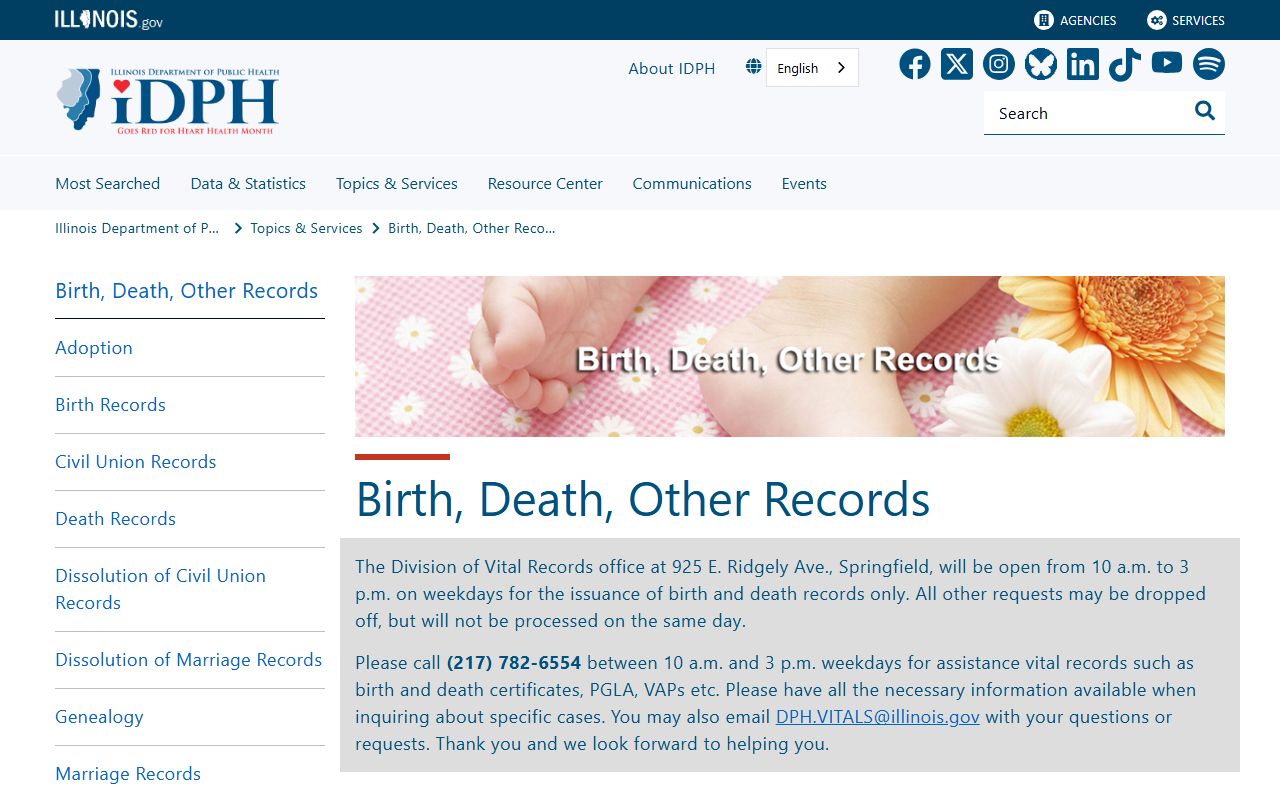
IDPH verifications are useful for confirming basic divorce facts but are not substitutes for a certified copy from the court clerk.
Legal Framework for Record Access
Court records in Illinois are public by default. The Vital Records Act (410 ILCS 535) sets the rules for IDPH records, while court records follow Illinois Supreme Court rules and the Illinois Marriage and Dissolution of Marriage Act. Taken together, these laws establish a system where divorce records are generally accessible but with narrow exceptions for sensitive information.
A judge can seal specific documents in a divorce file. This happens in some cases involving minors or sensitive business information. But the vast majority of Saline County divorce records are open to anyone who visits the courthouse and asks to see them. If you are turned away from a particular record, the clerk's office can tell you the reason and what options you may have to challenge the restriction.
Older Records and Genealogy Research
If you need Saline County divorce records from before the IDPH index started in 1962, the courthouse holds the files directly or they may have been moved to the Illinois State Archives. The Archives catalog is available online at illinois.gov/ihpa/Archives, and staff there can help you identify whether older Saline County records have been transferred. The Illinois State Genealogical Society is another good resource for historical family research in Illinois.
For very old divorces, the documentation may be minimal. Some 19th century divorce files consist of just a few handwritten pages. Even so, these records can contain valuable information about family relationships, property ownership, and residency that genealogists find useful.
Local Legal Resources
Land of Lincoln Legal Aid provides free civil legal help to qualifying residents in southern Illinois, including Saline County. If you have questions about a divorce record or are dealing with a related legal issue, their attorneys can provide guidance at no cost to those who qualify. The Illinois State Bar Association also maintains a lawyer referral service for those who need to consult a family law attorney.
Court forms for dissolution of marriage cases are available through the Illinois Courts website. Using the right forms is important, especially if you are handling a court matter without an attorney.
Neighboring Counties
Divorce filings in surrounding counties are handled by their own circuit court clerks. If you are unsure which county a case was filed in, check these neighboring offices: