
Adams County Divorce Records
Adams County divorce records are filed with the 8th Judicial Circuit Clerk in Quincy and cover every dissolution of marriage case brought in the county. This page walks through how to search for those records, what to expect in a case file, how state law applies to Adams County cases, and where to go for official verification or older historical filings.
County at a Glance
Adams County Circuit Clerk
Lori Geschwandner is the Circuit Clerk for Adams County. Her office in Quincy holds all court records generated in the county, including the full record for every divorce case that has been filed here. The Clerk's office receives new case filings, keeps records current as cases move through the courts, and handles requests for copies and certified documents. Contact the office by phone, visit in person at the courthouse, or use the county website to find online services.
Adams County is part of the 8th Judicial Circuit, which covers Adams, Brown, Hancock, McDonough, Schuyler, Mason, Cass, Pike, and Scott counties in west-central Illinois. Each county within the circuit maintains its own separate records. A dissolution of marriage case filed in Adams County stays in Quincy at the Adams County Courthouse. You would not find those records at the Hancock or McDonough clerk offices, even though they are in the same judicial circuit.
Note: The courthouse in Quincy is located on Vermont Street in the downtown area. Parking availability can vary on busy court days, so arriving early for in-person visits is a good idea.
How to Search Adams County Divorce Records
The Circuit Clerk's website is the best first stop when searching Adams County divorce records. The site provides access to a public case lookup system where you can search by name or case number and view basic case information without contacting the office. You can check filing status, see hearing dates, and confirm which parties are involved in a case.
When you need official documents, such as a certified copy of a divorce decree, you must request them from the Clerk's office. A certified copy has the official clerk's seal and is accepted by government agencies, courts in other states, and financial institutions as proof that a divorce occurred and what the judgment said. The office can tell you the current copy fees and accepted payment types. In-person requests are typically processed on the same day. Mail requests take longer, so plan accordingly if you are working on a deadline.
Knowing your case number helps. Adams County follows the standard Illinois case numbering format: a two-digit year plus a case type designation. Dissolution of marriage cases use a "D" code. If you do not have a case number, Clerk staff can search by the names of both parties. Having the filing year and both names reduces the chance of pulling up unrelated cases with similar names.
What an Adams County Divorce File Contains
Dissolution of marriage files in Adams County are generally public court records. The contents vary based on whether the case was contested or uncontested and how complicated the issues were. A simple uncontested case may have only a few documents. A long-running contested case covering property, support, and parenting disputes can fill a substantial file.
A standard Adams County divorce file often includes the original petition for dissolution of marriage, a summons issued to the other party, proof that service was completed, financial affidavits from both spouses, motions filed during the case and responses to those motions, any temporary orders entered for support or parenting time before judgment, a marital settlement agreement if both parties reached a deal on their own, a parenting plan when minor children are part of the case, and the final judgment of dissolution of marriage. Post-judgment filings, like child support modification petitions, may also appear in the case file if any were filed after the divorce was finalized.
Note: Some parts of a file may be restricted. Records involving minors or sealed financial documents require you to check with the Clerk's office before assuming they are open to the public.
Illinois Divorce Law and Adams County Cases
Every dissolution of marriage filed in Adams County is governed by the Illinois Marriage and Dissolution of Marriage Act (750 ILCS 5). Illinois has been a no-fault divorce state for some time. Under 750 ILCS 5/401, the only recognized ground for divorce is irreconcilable differences. No spouse is required to prove that the other did anything wrong. The court needs to find only that the marriage has broken down permanently and that trying to reconcile would not be in the best interest of the family.
Filing in Adams County requires that at least one spouse has lived in Illinois for 90 days before submitting the petition. This is required under 750 ILCS 5/413. Illinois does not require couples to live apart for any set period before filing. You can file as soon as you decide to end the marriage, as long as the residency requirement is satisfied.
Property division in Illinois follows the equitable distribution standard. That does not mean a judge splits everything in half. The court looks at the length of the marriage, each spouse's financial situation, what each contributed to building the marital estate, and other factors listed in the statute. Adams County judges apply these same criteria in contested property cases. Child support is calculated using state income-based guidelines, and spousal maintenance is determined on a case-by-case basis under the same statute.
IDPH Dissolution of Marriage Verification
The Illinois Department of Public Health maintains a statewide index of divorce records from 1962 to the present. This is a verification tool, not a source of full case documents. A verification letter from IDPH confirms that a dissolution of marriage happened in Illinois, gives the county where it was filed, and provides an approximate date. Many agencies and institutions accept this as sufficient proof that a prior marriage ended.
Mail a written request to the Division of Vital Records at 925 E. Ridgely Ave., Springfield, IL 62702. The fee is $5 per verification. You must include a valid government-issued photo ID. Accepted ID types are listed on the IDPH valid ID page. Call the office at (217) 782-6553 with questions. Mail processing usually takes 4 to 6 weeks, so request well ahead of any deadline.
Illinois Department of Public Health - Dissolution of Marriage Records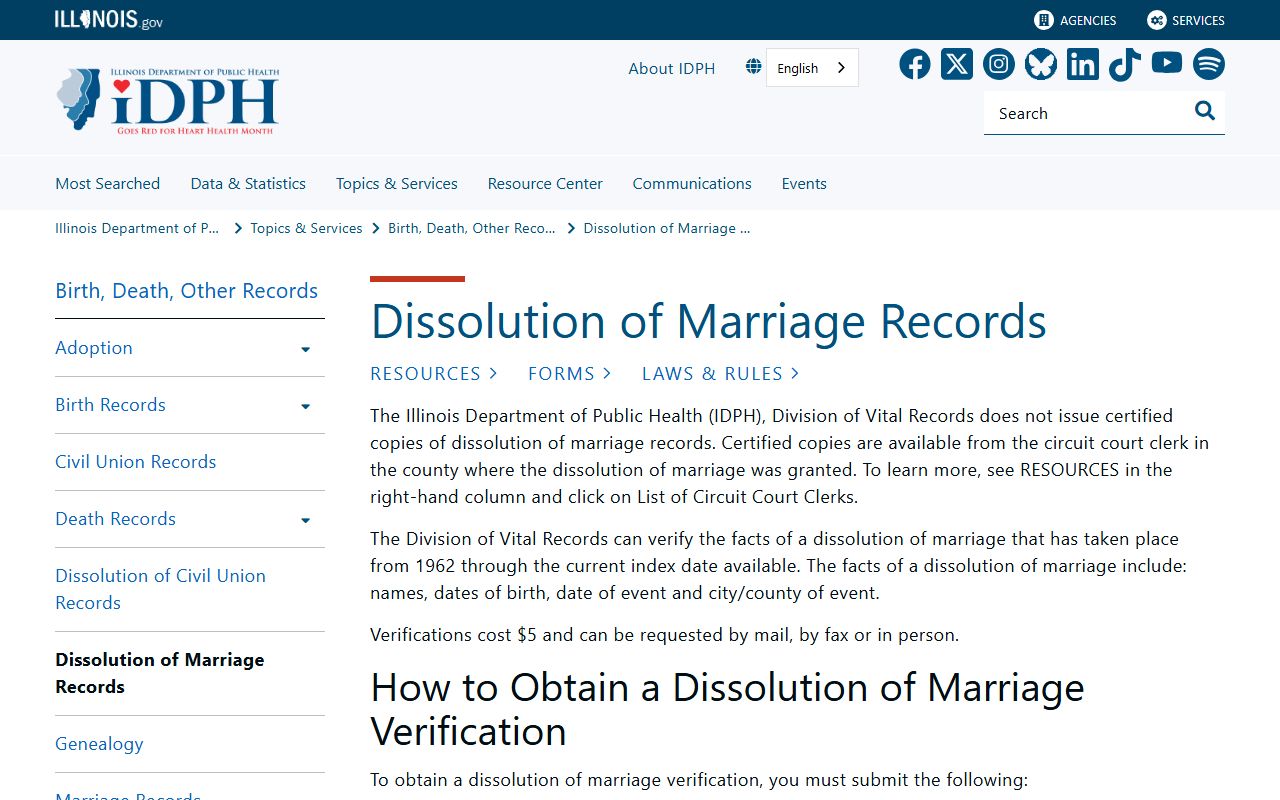
The IDPH page above covers what a dissolution of marriage verification includes, accepted payment methods, and what to include when submitting a mail request. If you need actual court documents, including the full decree from an Adams County case, contact the Circuit Clerk's office in Quincy instead.
Note: The IDPH index does not cover divorces before 1962. For older Adams County cases, try the Circuit Clerk's office or the Illinois State Archives.
Vital Records Act and Access Rules
The Illinois Vital Records Act (410 ILCS 535) establishes how the state manages and provides access to vital records across all Illinois counties. The Act covers dissolution of marriage records along with birth, death, and marriage records. It sets out who can request copies, what identification is required, and how agencies must handle those requests.
Illinois court records are public as a default. However, specific parts of a divorce case can be sealed or restricted by a judge's order. Common examples include financial affidavits with sensitive account details and documents that involve the welfare of minor children. The Adams County Circuit Clerk's office will tell you which sections of a particular file are open to you and which are restricted. The Clerk follows the Vital Records Act along with the local court rules in place for the 8th Judicial Circuit.
Older Records and Genealogy Resources
For divorces filed many years ago in Adams County, the Circuit Clerk may only have paper records, and some very old files may have been transferred to state custody. The Illinois State Archives in Springfield holds historical government documents from across Illinois and can be reached by phone at (217) 782-4682. Staff can help you find out whether Adams County records from a specific period are held at the Archives or are still at the Quincy courthouse.
Genealogy researchers working on Adams County family history can also connect with the Illinois State Genealogical Society. The society provides guidance on tracing records through Illinois counties and has members familiar with western Illinois courthouse research. The Adams County genealogical society and local public library may have additional index materials and microfilm that are useful for older records searches.
Illinois Courts Directory
The statewide court directory on the Illinois Courts website lists every circuit court clerk, organized by district and circuit. If you need to confirm the Adams County Clerk's contact information or find clerks for other 8th Circuit counties, the directory is the right place to look.
Illinois Courts - Circuit Court Clerks Directory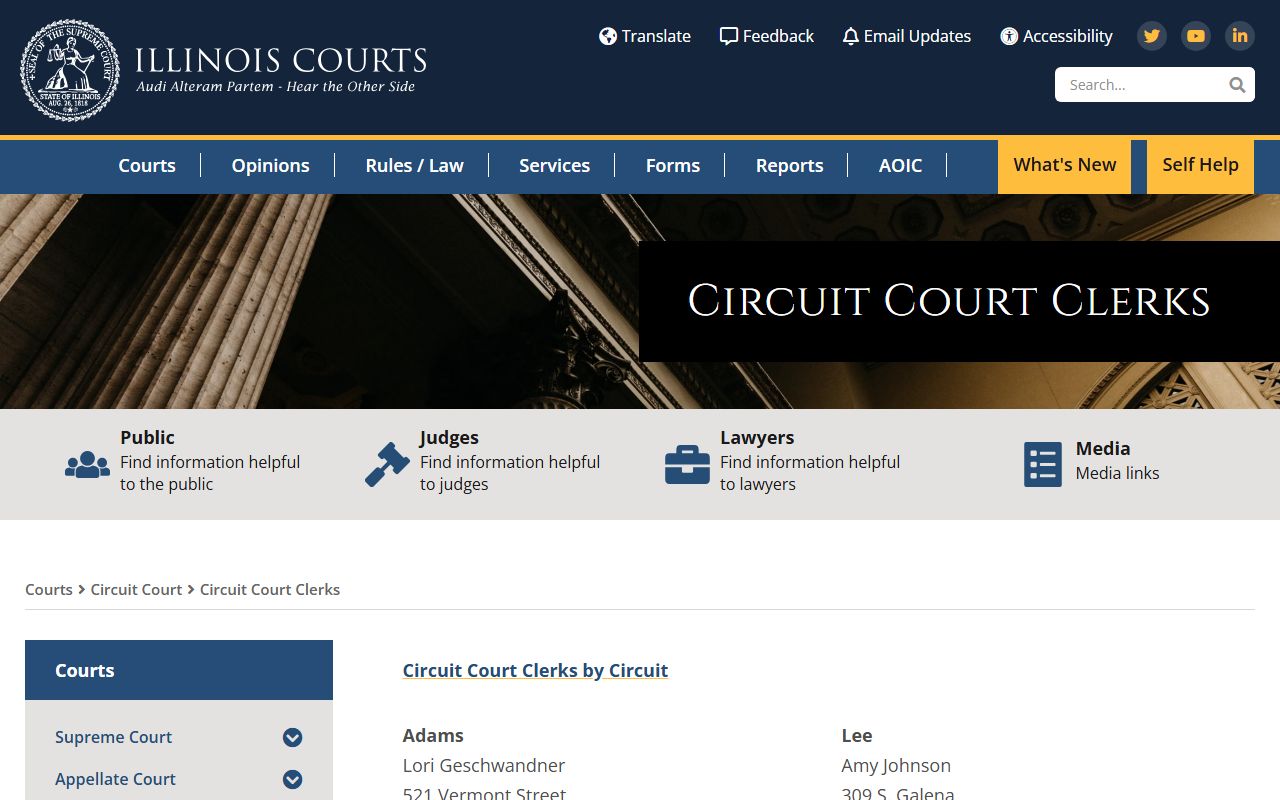
Adams County is listed under the 8th Judicial Circuit in this directory. The listing includes the current clerk's contact details and a direct link to the Adams County court website, so you can verify information before making contact.
Cities in Adams County
No city in Adams County exceeds 100,000 residents, so there are no separate city-level divorce records pages for this county. Quincy, the county seat, is by far the largest city with a population of roughly 40,000. Other communities in the county include Ursa, Camp Point, Payson, and Mendon. Divorce records for residents of all Adams County communities are held at the Circuit Clerk's office in Quincy at 521 Vermont Street.
Nearby Counties
If you need to check neighboring counties for a case that may have been filed outside Adams County, the links below point to the relevant circuit clerk offices. Adams County borders the Mississippi River and Missouri to the west, with Brown, Pike, Schuyler, and Hancock counties on the Illinois side.