
Search Richland County Divorce Records
Richland County divorce records are filed and maintained at the Circuit Court Clerk's office in Olney, the county seat. This page explains how to access those records, what they contain, and which state resources can help you verify or obtain dissolution of marriage documents in Richland County.
Richland County at a Glance
Richland County Circuit Court Clerk
All divorce records in Richland County originate at the Circuit Court Clerk's office in Olney. When a petition for dissolution of marriage is filed, the clerk assigns a case number, opens the file, and tracks the case through every stage. That file grows over time to include responses, motions, financial disclosures, interim orders, and ultimately the judgment of dissolution. The clerk's office is the one place to go for official records of any divorce that was filed and decided in Richland County.
The clerk can be reached by phone at (618) 392-2151. Staff can look up cases by party name or case number and tell you what documents are in the file. If you need certified copies, the clerk's office handles those requests in person or by mail. A valid government-issued photo ID is typically required, and fees apply per page or per document depending on the type of copy.
The Illinois Courts circuit clerk directory provides additional contact details for the Richland County clerk, including mailing address and any updated hours. This statewide directory is maintained by the Illinois Supreme Court and is a reliable first stop when you need to confirm clerk office information before making a trip or sending a request by mail.
Note: Richland County is part of the 2nd Judicial Circuit, which covers several counties in southern Illinois.
Accessing Divorce Records in Richland County
There are three main ways to access divorce records from the Richland County Circuit Court: in person, by phone, or by mail. In person is the most direct. You go to the courthouse in Olney, provide the names of the parties, and staff will locate the file. If it is a public record, you can review it on-site and request copies. Bring a photo ID and be prepared to pay copy fees at the time of your visit.
By phone, you can get basic information such as whether a case exists, the case number, and the filing date. The clerk's office cannot provide detailed case information over the phone, but that initial confirmation is often all you need before deciding whether to pursue a copy. Phone access is free and usually takes just a few minutes.
Mail requests work well when you already know the case number or have enough information to identify the record. Write to the Richland County Circuit Court Clerk in Olney, include the names of both parties, approximate dates, and a self-addressed stamped envelope along with payment for copy fees. If you are unsure of the exact cost, call first to confirm before sending a check. Allow a few weeks for mail processing.
What Divorce Records Include
A Richland County divorce file typically spans the entire legal process. It starts with the petition for dissolution, which sets out the grounds and the relief the petitioner is seeking. From there, the file adds responses, financial affidavits, motions, and any agreements the parties reach along the way. If children were involved, you will also find parenting plans or custody orders. The final judgment of dissolution closes the file and is the document most people specifically need.
For cases that involved property, the file may include real estate deeds or titles, pension orders, or debt allocation agreements. These documents can be important for estate planning, title searches, or financial matters that come up years after the divorce was finalized. Courts in Richland County follow the Illinois Marriage and Dissolution of Marriage Act (750 ILCS 5) in all dissolution proceedings, which determines what the court must address before a divorce is granted.
Note: Some documents in a divorce file may be restricted from public view, particularly those involving minor children's identifying information or sealed financial records.
State Verification Through IDPH
The Illinois Department of Public Health keeps a statewide index of divorces that were granted in Illinois going back to 1962. If you need a quick confirmation of whether a divorce occurred and do not need the full court file, the IDPH is a useful resource. They charge $5 per search and process requests by mail, with turnaround times running four to six weeks on average.
What the IDPH provides is a verification document, not a certified copy of the court decree. For many purposes, such as confirming a divorce before a remarriage or checking a basic timeline, the IDPH verification is sufficient. But for legal matters that require the actual judgment of dissolution, you will need to contact the Richland County Circuit Court Clerk directly.
The IDPH dissolution of marriage records page at dph.illinois.gov has request forms and current instructions. Their main records line is (217) 782-6553. All requests require a valid government-issued photo ID.
The Illinois Courts circuit court clerk directory lists contact details for every county in the state, including Richland County.
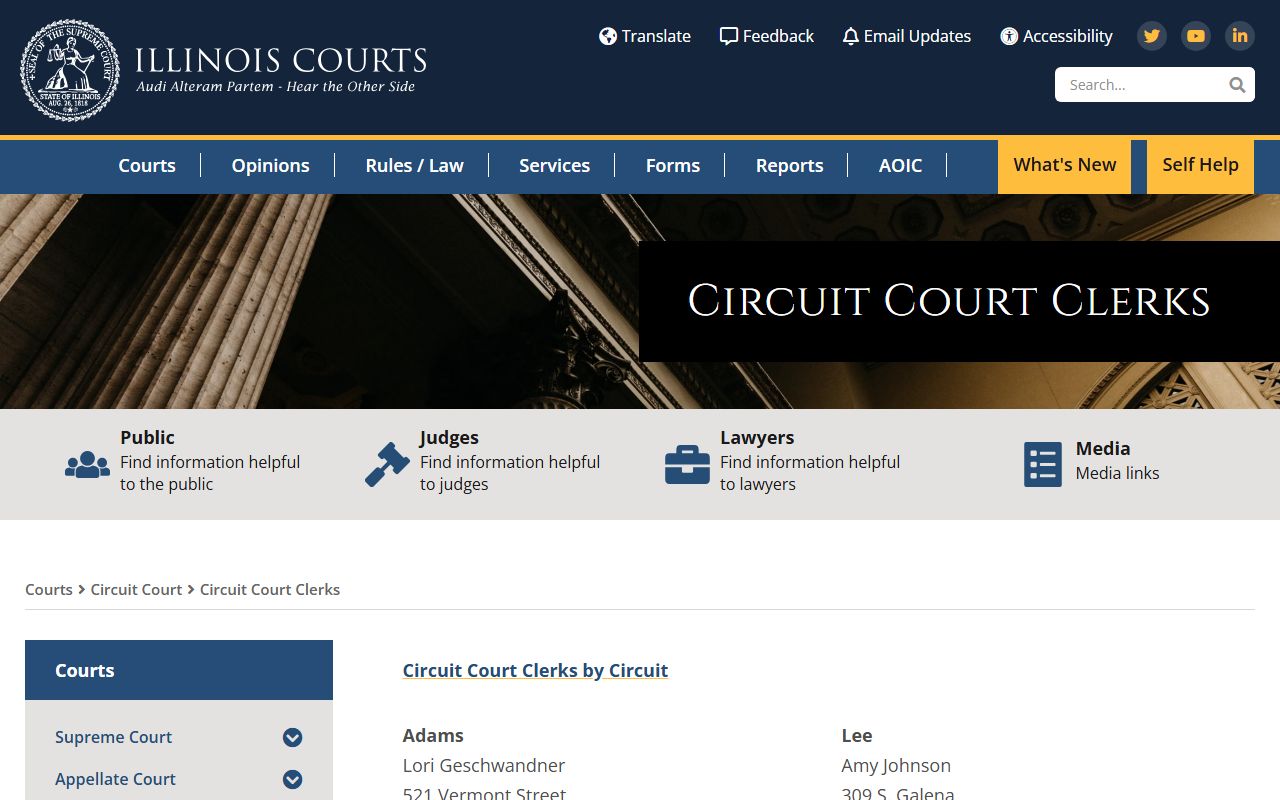
Use this directory to confirm the Richland County clerk's current mailing address and hours before sending a mail request.
Illinois Divorce Law and Record Access
Illinois treats most court records, including divorce records, as public unless a judge has specifically ordered them sealed. The Vital Records Act (410 ILCS 535) sets rules for the IDPH side of the process, while the Illinois Marriage and Dissolution of Marriage Act governs what the courts handle. Together, these laws define how records are created, how long they are kept, and under what circumstances access can be restricted.
In practice, most Richland County divorce records are open to the public. Anyone who goes to the courthouse and requests a file will generally be able to view it. Restrictions tend to apply to specific documents within a file rather than the entire record. If you are denied access, you can ask the clerk for the specific reason and, if warranted, file a motion with the court to challenge the restriction.
Genealogy and Historical Records
For older Richland County divorce records, especially those from before 1962, the Illinois State Archives is the primary resource. The Archives holds records transferred from county courts and other state agencies. You can begin a search through their online catalog at illinois.gov/ihpa/Archives.
Genealogical researchers may also find the Illinois State Genealogical Society helpful. The society maintains indexes and can point you toward local resources, including microfilmed county records that may not be available online. Richland County has a local historical society that sometimes holds older records as well.
Legal Resources in Richland County
If you need legal guidance related to a divorce record, Land of Lincoln Legal Aid serves southern Illinois, including Richland County, and offers free assistance to those who meet income guidelines. The Illinois State Bar Association's lawyer referral service can connect you with a local family law attorney for a consultation. Court forms for dissolution of marriage cases are available on the Illinois Courts website.
Understanding what is in a divorce file can be straightforward for simple cases. More complex files, especially those involving property disputes or custody arrangements, may be harder to interpret without legal help.
Nearby Counties
If a divorce may have been filed in an adjacent county, contact those circuit court clerks directly: